




01. Edit your 2015 form 1099 online
Type text, add images, blackout confidential details, add comments, highlights and more.

Type text, add images, blackout confidential details, add comments, highlights and more.

Draw your signature, type it, upload its image, or use your mobile device as a signature pad.

Send form 1099 b via email, link, or fax. You can also download it, export it or print it out.
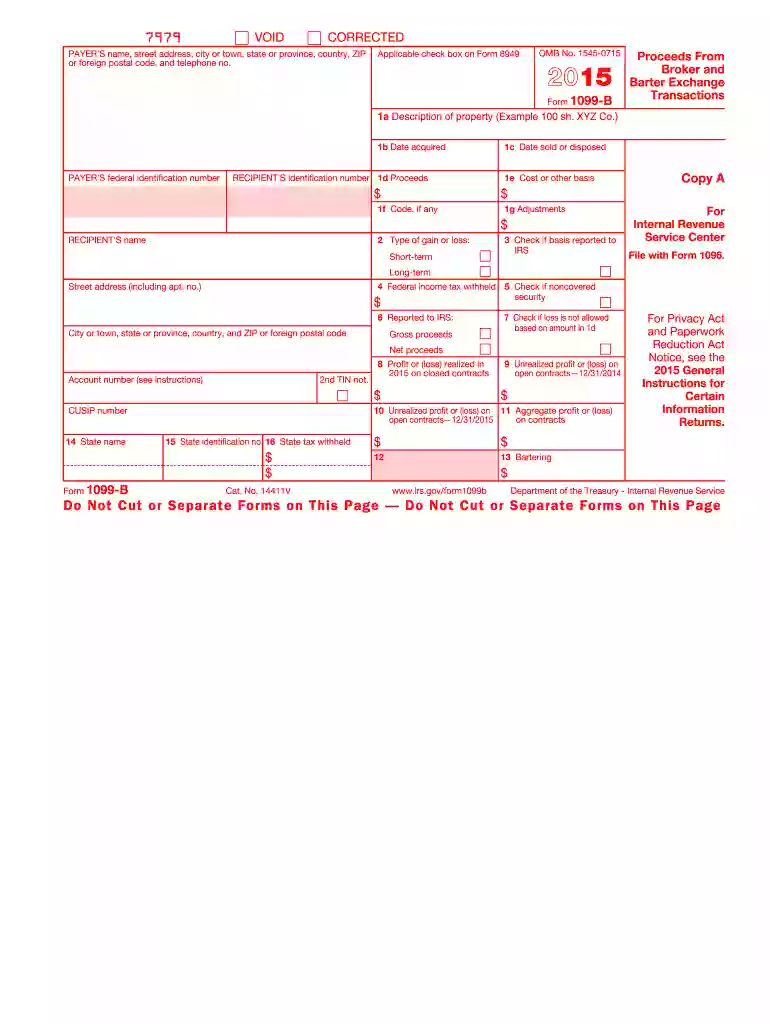
Form 1099-B is a tax document used in the United States to report proceeds from broker and barter exchange transactions. The form is typically issued by brokers to their clients or customers to detail the sale or exchange of securities, commodities, or barter exchanges. This information is crucial for accurately filing income taxes, as it helps to determine the amount of capital gains or losses experienced during the tax year. The 2015 version of Form 1099-B includes specific fields and instructions pertinent to that tax year’s reporting requirements.
Using Form 1099-B involves several steps that both payers (typically brokers) and recipients need to follow to ensure proper reporting. For recipients, the key is to ensure that the information provided by your broker matches your personal records of transactions made throughout the year. These numbers are used to calculate capital gains or losses on your tax return.
Payers must ensure that all relevant transaction data is accurately recorded on the form and provided to the IRS and the taxpayer within the specified deadlines.
Form 1099-B is generally disseminated by brokers to their clients. To obtain a copy of the 2015 form, consider these methods:
Ensure you have a reliable method for receiving tax documents and that your contact information with financial institutions is up to date.
Completing the 2015 Form 1099-B requires diligence to ensure accuracy:
Accuracy is vital to avoid any discrepancies with IRS records that may result in audits or penalties.
The form includes several important elements, crucial for tax reporting:
Each section must be accurately completed to ensure correct tax reporting and compliance with IRS regulations.
Timely filing of Form 1099-B is crucial to avoid penalties:
Ensure that all deadlines are strictly adhered to, enhancing the likelihood of a smooth tax filing season.
Adhering to IRS guidelines ensures compliance and minimizes tax issues:
Refer to the IRS website or a tax professional for detailed guidance or clarification on specific issues related to Form 1099-B.
Understanding the risks of non-compliance is essential:
Allocating the necessary effort to comprehend and adhere to form requirements can prevent these financial repercussions.
Familiarize yourself with these key terms associated with Form 1099-B for a better understanding:
Understanding these terms is essential for accurately interpreting and utilizing Form 1099-B.
We've got more versions of the 2015 form 1099 form. Select the right 2015 form 1099 version from the list and start editing it straight away!
| Versions | Form popularity | Fillable & printable |
|---|---|---|
| 2025 | 4.4 Satisfied (22 Votes) | |
| 2024 | 4.9 Satisfied (52 Votes) | |
| 2023 | 4 Satisfied (25 Votes) | |
| 2022 | 4.5 Satisfied (41 Votes) | |
| 2021 | 4.8 Satisfied (80 Votes) | |
| 2020 | 4.3 Satisfied (97 Votes) | |
| 2019 | 4.4 Satisfied (362 Votes) | |
| 2018 | 4.1 Satisfied (67 Votes) | |
| 2017 | 4.3 Satisfied (63 Votes) | |
| 2016 | 4.3 Satisfied (55 Votes) | |
| 2015 | 4.4 Satisfied (484 Votes) | |
| 2014 | 4.4 Satisfied (53 Votes) | |
| 2013 | 4.2 Satisfied (58 Votes) | |
| 2012 | 4.2 Satisfied (53 Votes) | |
| 2011 | 4 Satisfied (51 Votes) |
At DocHub, your data security is our priority. We follow HIPAA, SOC2, GDPR, and other standards, so you can work on your documents with confidence.
Feb 22, 2016 Tax forms for 2015 are due April 18, 2016. The following topics are covered herein: A) Federal tax: who must file? B) Forms you receive to helpRead more
Jan 14, 2015 Report transactions involving regulated futures, foreign currency, or section 1256 option contracts on an aggregate basis. However you mayRead more
Apr 15, 2015 Form 1099-B (or substitute statement). Exception for certain children un- der age 19 or full-time students. If your child was under age 19Read more


