




01. Edit your missing receipt declaration template online
Type text, add images, blackout confidential details, add comments, highlights and more.

Type text, add images, blackout confidential details, add comments, highlights and more.

Draw your signature, type it, upload its image, or use your mobile device as a signature pad.

Send declaration letter for missing documents via email, link, or fax. You can also download it, export it or print it out.
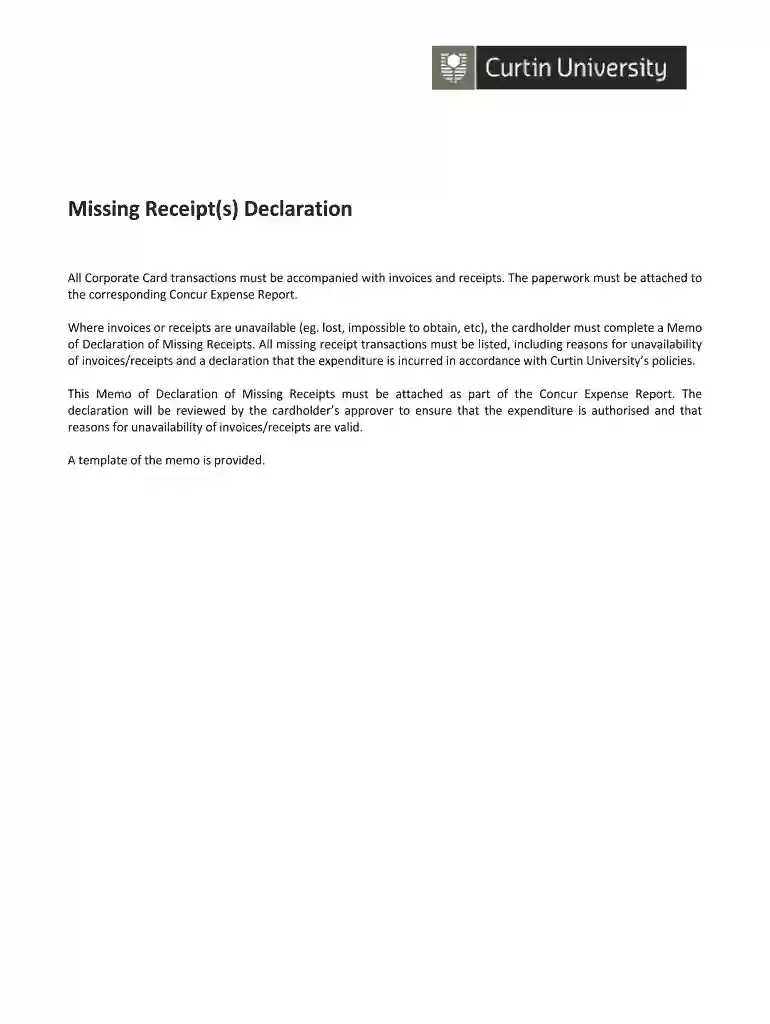
The Missing Receipt(s) Declaration serves as a written statement that cardholders at Curtin University use to account for missing invoices or receipts associated with Corporate Card transactions. This document is essential for maintaining transparency and compliance with university financial policies. By providing specific reasons for the absence of receipts, cardholders affirm the legitimacy of their expenses, ensuring they align with established guidelines.
Key components of this declaration include:
This declaration is crucial for facilitating timely reviews of expense reports and for maintaining institutional integrity in financial reporting.
Completing the Missing Receipt(s) Declaration involves a structured process to ensure that all necessary information is captured correctly. Follow these steps for accurate completion:
Ensure that all entries are filled accurately to avoid delays in processing.
Understanding specific terminology related to the Missing Receipt(s) Declaration can streamline the process for both cardholders and approvers. Here are vital terms associated with this form:
Familiarity with these terms enhances comprehension of the declaration process and encourages precise usage within documentation.
Understanding how to apply the Missing Receipt(s) Declaration effectively can improve compliance and accuracy in financial reporting. Here are practical examples of scenarios where this declaration may be utilized:
These examples highlight the flexible nature of the declaration while upholding compliance.
Timely submission of the Missing Receipt(s) Declaration is vital for maintaining accurate expense reporting. The following outlines important deadlines and methods for submission:
Adhering to the specified deadlines and using the correct submission methods enhances efficiency and compliance with university procedures.
We've got more versions of the missing receipt declaration template form. Select the right missing receipt declaration template version from the list and start editing it straight away!
| Versions | Form popularity | Fillable & printable |
|---|---|---|
| 2010 | 4.8 Satisfied (34 Votes) |
At DocHub, your data security is our priority. We follow HIPAA, SOC2, GDPR, and other standards, so you can work on your documents with confidence.
Sep 13, 2015 This publication is provided for the purpose of disseminating information relating to scientific and technical matters. ParticipatingRead more
There is also an inter-district conflict with Curtin v. Deluca, 886 So.2d 298 (Fla. 4 th. DCA 2004), and Insua v. Chantres,. 665 So.2d 288 (Fla. 3d DCA 1995)
On this page you will find answers to the Bursars most frequently asked questions by students and families. You can click on the Category drop down menuRead more


