




01. Edit your weight lifting percentage chart online
Type text, add images, blackout confidential details, add comments, highlights and more.

Type text, add images, blackout confidential details, add comments, highlights and more.

Draw your signature, type it, upload its image, or use your mobile device as a signature pad.

Send weightlifting percentage chart via email, link, or fax. You can also download it, export it or print it out.
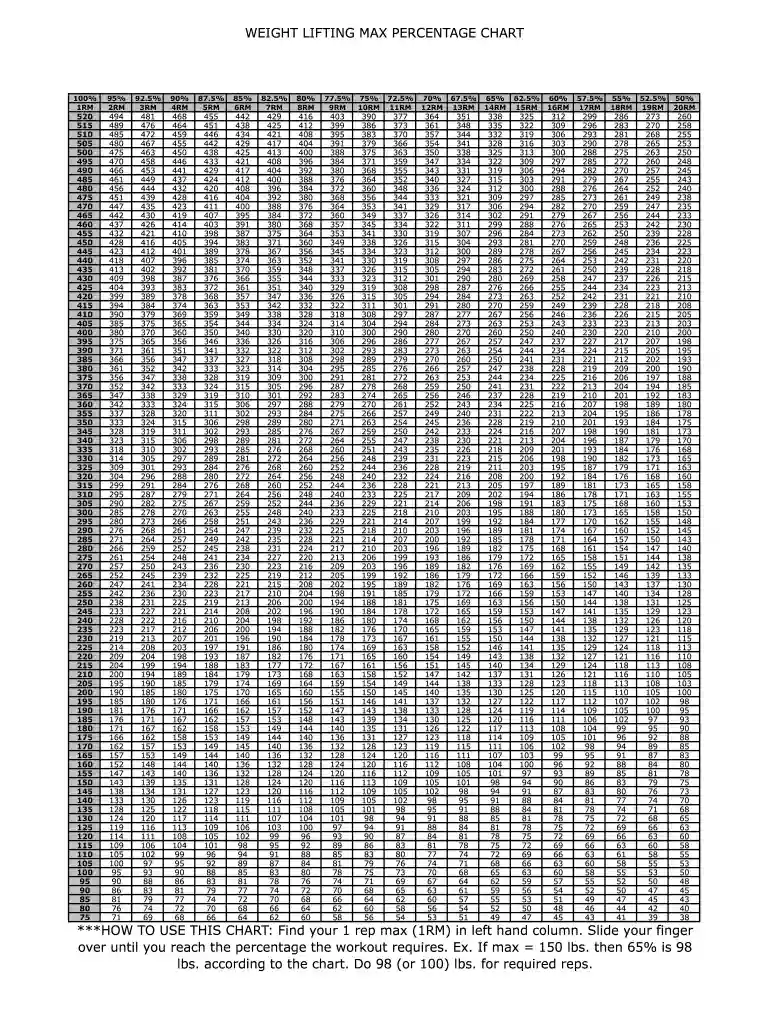
The Weight Lifting Max Percentage Chart is a crucial tool for athletes and fitness enthusiasts aiming to optimize their training routines. It provides a clear outline of various percentages of a lifter's one-repetition maximum (1RM) and the corresponding weights that can be lifted across multiple rep ranges. This chart is designed to help users select the appropriate weight when training, ensuring they are neither overexerting themselves nor lifting too light to achieve effective muscle engagement.
Understanding the chart’s elements enables users to tailor their workouts effectively and track their progress.
Using the Weight Lifting Max Percentage Chart correctly can significantly enhance a training program's effectiveness. Here’s a straightforward process to utilize the chart efficiently.
Understanding the terminology associated with the Weight Lifting Max Percentage Chart can enhance one's effectiveness in utilizing it. Here's a brief glossary of key terms:
Familiarity with these terms aids in grasping the chart’s functionality and aligning training practices with fitness goals.
Real-world scenarios illustrate how to apply the Weight Lifting Max Percentage Chart effectively.
An athlete determined their 1RM for the squat is 200 pounds. To focus on strength, they may use 85% of this weight, which equals 170 pounds. Referring to the chart, they identify that this weight corresponds to a rep range of three to five. They can now design their training session around this lift.
A lifter with a 1RM of 150 pounds wants to maximize muscle growth. By referencing the chart, they find that 70% (105 pounds) allows for a rep range of eight to twelve. They incorporate this weight into a structured workout, ensuring appropriate volume and intensity for effective muscle engagement.
The Weight Lifting Max Percentage Chart is not subject to legal regulations in the traditional sense, as it is a training tool rather than a legal document. However, its application must be ethical and safe. Users must ensure they are training in accordance with their fitness levels and not using the chart as a means to compete or validate unsafe lifting practices.
Understanding these principles fosters a safe training environment and promotes responsible use of the chart.
At DocHub, your data security is our priority. We follow HIPAA, SOC2, GDPR, and other standards, so you can work on your documents with confidence.


