




01. Edit your pedicure cleaning log sheet florida online
Type text, add images, blackout confidential details, add comments, highlights and more.

Type text, add images, blackout confidential details, add comments, highlights and more.

Draw your signature, type it, upload its image, or use your mobile device as a signature pad.

Send pedicure cleaning log via email, link, or fax. You can also download it, export it or print it out.
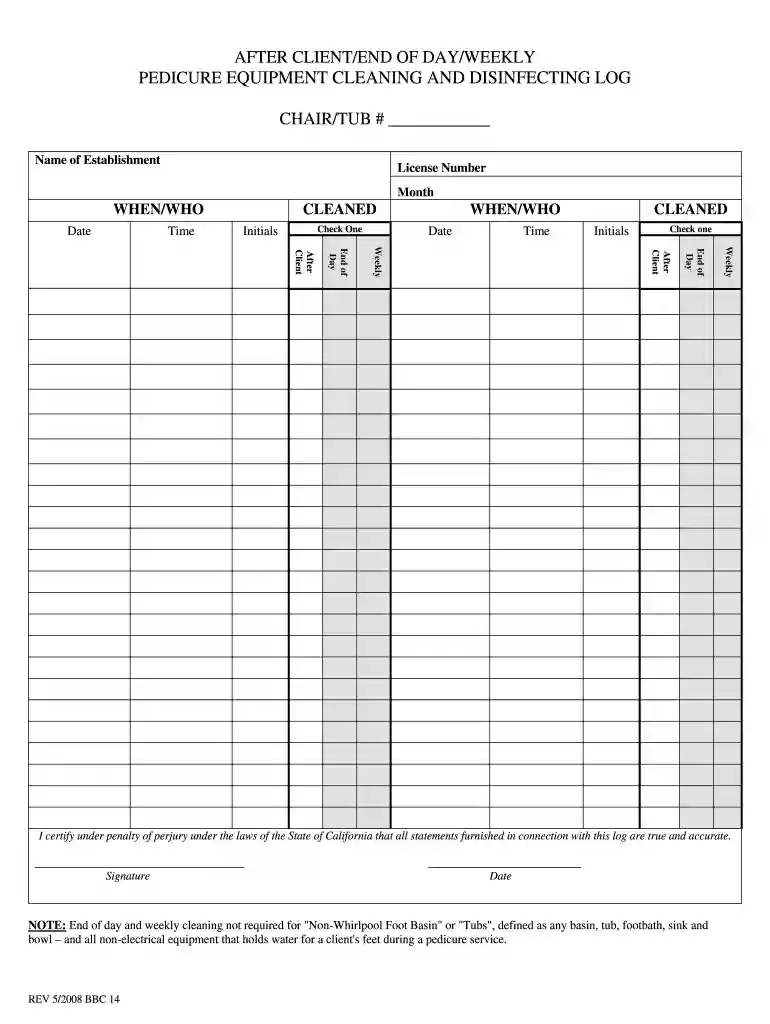
A pedicure cleaning log is an essential tool for nail establishments to maintain hygiene and ensure compliance with health regulations. This log serves as documentation for the cleaning and disinfecting processes performed on pedicure equipment, which is crucial for preventing infections and ensuring customer safety.
The primary purpose of a pedicure cleaning log is to track and certify that all pedicure tools and equipment are cleaned and disinfected at required intervals. Key functions include:
A comprehensive pedicure cleaning log includes several important sections and fields that support effective tracking and monitoring:
Understanding the different cleaning schedules is vital for maintaining hygiene standards:
A certification statement in the pedicure cleaning log affirms the accuracy of the recorded information. This declaration is critical for:
While maintaining a pedicure cleaning log is essential, there are specified exemptions outlined by health authorities:
For optimal effectiveness, follow these practices when implementing a pedicure cleaning log:
Maintaining a pedicure cleaning log is not just a regulatory requirement but a commitment to professionalism in the nail care industry. Proper implementation fosters a safe environment for clients and staff, promotes best practices in hygiene, and ultimately supports the establishment's reputation. By documenting cleaning efforts, businesses can demonstrate diligence and integrity in their operations, contributing to overall industry standards.
We've got more versions of the pedicure cleaning log sheet florida form. Select the right pedicure cleaning log sheet florida version from the list and start editing it straight away!
| Versions | Form popularity | Fillable & printable |
|---|---|---|
| 2008 | 4.8 Satisfied (299 Votes) |
Sure, you’ll find numerous applications for this on the web. Nevertheless, if you need to eSign your pedicure equipment cleaning and disinfecting log without installing extra software, DocHub is the optimum choice you can make. This powerful editor works on mobile devices just as on desktops. Open our editor in any internet browser, register or sign in to your account, and start managing your paperwork.
It is a no-brainer on a computer or via a mobile device to fill out a pedicure log with DocHub. All you need to do is open any installed browser on your smartphone and go to the DocHub website. Once authenticated, add your document and open it in editing mode. Use our toolbar to make your edits and save modifications. Optionally, keep your document in your files or send it to a recipient immediately.
At DocHub, your data security is our priority. We follow HIPAA, SOC2, GDPR, and other standards, so you can work on your documents with confidence.
Manual cleaning equipment (excl. buckets or pails)..0480. The entry for manual cleaning equipment indicates that there is a separate entry for buckets or.Read more
Jun 1, 2008 For each cleaning/disinfecting insert only one check-mark for the type of cleaning performed. There may be several entries with the same date.Read more
Always write down the time and date of each cleaning in a pedicure-cleaning log. Tip: Protect yourself when using disinfectant. Try to avoid using disinfec-.Read more


