1831 form-2026

Get Form
1831 form Preview on Page 1

Here's how it works

01. Edit your form online
Type text, add images, blackout confidential details, add comments, highlights and more.

02. Sign it in a few clicks
Draw your signature, type it, upload its image, or use your mobile device as a signature pad.

03. Share your form with others
Send it via email, link, or fax. You can also download it, export it or print it out.

How to use or fill out 1831 form with our platform

Form edit decoration
9.5
Ease of Setup
DocHub User Ratings on G2
9.0
Ease of Use
DocHub User Ratings on G2
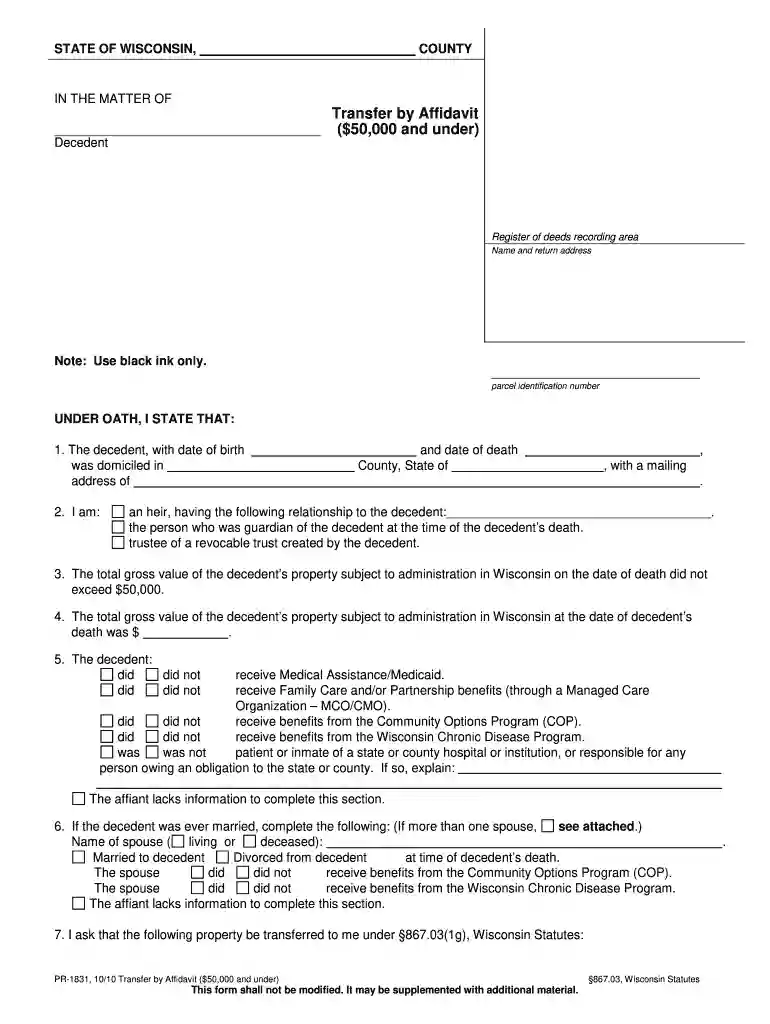
  1. Click ‘Get Form’ to open the 1831 form in the editor.
  2. Begin by filling in the decedent's name, date of birth, and address in the designated fields. Ensure accuracy as this information is crucial for identification.
  3. Indicate your relationship to the decedent by selecting from options such as heir, guardian, or trustee. This section helps establish your legal standing.
  4. Provide details about the total gross value of the decedent’s property. If it exceeds $50,000, consider alternative procedures as this form is specifically for lower values.
  5. Complete sections regarding any benefits received by the decedent or their spouse. This includes checking boxes for Medical Assistance or other programs.
  6. In the property description section, clearly list all real estate and personal property to be transferred. Include legal descriptions and parcel numbers where applicable.
  7. Finally, ensure you sign and date the affidavit before submitting it for recording. A notary public may need to witness your signature.

Start using our platform today to fill out your 1831 form online for free!

See more 1831 form versions

We've got more versions of the 1831 form form. Select the right 1831 form version from the list and start editing it straight away!
Versions Form popularity Fillable & printable
2019 4.9 Satisfied (51 Votes)
2018 4.4 Satisfied (112 Votes)
2010 4.2 Satisfied (66 Votes)
be ready to get more

Complete this form in 5 minutes or less

Get form

Got questions?

We have answers to the most popular questions from our customers. If you can't find an answer to your question, please contact us.
Contact us
Often times Wisconsin sets a estate size limit threshold of $50,000 or less. The estate includes real estate, vehicles, and accounts. The estate does not include the following: Jointly owned or titled real property, vehicles, or bank accounts.
The transfer by affidavit process can be used to close a persons estate when the deceased has $50,000 or less in assets subject to administration in Wisconsin. It is an alternative to using a court process for smaller estates.
The Transfer by Affidavit process may be used to close a persons estate when the deceased had $50,000 or less in assets subject to administration in Wisconsin. It is an alternative to using a court process for smaller estates.
Pursuant to Wisconsin State Statute Section 867.03, Transfer by Affidavit is used for solely owned property within this state valued under $50,000. Any heir, trustee, or person who was guardian, may collect and transfer the solely owned assets by completing an affidavit in duplicate.

Security and compliance

At DocHub, your data security is our priority. We follow HIPAA, SOC2, GDPR, and other standards, so you can work on your documents with confidence.

Learn more
ccpa2
pci-dss
gdpr-compliance
hipaa
soc-compliance