




01. Edit your washington state quit claim deed pdf online
Type text, add images, blackout confidential details, add comments, highlights and more.

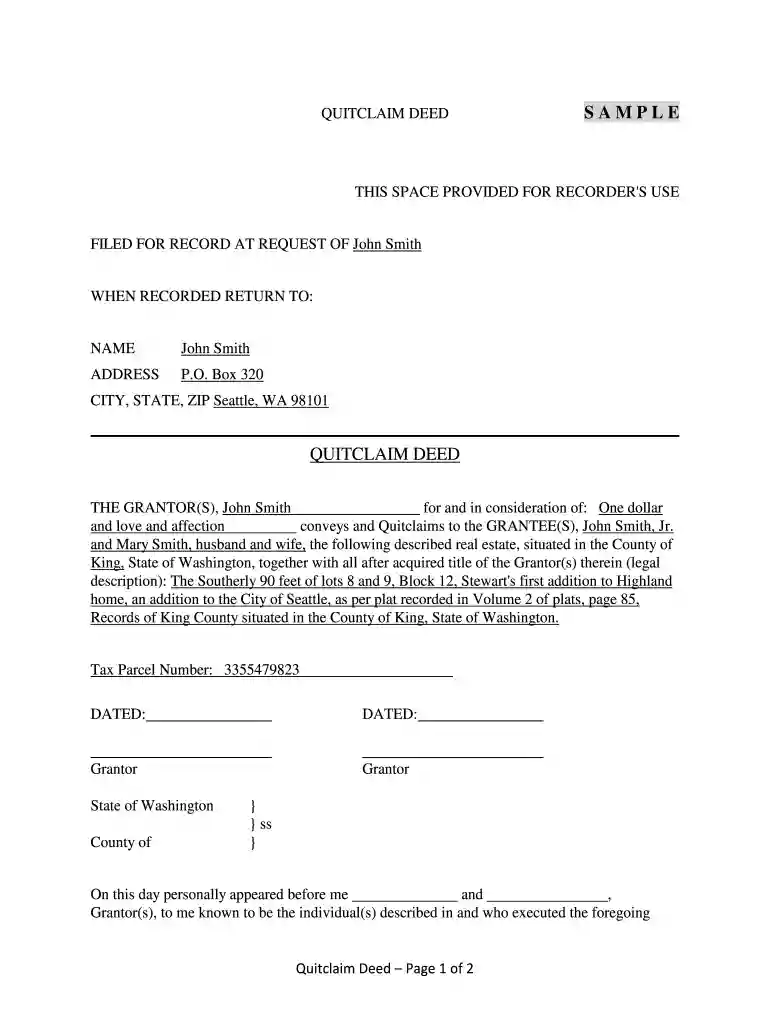
Type text, add images, blackout confidential details, add comments, highlights and more.

Draw your signature, type it, upload its image, or use your mobile device as a signature pad.

Send quit claim deed form washington state pdf via email, link, or fax. You can also download it, export it or print it out.
A quitclaim deed serves as a legal document that allows an individual, known as the grantor, to transfer their interest in a property to another party, called the grantee. In Washington State, the quitclaim deed does not guarantee that the property title is free of claims or liens; rather, it simply conveys whatever interest the grantor holds at the time of signing. This makes it particularly useful for situations like transferring property between family members or clearing up title issues.
Lack of Warranty: Unlike warranty deeds, quitclaim deeds do not come with warranties about the property title. This means the grantee accepts the property 'as-is' without recourse if issues arise concerning title or claims.
Ease of Transfer: Quitclaim deeds are often used in straightforward property transfers due to their simplicity. They can be completed quickly and do not require extensive documentation.
No Title Search Required: Since the grantor is not making any assurances regarding the property title, a title search is not necessarily conducted. This can streamline the process but leaves the grantee exposed to potential risks.
Prepare the Document:
Fill in the Required Information:
Sign the Deed:
Record the Deed:
Retention of Copies:
Family Transfers: Family members often use quitclaim deeds to transfer property without engaging in lengthy sales processes. This is particularly useful when dealing with estates or inheritance situations.
Divorce Settlements: During divorce proceedings, joint ownership of property can be transferred using a quitclaim deed, enabling one spouse to relinquish their rights to the other spouse.
Clearing Title Issues: Quitclaim deeds can also resolve title discrepancies. For instance, if a previous owner’s interest in a property wasn’t properly documented, a quitclaim deed from that individual can help clarify ownership.
Tax Implications: While a quitclaim deed itself is not subject to sales tax, it may have tax implications for the grantee. Property taxes can be reassessed based on the new ownership, and understanding this before the transfer can be beneficial.
Limitations on Use: Quitclaim deeds cannot be used for certain types of property transactions, such as properties with mortgages unless both parties agree on how to handle those obligations.
Sample Quitclaim Deed for Family Transfer: A parent transferring ownership of their home to their child through a quitclaim deed, ensuring simplified title transfer without a formal sale.
Divorce Settlement Quitclaim Deed Example: In a divorce, one spouse may quitclaim their interest in a jointly owned property to the other, facilitating a clean financial break and avoiding future disputes.
Utilizing a Washington quitclaim deed template can vastly simplify the process of property transfer. The template provides a structured and legally compliant format that can be modified to fit individual circumstances while ensuring all necessary information is captured for recording. Understanding the implications and processes involved in using such a template is crucial for anyone looking to navigate property transfers in Washington State effectively.
Upload your sample quit claim deed washington state to DocHub (after you’ve set up an account for this). If you need to complete fields in it, use appropriate tools from the top pane. For instance, add Signature Fields, assign each to a particular person, and click on Sign → Request signatures from others. Personalize your message for your recipients and click Send Request. You can also send your document by fax or as a Signing link instead of using email (you’ll find these options by navigating to the Menu → Send)
Document editing with DocHub is equally convenient on desktop and mobile devices. You only need an internet browser to revise your free quit claim deed form washington state on Android. Open our website and sign in to access the instruments you require. Add your document and introduce your intended modifications. After that, you can keep your form in your document storage or send it out immediately.
At DocHub, your data security is our priority. We follow HIPAA, SOC2, GDPR, and other standards, so you can work on your documents with confidence.
Our sample templates are blank, fillable and printable as pdf or word documents. Quitclaim deeds may be in substance in the following form: To fill out a
QUIT CLAIM DEED the following described real estate, situated in the County of. State of Washington: Tax Account Numbers: Dated: STATE OF. 20. COUNTY OF. IRead more


