




01. Edit your schedule g form 1120 example online
Type text, add images, blackout confidential details, add comments, highlights and more.

Type text, add images, blackout confidential details, add comments, highlights and more.

Draw your signature, type it, upload its image, or use your mobile device as a signature pad.

Send schedule g form 1120 via email, link, or fax. You can also download it, export it or print it out.
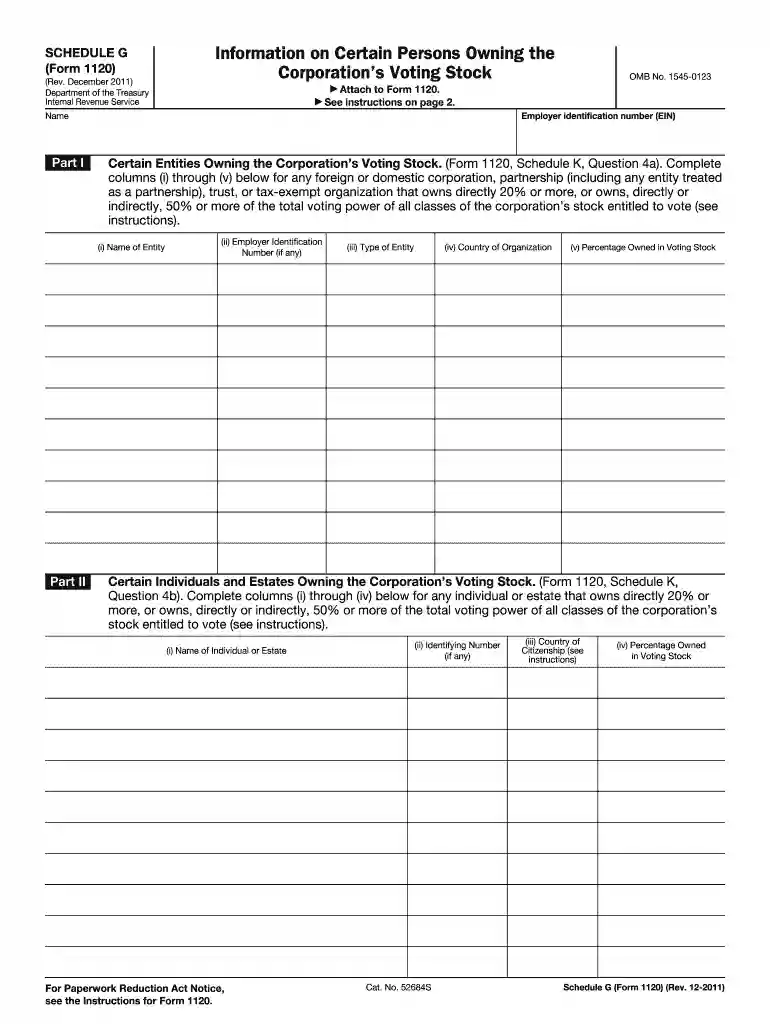
Schedule G (Form 1120) is an integral document used by corporations to report essential information regarding individuals, estates, and certain entities that hold significant ownership in the corporation’s voting stock. This form is mandated by the Internal Revenue Service (IRS) to ensure transparency in the declaration of ownership interests. It specifically requires corporations to disclose details about owners holding 20% or more directly, or 50% or more indirectly, of the corporation’s stock.
Schedule G encompasses several important sections, each dedicated to capturing specific data. These include:
Completing Schedule G involves a series of methodical steps to ensure accuracy:
Corporations can obtain Schedule G through several channels:
Adherence to IRS guidelines is crucial when filling out Schedule G. These guidelines outline how to accurately report ownership percentages and determine whether an entity or individual falls under the Schedule G criteria. It is important for corporations to stay updated on any changes in IRS regulations that may impact how Schedule G is completed and filed.
Schedule G is primarily utilized by corporations with complex ownership structures. It is particularly relevant for:
Filing Schedule G necessitates several supporting documents to ensure comprehensive reporting:
Not properly completing or failing to file Schedule G can result in significant penalties. Corporations might face fines, increased scrutiny from the IRS, or delays in processing their tax returns. It is critical to adhere strictly to guidelines to avoid such complications.
Corporations have the flexibility to choose between digital and paper formats for Schedule G. However, the IRS encourages electronic filing, providing several benefits:
Schedule G is compatible with various tax software solutions such as TurboTax and QuickBooks. Utilizing software streamlines the process through features like auto-fill from previous entries, integrated IRS guidelines, and real-time validation checks to ensure form completeness before submission.
We've got more versions of the schedule g form 1120 example form. Select the right schedule g form 1120 example version from the list and start editing it straight away!
At DocHub, your data security is our priority. We follow HIPAA, SOC2, GDPR, and other standards, so you can work on your documents with confidence.
May 18, 2022 If Yes, complete Part I of Schedule G (Form 1120) (attach Schedule G). Did any individual or estate own directly 20% or more, or ownRead more
Enter the sum of the amounts from Form 1041, Schedule G, lines 1a and. 1b; or ) Report this amount on Form 1040, line 54 or Form 1040NR, line 51; Form 1120,.Read more
Use Schedule G (Form 1120) to provide information applicable to certain entities, individuals, and estates that own, directly,. 20% or more, or own, directly orRead more


