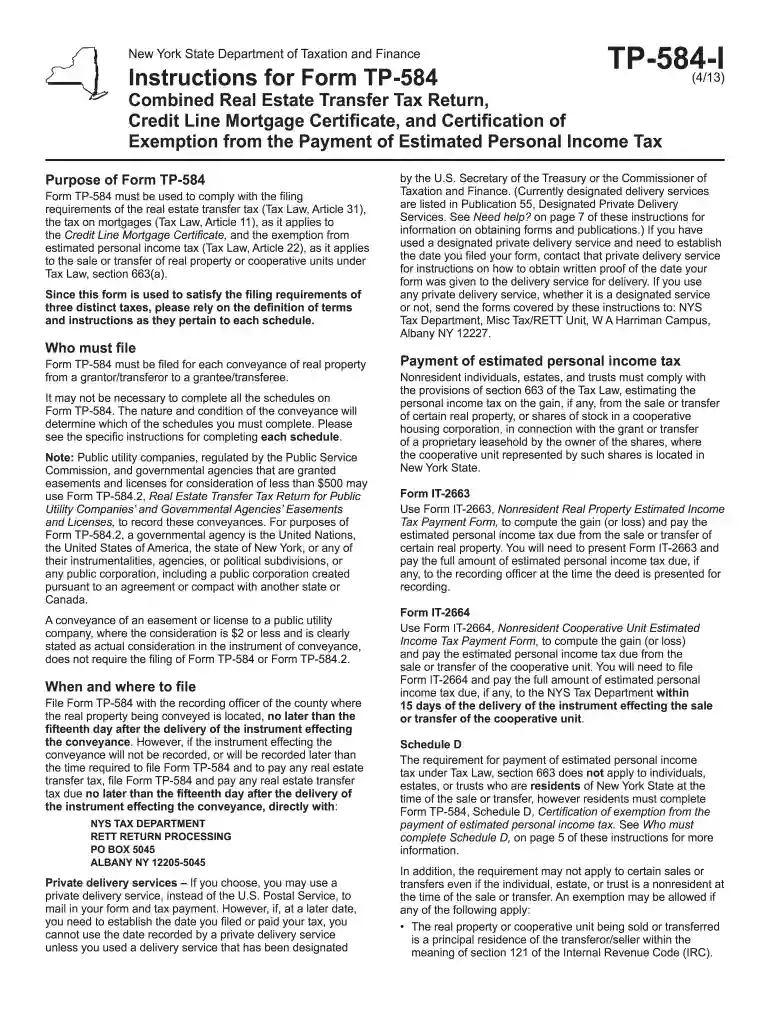
584 instructions 2026

Get Form
frc double elimination bracket Preview on Page 1

Here's how it works

01. Edit your frc double elimination bracket online
Type text, add images, blackout confidential details, add comments, highlights and more.

02. Sign it in a few clicks
Draw your signature, type it, upload its image, or use your mobile device as a signature pad.

03. Share your form with others
Send frc elimination bracket via email, link, or fax. You can also download it, export it or print it out.

How to use or fill out 584 instructions with our platform

Form edit decoration
9.5
Ease of Setup
DocHub User Ratings on G2
9.0
Ease of Use
DocHub User Ratings on G2
  1. Click ‘Get Form’ to open the TP-584 instructions in the editor.
  2. Begin by filling out Schedule A, entering the names and addresses of both the grantor and grantee as they appear in your deed. Ensure you include social security or employer identification numbers.
  3. Provide a detailed description of the property being conveyed, including its location and tax map designation. If unsure about the SWIS Code, consult your local assessor's office.
  4. Indicate the type of property conveyed by checking the appropriate box. Specify whether it is a one-to-three family house, condominium, or other types.
  5. Complete Schedule B by entering the consideration amount for the property. If applicable, include any continuing lien deductions.
  6. If claiming an exemption from estimated personal income tax, complete Schedule D based on your residency status and sign accordingly.

Start using our platform today to streamline your form completion process for free!

See more 584 instructions versions

We've got more versions of the 584 instructions form. Select the right 584 instructions version from the list and start editing it straight away!
Versions Form popularity Fillable & printable
2021 4.8 Satisfied (129 Votes)
2019 4 Satisfied (54 Votes)
2013 4.4 Satisfied (282 Votes)
be ready to get more

Complete this form in 5 minutes or less

Get form

Got questions?

We have answers to the most popular questions from our customers. If you can't find an answer to your question, please contact us.
Contact us
For conveyances of real property located outside New York City, file Form TP-584, Combined Real Estate Transfer Tax Return, Credit Line Mortgage Certificate, and Certification of Exemption from the Payment of Estimated Personal Income Tax, with the county clerk where the property transferred is located.
There are implementable strategies to soften the transfer tax obligations legally: Strategic Transfer Plans: Individuals should avoid selling or transferring property during peak market periods. A higher sales price naturally results in a higher transfer tax. Waiting for better conditions is a considerable strategy.
File Form TP-584-NYC, Combined Real Estate Transfer Tax Return, Credit Line Mortgage Certificate, and Certification of Exemption from the Payment of Estimated Personal Income Tax for the Conveyance of Real Property Located in New York City, for all real property conveyances in New York City.
Declaration control number (DCN). The DCN is a 14-digit number assigned to each tax return. It should be included in your acknowledgement message. Clearly print or type the DCN in the top left corner of each Form 8453 after the IRS has acknowledged receipt of the electronic tax return.
Key Takeaways. A transfer tax is charged by a state or local government to complete a sale of property from one owner to another. The tax is typically based on the value of the property. A federal or state inheritance tax or estate tax may be considered a type of transfer tax.

Security and compliance

At DocHub, your data security is our priority. We follow HIPAA, SOC2, GDPR, and other standards, so you can work on your documents with confidence.

Learn more
ccpa2
pci-dss
gdpr-compliance
hipaa
soc-compliance
be ready to get more

Complete this form in 5 minutes or less

Get form

People also ask

In a sale/purchase transaction, a CEMA allows (1) the seller to pay NYS transfer tax on only the difference between the purchase price and the unpaid principal balance of the sellers existing loan (known as a continuing lien deduction); (2) the buyer to pay NYS mortgage tax on only the difference between the buyers
In the vast majority of real estate transactions, the seller pays the transfer taxes. The only real exception is in new developments where they are part of the negotiation (but still usually paid by the seller, especially in softer markets).
The Certificate of Authority gives you the right to collect tax on your taxable sales and to issue and accept most New York State sales tax exemption certificates.

frc bracket