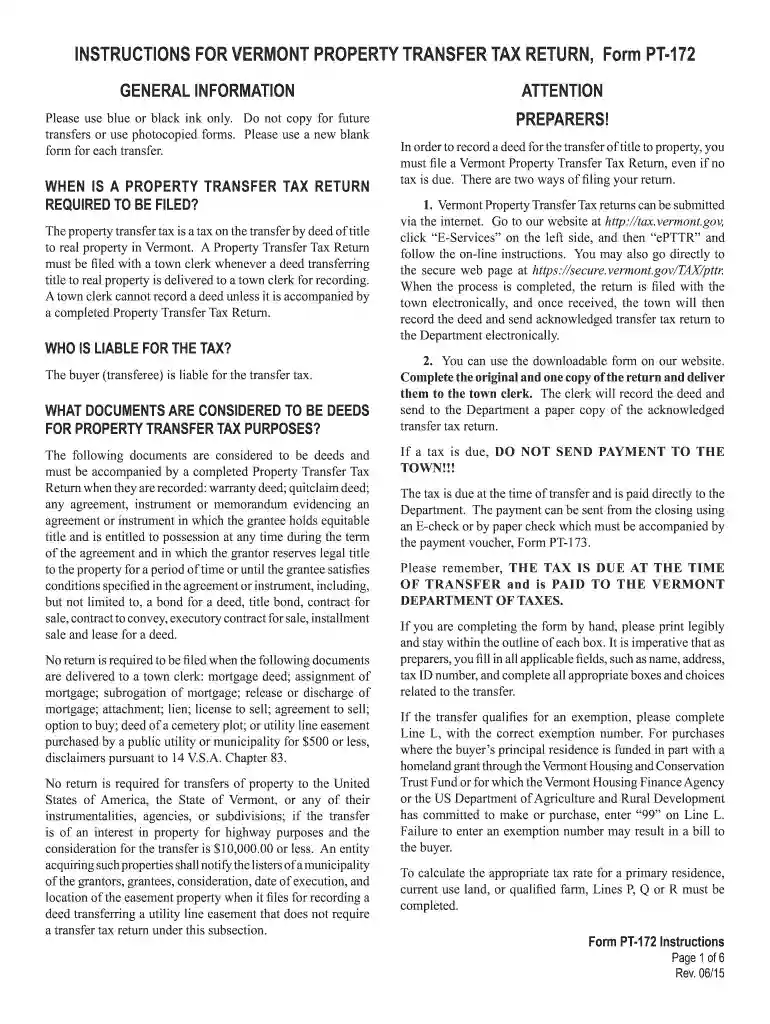
property tax transfer form Preview on Page 1

Vermont property transfer tax form pt 172 2026

Here's how it works

  • 01. Edit your property tax transfer form online

    Type text, add images, blackout confidential details, add comments, highlights and more.

  • 02. Sign it in a few clicks

    Draw your signature, type it, upload its image, or use your mobile device as a signature pad.

  • 03. Share your form with others

    Send property transfer tax form via email, link, or fax. You can also download it, export it or print it out.

How to use or fill out Vermont Property Transfer Tax Form PT-172 with DocHub

Form edit decoration
9.5
Ease of Setup
DocHub User Ratings on G2
9.0
Ease of Use
DocHub User Ratings on G2
  1. Click ‘Get Form’ to open the Vermont Property Transfer Tax Form PT-172 in our platform.
  2. Begin by filling in the seller's information. Enter the entity name or individual name on Lines A and B, ensuring to use blue or black ink only.
  3. Proceed to Line C to provide the property location, including street address and town. If applicable, indicate if the property is located in multiple towns.
  4. On Line D, enter the date of transfer. Ensure this matches the closing date on your payment voucher (Form PT-173) for accurate processing.
  5. Complete Lines E through H by selecting the type of property interest being acquired and providing details about building construction.
  6. Fill out Lines M, N, and O with total consideration paid for personal and real property. Be sure to explain any discrepancies if less than fair market value.
  7. Finally, calculate the tax due using the rate schedule provided on page 3 of the form and enter it on Line S before saving your completed form.

Start using our platform today to easily complete your Vermont Property Transfer Tax Form PT-172 online for free!

See more property tax transfer form versions

We've got more versions of the property tax transfer form form. Select the right property tax transfer form version from the list and start editing it straight away!

VersionsForm popularityFillable & printable
20244.7 Satisfied (36 Votes)
20234.5 Satisfied (51 Votes)
20204.8 Satisfied (160 Votes)
20174.4 Satisfied (62 Votes)
20154.8 Satisfied (22 Votes)
20084 Satisfied (54 Votes)

be ready to get more

Complete this form in 5 minutes or less

Got questions?

We have answers to the most popular questions from our customers. If you can't find an answer to your question, please contact us.

Yes, it is possible with DocHub. This safe and compliant online solution has a phone-based signing option. After you log in to your DocHub account and import your pt 172 to our editor, fill out all required areas and utilize the Sign tool on the upper barf. Click on Create your signature and select Phone from the available choices. Here, you scan a QR code with your smartphone and draw your signature on your phone display, as you normally do when signing hard copies. If you access DocHub right from your mobile device, you can eSign your document by drawing your eSignature, uploading its image, or simply with a typed name.

You may complete and sign your pt172 on the internet, even on a tight deadline. All you need to access top-notch editing tools on any device is a DocHub account, that you can register within a few moments. When you register, add your file or find what you are searching for in our catalog, complete it utilizing the editing tools you need, and put your electronic signature on it at the end.

Understanding Transfer Taxes A transfer tax on real estate may be imposed by state, county, or municipal authorities for the privilege of transferring real property within the jurisdiction. The government is effectively taxing the transfer of a legal deed, certificate, or title from a seller to a buyer.
Vermonts transfer tax, known as a Property Transfer Tax, is calculated at a rate of 1.25% of the propertys sale price. This does not include the states Clean Water Surcharge. For example, if you sold your home for $388,000 (Vermonts median home price), you could expect to pay $4,850 in Vermont transfer taxes.
Depending on where youre buying, selling or transfering property, they might be referred to as a deed transfer tax, documentary stamp tax or state documentary fee.

Security and compliance

At DocHub, your data security is our priority. We follow HIPAA, SOC2, GDPR, and other standards, so you can work on your documents with confidence.

People also ask

To properly convey a deed the deed must be signed in front of a notary and recorded in the county clerks office. If a survey is referenced in the deed, that survey should also be recorded. If a deed divides a parcel a survey should be recorded with the deed.
The Vermont Property Transfer Tax Return Form PTT-172 is used to report the transfer of property within the state of Vermont and to calculate the property transfer tax due. This form must be completed by both the transferor (seller) and transferee (buyer) to ensure compliance with Vermont tax laws.
Tax Rates and Exemptions Under Act 181 (H. 687) of 2024, and effective August 1, 2024, the Property Transfer Tax rates are as follows: General Tax Rate: 1.25%. Clean Water Surcharge Rate: 0.22%.

vermont property transfer tax return

Vermont Tax Expenditures

Jan 15, 2008 In its simplest form, a tax is an across- the-board levy on a base, such as income or retail sales, to which a specific rate applies and for.Read more

Learn more
EPA

As required by the Water Resources Development Act of 1992 (WRDA), I am pleased to transmit the Environmental Protection Agencys (EPA) Report to CongressRead more

Learn more
If you believe that this page should be taken down, please follow our DMCA take down process here