




Here's how it works

01. Edit your biological classification worksheet answer key online
Type text, add images, blackout confidential details, add comments, highlights and more.

02. Sign it in a few clicks
Draw your signature, type it, upload its image, or use your mobile device as a signature pad.

03. Share your form with others
Send biological classification pogil answer key via email, link, or fax. You can also download it, export it or print it out.
How to use or fill out biological classification pogil answers with our platform

- Click ‘Get Form’ to open the biological classification pogil answers document in the editor.
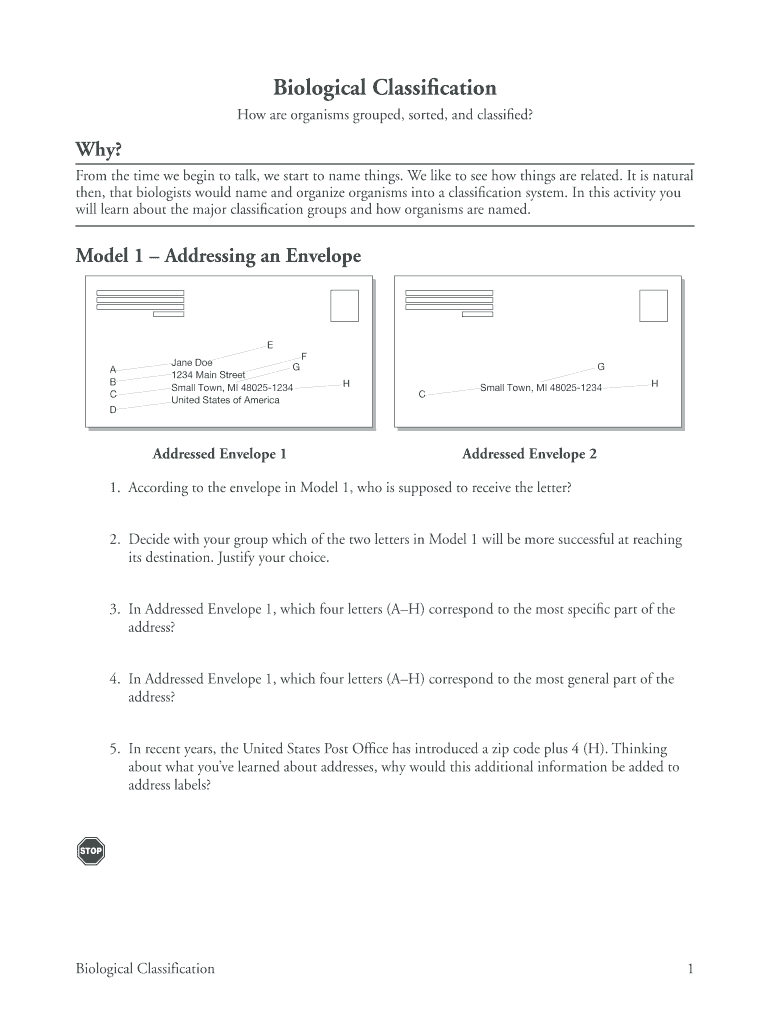
- Begin by reviewing Model 1, which addresses an envelope. Identify the recipient's name and address components. Fill in the corresponding fields based on your understanding of organism classification.
- Move to Model 2, where you will classify organisms like lions and tigers. Use the provided taxa categories to complete the table accurately, ensuring you understand each taxonomic level.
- Refer to Model 3 for domains and kingdoms. Fill in the characteristics of each kingdom based on their cell organization and energy sources as outlined in the chart.
- Finally, utilize Model 4’s dichotomous key to answer questions about organism classification. Follow the yes/no flowchart carefully to reach accurate conclusions.
Start using our platform today for free and streamline your document editing experience!
Fill out biological classification pogil answers online
It's free
It's free
See more biological classification pogil answers versions
We've got more versions of the biological classification pogil answers form. Select the right biological classification pogil answers version from the list and start editing it straight away!
| Versions | Form popularity | Fillable & printable |
|---|---|---|
| 2015 | 4.9 Satisfied (46 Votes) |
Got questions?
We have answers to the most popular questions from our customers. If you can't find an answer to your question, please contact us.
Contact us
What are the 7 levels of classification in order PDF?
Classification of living organisms animals (all multicellular animals) plants (all green plants) fungi (moulds, mushrooms, yeast) protists (Amoeba, Chlorella and Plasmodium) prokaryotes (bacteria, blue-green algae) Classification of living organisms - AQA - GCSE Biology (Single - BBC BBC bitesize guides revision BBC bitesize guides revision
What are the 7 levels of biological classification?
The seven levels of taxonomy from broadest to most specific are: Kingdom. Phylum. Class. Order. Family. Genus. Species.
What are the 7 levels of classification in biology?
The seven levels of taxonomy from broadest to most specific are: Kingdom. Phylum. Class. Order. Family. Genus. Species. Definition Levels of Classification - Taxonomy - Study.com Study.com learn lesson taxonomic-levels-cl Study.com learn lesson taxonomic-levels-cl
What is the short trick to learn biological classification?
Mnemonic Explanation: The mnemonic MaP oF PLAces is a helpful tool for remembering the five kingdoms in the classification of living organisms: Monera, Protista, Fungi, Plantae, and Animalia. Each letter in the mnemonic represents the first letter of one of these kingdoms.
What are the 5 classification of biology?
Living things are divided into five kingdoms: animal, plant, fungi, protist and monera.
Security and compliance
At DocHub, your data security is our priority. We follow HIPAA, SOC2, GDPR, and other standards, so you can work on your documents with confidence.
Learn more


People also ask
What are the 7 levels of classification for a human?
Domain, Kingdom, Phylum, Class, Order, Family, Genus, Species. Levels of Classification | PDF | Genus | Taxonomy (Biology) - Scribd Scribd presentation Levels-of-Classi Scribd presentation Levels-of-Classi
What is biological classification pdf?
Biological classification is used to categorize living organisms, so pseudo-living organisms like viruses are not included. Domain. Dome. The first taxonomic rank is domain, and there are three generally accepted domains: archaea, bacteria, and eukarya. Plants and animals are in eukarya.