



01. Edit your probation review template online
Type text, add images, blackout confidential details, add comments, highlights and more.

Type text, add images, blackout confidential details, add comments, highlights and more.
Draw your signature, type it, upload its image, or use your mobile device as a signature pad.

Send 3 month probation review example via email, link, or fax. You can also download it, export it or print it out.
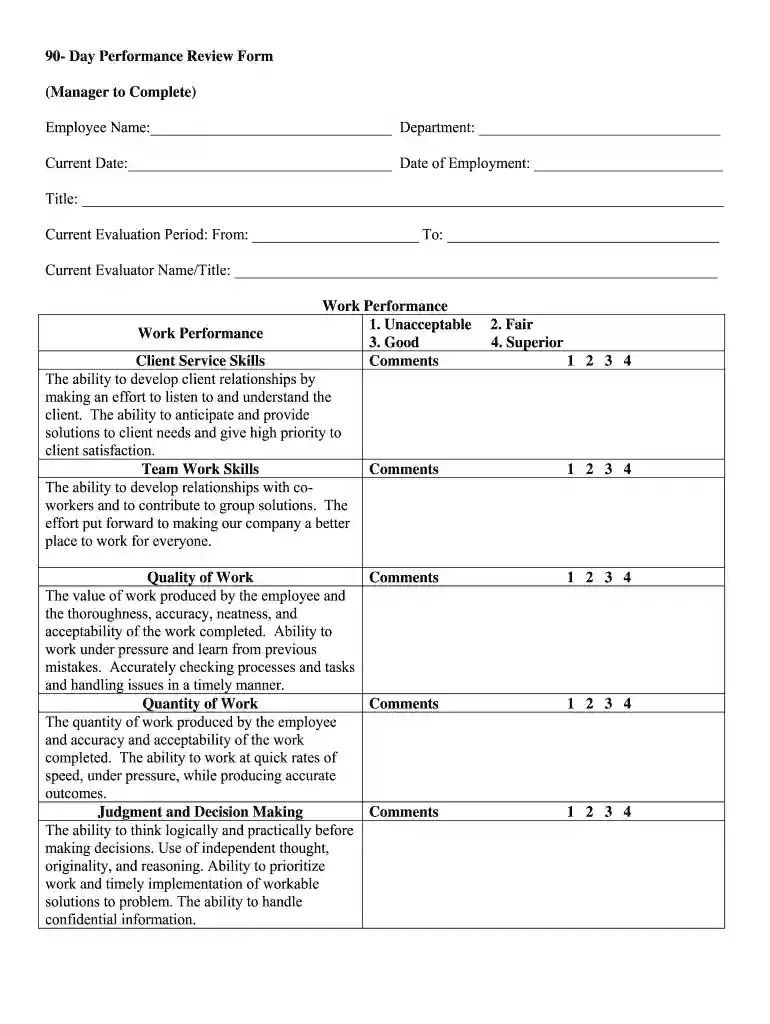
The 90-day review template is a structured document designed for managers and human resources professionals to evaluate an employee's performance during their initial probationary period. This review typically occurs three months after the employee's start date and aims to assess various aspects of their performance, including job knowledge, teamwork, adaptability, and productivity. It provides a framework for feedback between the employee and the supervisor, promoting a dialogue about performance and areas for development.
The template generally features sections for both quantitative assessments and qualitative comments. Managers can rate employees across different criteria, such as adherence to company values and communication skills, while also leaving space for written feedback. This dual approach helps to create a comprehensive view of the employee's strengths and areas needing improvement.
Beyond performance evaluation, the 90-day review template often includes sections for goal-setting and planning for future professional development, aligning the employee’s aspirations with organizational objectives. This process not only aids in clarifying expectations but also reinforces the company culture of regular feedback and growth.
Completing the 90-day review template involves several clear steps to ensure that both the evaluation process is thorough and that the employee receives meaningful feedback. Here are the steps to follow:
Preparation: Review the employee’s job description and any previous performance documentation. Gather feedback from team members and stakeholders to provide a well-rounded assessment.
Fill Out Quantitative Ratings: Assess the employee on key performance indicators (KPIs) relevant to their role. This could include ratings in areas such as punctuality, teamwork, and quality of work. Use a clear scale (e.g., 1-5) for consistency.
Provide Qualitative Feedback: In addition to numerical ratings, write personalized comments on strengths, areas for improvement, and specific examples of the employee's performance. This section should encourage open dialogue and show support for the employee's career growth.
Set Goals for Development: Identify key developmental goals based on the review. Collaboratively agree on realistic, measurable targets that the employee can work towards in the upcoming months.
Discuss with the Employee: Schedule a meeting to discuss the completed review with the employee. This should be a two-way conversation where the employee can share their thoughts and feelings regarding their performance and express any challenges faced.
Finalize and Document: After the discussion, finalize the document and have both the manager and employee sign it to acknowledge the review. Keep a copy in the employee’s file for future reference and to track progression over time.
The 90-day review template typically includes several critical elements designed to facilitate a comprehensive evaluation process. Key components often found within the template are:
Employee Information: Basic details about the employee being reviewed, including their name, position, start date, and department.
Performance Criteria: Clearly defined metrics or competencies specific to the role, such as communication skills, problem-solving ability, and goal achievement.
Rating Scale: A predefined rating scale for managers to uniformly assess the employee's performance across different criteria, often ranging from poor to excellent.
Written Feedback Section: Space for managers to provide qualitative feedback, including specific examples of performance successes or areas that require improvement.
Goals and Development Plans: A dedicated section to outline objectives for the employee for the upcoming months, fostering a growth-oriented mindset.
Signatures: Areas for both the manager and the employee to sign, confirming that the review has been discussed and is understood by both parties.
Utilizing the 90-day review template can be beneficial across various scenarios. Here are a few practical examples to illustrate its use:
New Hires: A marketing specialist who joined the team three months ago may have their performance evaluated using this template. The manager can note achievements in successful campaign execution while also addressing areas for growth in data analysis skills.
Transitional Roles: An employee transitioning from a different department, such as from sales to customer service, could have their skills assessed using the 90-day review template to identify how they are adapting to new responsibilities and where they may need support.
Performance Improvement: An employee who has struggled during their probationary period may be given specific feedback through the template. The template allows for setting clear improvement goals and provides a framework for follow-up reviews.
By illustrating these varied scenarios, the template proves versatile and essential in different contexts of employee evaluation.
The 90-day review template is primarily utilized by the following groups:
Managers: Responsible for evaluating their team members, managers leverage this template to provide structured feedback, ensuring consistency and fairness in performance assessments.
Human Resources Professionals: HR teams often implement the 90-day review process as part of the broader employee performance management strategy, ensuring compliance with internal policies and promoting best practices.
Trainers and Coaches: Individuals focused on developing employee skills can use insights gained from the review process to guide training sessions, ensuring that they align with employee needs.
Senior Leadership: Executives or senior leaders may review aggregated data from multiple employee evaluations to assess overall team performance and identify trends for organizational development.
In all cases, the 90-day review template serves as a vital tool for fostering open communication, setting expectations, and promoting employee success within the organization.


At DocHub, your data security is our priority. We follow HIPAA, SOC2, GDPR, and other standards, so you can work on your documents with confidence.


90 Day Treatment Plan Review. CLIENT: PACTS#. Progress in Achieving Long Term Goals: Progress in Achieving Short Term Goals:.Read more
Mar 20, 2014 In some case, measurements were taken every day for many days in a row; in other cases there were gaps of a year or more betweenRead more
90-Day Performance Appraisal Form. This appraisal provides a written record of the employees 90-day probationary period. Supervisors are expected to beRead more


