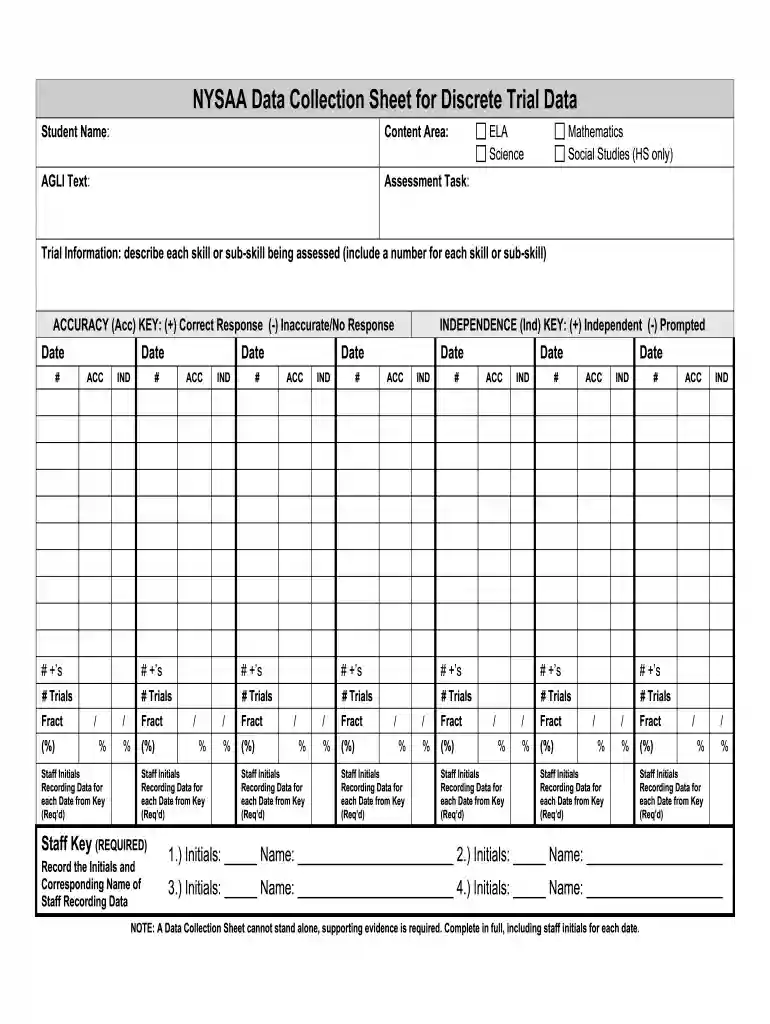
Nysaa data collection sheet 2026

Get Form
what is nysaa Preview on Page 1

Here's how it works

01. Edit your what is nysaa online
Type text, add images, blackout confidential details, add comments, highlights and more.

02. Sign it in a few clicks
Draw your signature, type it, upload its image, or use your mobile device as a signature pad.

03. Share your form with others
Send it via email, link, or fax. You can also download it, export it or print it out.

How to use or fill out nysaa data collection sheet with DocHub

Form edit decoration
9.5
Ease of Setup
DocHub User Ratings on G2
9.0
Ease of Use
DocHub User Ratings on G2
  1. Click ‘Get Form’ to open the NYSAA Data Collection Sheet in our editor.
  2. Begin by entering the 'Student Name' and 'Content Area' at the top of the form. Select from options like ELA, Mathematics, or Science.
  3. In the 'Trial Information' section, describe each skill or sub-skill being assessed. Ensure to number each skill for clarity.
  4. Record accuracy data by filling in the date and corresponding accuracy scores using the provided keys: (+) for correct responses and (-) for inaccurate/no response.
  5. Next, document independence levels by entering dates and scores under the Independence (Ind) section, using similar keys: (+) for independent and (-) for prompted.
  6. Complete staff initials for each date recorded to ensure accountability. This is a required field.
  7. Finally, review all entries for completeness before saving your document. Remember that supporting evidence is required alongside this sheet.

Start using our platform today to effortlessly fill out your NYSAA Data Collection Sheet online for free!

be ready to get more

Complete this form in 5 minutes or less

Get form

Got questions?

We have answers to the most popular questions from our customers. If you can't find an answer to your question, please contact us.
Contact us
Observation: Observe the students in their natural environment and record their behavior. For instance, you could observe the student during a small group reading activity to see how many sight words they can identify correctly. Checklist: Use a checklist to track specific behaviors or skills.
Results indicated that the quality of IEP goals written using ChatGPT was much higher, indicating it as a potential tool for novice special education teachers in creating high-quality IEP goals.
A solid IEP data collection system is aligned to SMART goals and involves the following: Writing measurable IEP goals and objectives; Collecting data together by relevance; Ensuring collected data is related to an attainable goal; Having a relevant data collection system; and. A timely data collection.
Analyzing/Interpreting Assessment Data Use both qualitative and quantitative methods to analyze and describe assessment results. Compare data to provide greater meaning. Analyze data with an equity mindset. Analyze data in the context of stated SLOs and benchmarks. Note and describe observations and trends.
Tips to Collect and Manage Data Share the collection of data. Use technology to support collaboration. Develop sets of questions to obtain important information from students, parents and teachers. Create ways to provide coverage so team members can do observations and collaborate around the IEP process.

Security and compliance

At DocHub, your data security is our priority. We follow HIPAA, SOC2, GDPR, and other standards, so you can work on your documents with confidence.

Learn more
ccpa2
pci-dss
gdpr-compliance
hipaa
soc-compliance
be ready to get more

Complete this form in 5 minutes or less

Get form

People also ask

Some examples of data you can track and collect are: Learner work. Formative assessment, such as pre-tests (comparative assessments), quizzes, exit tickets. Learner perception surveys. Classroom observation records. Other people who interact with the learner can provide useful data points.
The New York State Alternate Assessment (NYSAA) is part of the New York State testing program that measures the attainment of the States learning standards in the areas of English language arts (ELA), mathematics, and science for students with the most severe cognitive disabilities.

Related links