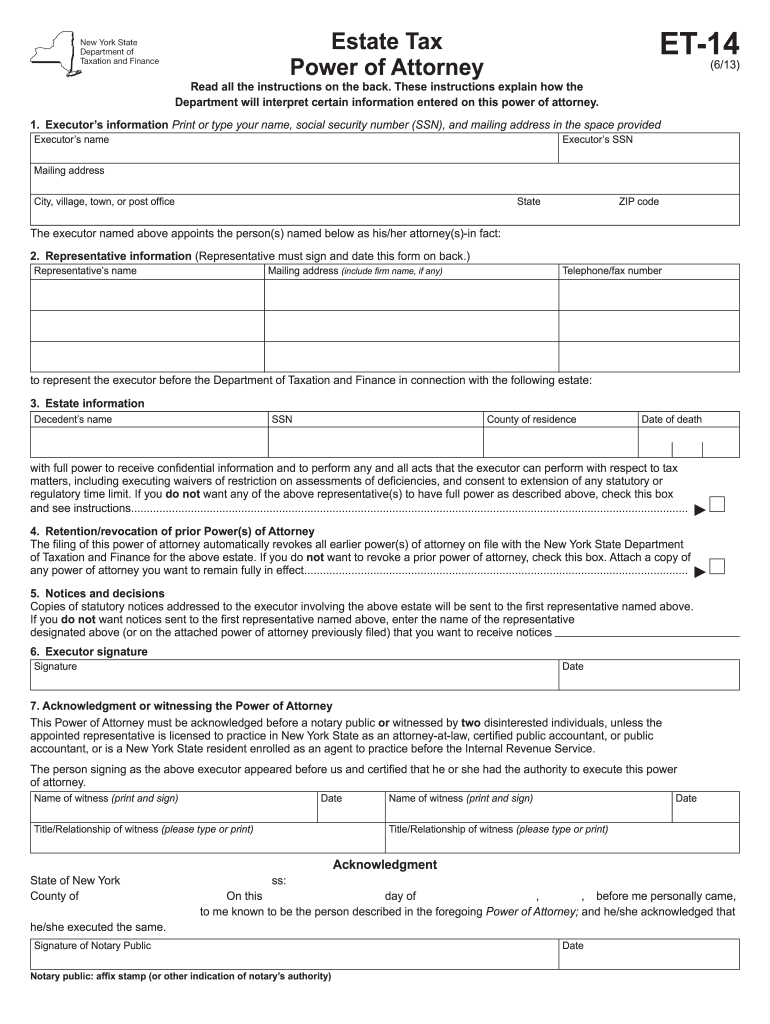
Et 14 2026

Get Form
et 14 Preview on Page 1

Here's how it works

01. Edit your et 14 online
Type text, add images, blackout confidential details, add comments, highlights and more.
02. Sign it in a few clicks
Draw your signature, type it, upload its image, or use your mobile device as a signature pad.
03. Share your form with others
Send form et 14 via email, link, or fax. You can also download it, export it or print it out.

How to use or fill out et 14 with our platform

Form edit decoration
9.5
Ease of Setup
DocHub User Ratings on G2
9.0
Ease of Use
DocHub User Ratings on G2
  1. Click ‘Get Form’ to open the ET-14 in the editor.
  2. Begin by entering the executor’s information. Fill in your name, social security number (SSN), and mailing address in the designated fields.
  3. Next, provide the representative's information. Include their name, mailing address (with firm name if applicable), and contact details.
  4. In the estate information section, input the decedent’s name, SSN, county of residence, and date of death.
  5. Review the retention/revocation section. If you wish to revoke any prior powers of attorney, check the appropriate box and attach necessary documentation.
  6. Complete the notices and decisions section by specifying which representative should receive statutory notices.
  7. Sign and date the form as the executor. Ensure that a copy of Letters Testamentary or Administration is attached for verification.
  8. Finally, have your representatives complete their declaration by signing and dating it in accordance with their professional designation.

Start using our platform today to streamline your document editing and form completion for free!

be ready to get more

Complete this form in 5 minutes or less

Get form

Got questions?

We have answers to the most popular questions from our customers. If you can't find an answer to your question, please contact us.
Contact us
New York Estate Tax Exemption The New York estate tax threshold is $7.16 million in 2025 and $6.94 million in 2024. That number will keep going up annually with inflation. This means that if a persons estate is worth less than $7.16 million and they die in 2024, the estate owes nothing to the state of New York.
There is good reason to believe that heirs most often bear the tax in the form of lower inheritances. When the burdens are analyzed this way, individuals inheriting over $1 million are likely to bear most of the estate tax.
Box 14 is used to report amounts that dont belong in other boxes on Form W-2. Employers can use it to report additional tax or income information for filing or informational purposes.
Most relatively simple estates (cash, publicly traded securities, small amounts of other easily valued assets, and no special deductions or elections, or jointly held property) do not require the filing of an estate tax return.
The total of all of these items is your gross estate. The includible property may consist of cash and securities, real estate, insurance, trusts, annuities, business interests and other assets. Keep in mind that the Gross Estate will likely include non-probate as well as probate property.

Security and compliance

At DocHub, your data security is our priority. We follow HIPAA, SOC2, GDPR, and other standards, so you can work on your documents with confidence.

Learn more
ccpa2
pci-dss
gdpr-compliance
hipaa
soc-compliance
be ready to get more

Complete this form in 5 minutes or less

Get form

People also ask

An estate tax return is required if the gross value of the estate is over a certain threshold. For individuals who die in 2025, the threshold is $13.99 million (up from $13.61 million in 2024). Almost anything belonging to the deceased with a tangible cash value is included in the value of the estate.
Federal Inheritance Tax While California does not impose an inheritance tax, the federal government does have an estate tax that applies to large estates. For 2024, the federal estate tax exemption is $12.92 million per individual.
An application for an extension of time to pay estate tax applied for after the estate tax due date will generally not be considered by the IRS. File a separate Form 4768 for each return for which you are requesting an extension of time to file. Check the appropriate form number in Part II of Form 4768.

Related links