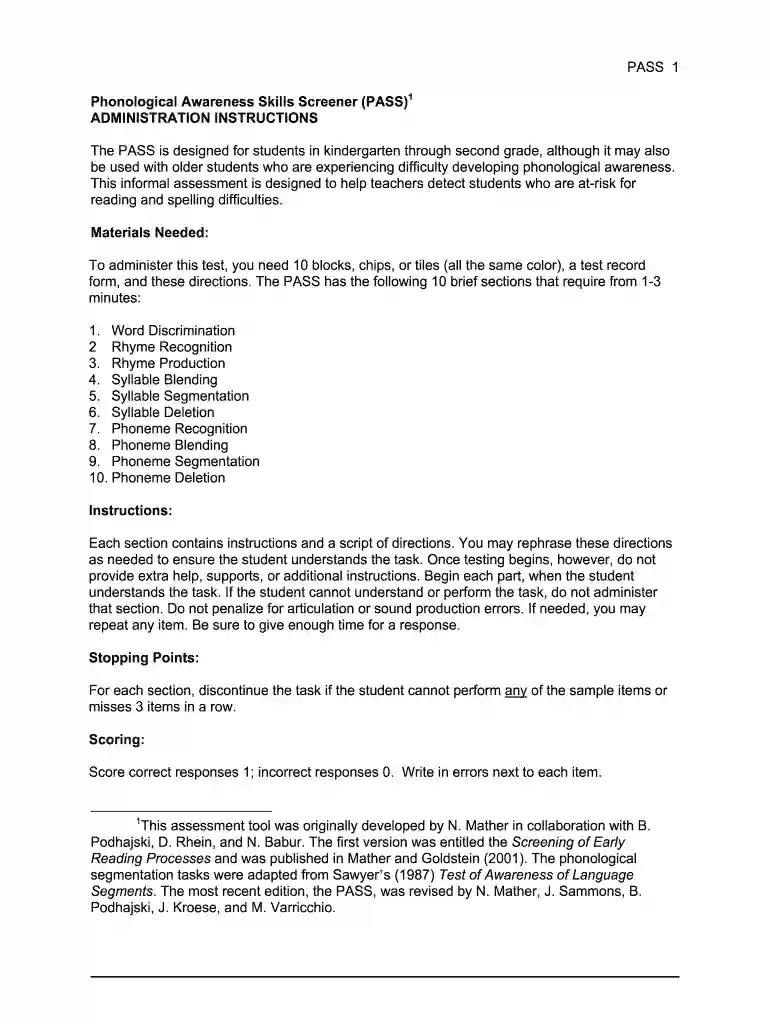
pass assessment phonological awareness Preview on Page 1

Phonological awareness screener 2026

Here's how it works

  • 01. Edit your pass assessment phonological awareness online

    Type text, add images, blackout confidential details, add comments, highlights and more.

  • 02. Sign it in a few clicks

    Draw your signature, type it, upload its image, or use your mobile device as a signature pad.

  • 03. Share your form with others

    Send phonological awareness screener via email, link, or fax. You can also download it, export it or print it out.

How to use or fill out phonological awareness screener with our platform

Form edit decoration
9.5
Ease of Setup
DocHub User Ratings on G2
9.0
Ease of Use
DocHub User Ratings on G2
  1. Click ‘Get Form’ to open the phonological awareness screener in the editor.
  2. Begin with the 'Word Discrimination' section. Read the instructions aloud and ask the student to identify if two words are the same or different.
  3. Proceed to 'Rhyme Recognition'. Present three words and prompt the student to identify which two rhyme, following the provided examples.
  4. In 'Rhyme Production', encourage the student to produce a word that rhymes with a given word, using clear prompts.
  5. For 'Syllable Blending', say parts of a word slowly and ask the student to blend them together. Use blocks for visual support if needed.
  6. Continue with 'Syllable Segmentation', where you demonstrate breaking a word into syllables using blocks, then have the student do it.
  7. In 'Phoneme Recognition', ask for words that start with specific sounds, providing examples as necessary.
  8. 'Phoneme Blending' requires you to say individual sounds slowly; prompt the student to guess the complete word.
  9. 'Phoneme Segmentation' involves showing sounds in a word using blocks, allowing students to segment correctly.
  10. 'Phoneme Deletion' asks students to say a word without one sound; guide them through examples for clarity.

Start using our platform today for free and streamline your assessment process!

be ready to get more

Complete this form in 5 minutes or less

Got questions?

We have answers to the most popular questions from our customers. If you can't find an answer to your question, please contact us.

Assessing phonological awareness involves evaluating a childs capacity to recognize and manipulate sounds in the spoken language. Understanding these methods and when to use them can help ensure children receive the support they need to develop strong literacy skills.
The Phonological awareness diagnostic assessment is a short on-demand assessment that tells teachers how students are progressing in phonological awareness. The assessment complements existing strategies used to identify students progress in foundational literacy skills development.
Assessment tools Rosners Test of Auditory Analysis Skills (TAAS) via Spelfabet. Phonological Awareness Literacy Screening PALS. Sutherland Phonological Awareness Test Revised (SPAT-R) School Entry and Phonological Awareness Readiness Test (SEAPART) Foundations of Early Literacy Assessment (FELA)
The test has six core subtests (Rhyming, Segmentation, Isolation, Deletion, Substitution, and Blending) that measure students awareness of spoken syllables and phonemes in students ages 5 through 9 years of age.
95 Phonemic Awareness Screener for Intervention (95 PASI) The easy-to-administer, diagnostic assessment that teachers need to quickly identify phonemic awareness skill gaps and pinpoint exactly where to begin instruction.

Security and compliance

At DocHub, your data security is our priority. We follow HIPAA, SOC2, GDPR, and other standards, so you can work on your documents with confidence.

heggerty assessment pdf

phonological awareness screening test (past) form a

INSTRUCTIONS: See Equipped for Reading Success Chapter 11: Assessment of Phonological Awareness for detailed instructions on the PAST. RESULTS: Correct.Read more

Learn more
PALS Early Literacy Screener

PALS 1-3 (for grades 1 and 2) - Phonological Awareness Literacy Screening for first through third grades measured: Spelling; Word knowledge; Letter Sounds; OralRead more

Learn more
If you believe that this page should be taken down, please follow our DMCA take down process here