




01. Edit your qualified dividends and capital gains worksheet 2023 online
Type text, add images, blackout confidential details, add comments, highlights and more.

Type text, add images, blackout confidential details, add comments, highlights and more.

Draw your signature, type it, upload its image, or use your mobile device as a signature pad.

Send 2023 qualified dividends and capital gains worksheet pdf via email, link, or fax. You can also download it, export it or print it out.
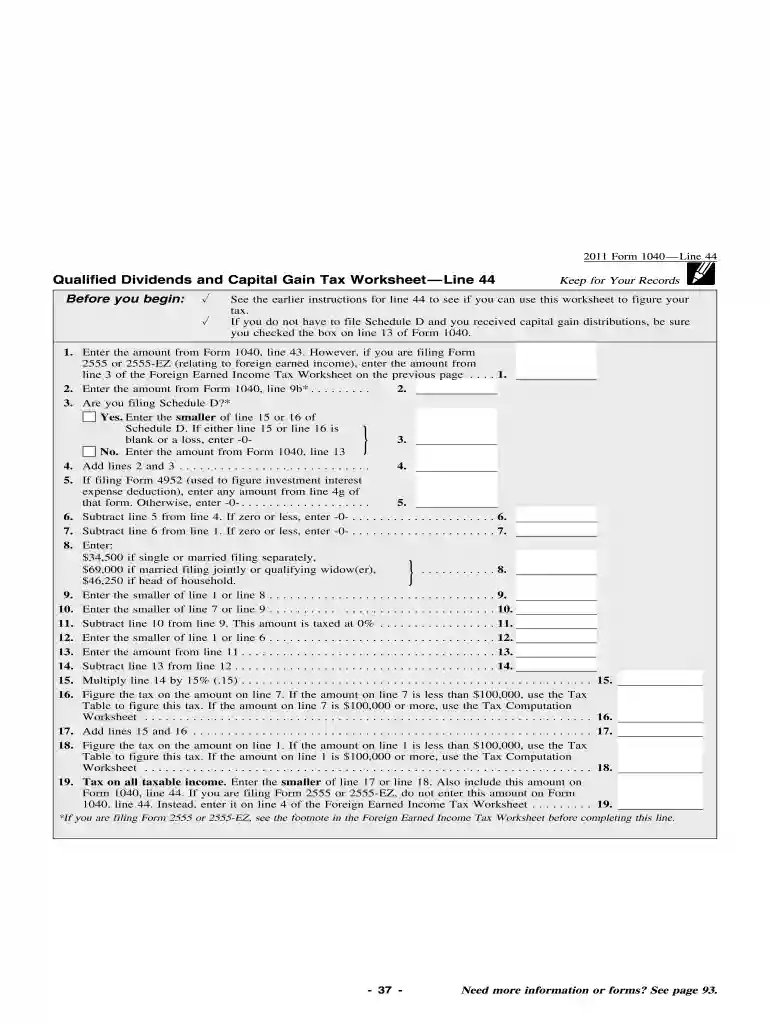
The IRS Capital Gains Worksheet 2011 Form is an essential tool for taxpayers required to calculate the tax owed on qualified dividends and capital gains. This worksheet is part of the 2011 Form 1040 and is crucial for determining the taxpayer's tax liability when capital gains are present. Capital gains refer to the profit realized from the sale of a capital asset, such as stocks, bonds, or real estate, and this worksheet helps to ensure accurate tax calculations by aligning with IRS regulations.
Taxpayers who experienced capital gain transactions in 2011 need this worksheet to properly report their income. The form captures various components of a taxpayer's income, such as gains from investments and dividends, and applies the correct tax rate to these gains. The rates often differ from ordinary income tax rates, making the accurate use of this worksheet critical to compliance and minimizing tax liabilities.
Determine Total Capital Gains and Losses: Collect all records of sales or exchanges of capital assets in 2011. Include the cost basis and sale price to calculate gain or loss.
Enter Data on Form 1040: Begin by transferring the calculated capital gains and losses to the appropriate lines on Form 1040.
Use Schedule D: If applicable, details of capital gain transactions should be reported on Schedule D. This serves as a summary that feeds into the worksheet.
Calculate Tax Using the Worksheet: The worksheet includes calculations for different tax rates applicable to various capital gains, ensuring you apply rates correctly based on transaction type.
Account for Qualified Dividends: Incorporate any dividends that qualify for preferred tax rates using the worksheet.
Complete Line 44 of Form 1040: Once all computations are finalized, the worksheet should guide the completion of Line 44, reflecting the correct amount of tax due on capital gains and dividends.
Primarily, individual taxpayers who have engaged in activities yielding capital gains, such as the sale of stocks, bonds, or real estate, will use this form. Real estate investors, stock market participants, and retirement account holders may also commonly utilize this worksheet to determine taxes on dividends and gains.


The IRS Capital Gains Worksheet 2011 Form is designed to comply with IRS tax regulations for the 2011 fiscal year. It is vital for taxpayers using the worksheet to adhere to these guidelines to avoid penalties or interest. Detailed instructions provided with Form 1040 are intended to assist taxpayers in proper completion.
The IRS Capital Gains Worksheet 2011 Form and related Form 1040 components can be submitted through various methods:
Software platforms such as TurboTax and QuickBooks support the completion of Form 1040 and related worksheets, including the IRS Capital Gains Worksheet 2011 Form. These tools provide step-by-step guidance and can import data from related financial records to facilitate the filing process.
Failing to report capital gains or filing incorrect information on the IRS Capital Gains Worksheet 2011 Form can result in penalties. Potential consequences include interest on underpaid taxes and late filing fees. Accurate reporting is crucial for maintaining compliance with IRS regulations.
We've got more versions of the qualified dividends and capital gains worksheet 2023 form. Select the right qualified dividends and capital gains worksheet 2023 version from the list and start editing it straight away!
Electronic signatures are a great alternative to traditional signing, as they save time, effort, and money people spend on printing, scanning, and paper delivery. You can electronically sign your 2023 qualified dividends and capital gains worksheet using a trustworthy and powerful online document management services like DocHub. It complies with major eSignature regulations (ESIGN and UETA), so all forms approved there are legally binding and have the same validity as manually signed ones.
You can get and modify your qualified dividends and capital gain tax worksheet 2023 online with the help of DocHub. Its straightforward yet feature-rich design enables you to start productive work immediately after you register your account. Create your account and add your file, and then our interface will guide you via our stress-free form completion experience.
At DocHub, your data security is our priority. We follow HIPAA, SOC2, GDPR, and other standards, so you can work on your documents with confidence.
If you had a capital gain excess, complete a second 2011 Qualified Dividends and Capital Gain Tax Worksheet or 2011 Schedule D Tax. Worksheet (whicheverRead more
Dec 6, 2017 Individuals can get a refund by filing. Form 1040X, Amended U.S. Individual. Income Tax Return, instead of Form. 1045. An estate or trust canRead more
Complete Form 1040 through line 43, or Form 1040NR through line 41. Then complete the Qualified Dividends and Capital Gain Tax Worksheet in the instructions forRead more


