




01. Edit your cmr form online
Type text, add images, blackout confidential details, add comments, highlights and more.

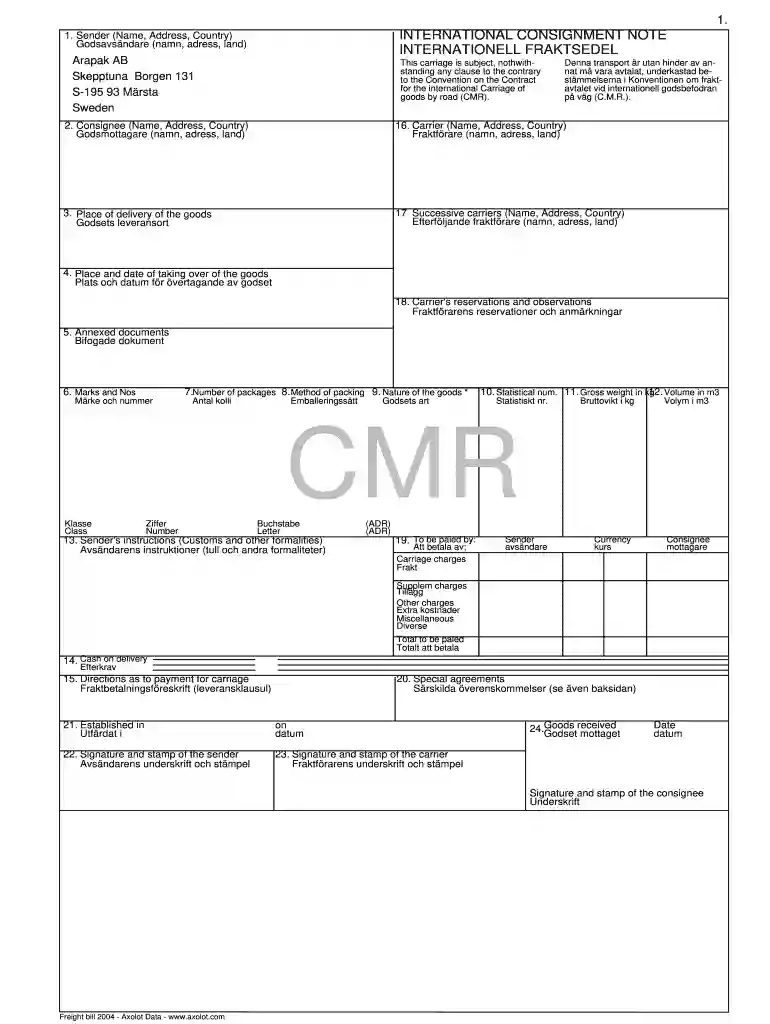
Type text, add images, blackout confidential details, add comments, highlights and more.

Draw your signature, type it, upload its image, or use your mobile device as a signature pad.

Send cmr template via email, link, or fax. You can also download it, export it or print it out.
The CMR blank refers to the International Consignment Note, which is critical for the road transport of goods internationally. This document comprehensively outlines the details of the shipment, including pertinent information about the sender, consignee (receiver), carrier, and the delivery location.
The CMR blank is essential under the CMR Convention, which governs the carriage of goods by road between European and other countries. The document serves multiple functions:
Understanding the CMR blank is crucial for professionals involved in international trade, logistics, and transportation, ensuring compliance with regulatory requirements while facilitating efficient, legally binding shipping practices.
Using the CMR blank effectively requires understanding its structure and the necessary steps to fill it out. Follow this guide to ensure proper use:
Prepare the Required Information: You need to gather details about all parties involved:
Complete the CMR Blank: Fill out the document accurately, addressing the following sections:
Signing the Document: Once completed, the sender and the carrier must sign the CMR blank to validate the agreement. This step is essential to confirm acceptance of the cargo and terms stipulated in the document.
Retain Copies: It is advisable to keep copies of the CMR for record-keeping, potential claims, or legal matters.
Utilize for Customs: Make sure to provide the CMR blank to customs as it serves as proof for customs clearance processes when crossing international borders.
Using the CMR blank correctly is vital for smooth logistics operations and ensuring adherence to legal standards.
Filling out the CMR blank accurately is essential for the effective transportation of goods. Follow these steps for completion:
Header Section: Begin by filling in the header with the document title "CMR – International Consignment Note".
Sender and Consignee Details:
Carrier Information: Provide the carrier's name, contact details, and address. This section identifies the party responsible for transportation.
Goods Details:
Transport Instruction: Indicate the mode of transportation (e.g., road) and any specific routing preferences.
Signatures: Include the signatures of both the sender and carrier. This is a critical legal component as it illustrates agreement on the terms of the consignment.
Additional Fields: Complete any other required sections, such as instructions for clearance, and ensure all signatures are dated appropriately.
Following these steps provides a thorough and compliant CMR blank, facilitating smoother logistics processes.
The CMR blank is a cornerstone document for businesses engaged in international goods transport. Here are key reasons to utilize it:
Utilizing the CMR blank is essential for safeguarding interests, optimizing transport efficiency, and ensuring compliance with international shipping regulations.
Familiarity with specific terms associated with the CMR blank can enhance understanding of its usage and implications in road transport:
Understanding these terms allows individuals and businesses to navigate the complexities of international shipping more effectively.
When completing a CMR blank, several key elements must be accurately represented to ensure the document serves its purpose effectively. Here are the primary components:
Having all relevant information filled accurately prevents misunderstandings and allows for efficient processing through customs and during transit.
Practical examples illustrate the importance of the CMR blank in various scenarios:
Cross-Border Shipment: A company based in the United States exporting machinery to Germany would complete a CMR blank to ensure legal clarity during the journey. This document includes details about the machinery type, weight, and any special handling instructions.
Multi-Party Involvement: A logistics firm transporting goods on behalf of multiple clients must ensure each shipment is accompanied by a properly filled CMR blank. Each client’s shipment can have distinct requirements, and a well-completed CMR ensures compliance and expedites each delivery.
Dispute Resolution: If goods arrive damaged, the CMR blank serves as crucial documentation. It provides evidence of agreement on condition and handling instructions, significantly aiding the claims process with insurers or involved parties.
These examples emphasize the operational significance of the CMR blank in facilitating international trade and preventing potential disputes.
We've got more versions of the cmr form form. Select the right cmr form version from the list and start editing it straight away!
| Versions | Form popularity | Fillable & printable |
|---|---|---|
| 2004 | 4.9 Satisfied (36 Votes) |
At DocHub, your data security is our priority. We follow HIPAA, SOC2, GDPR, and other standards, so you can work on your documents with confidence.
Copyright 1993 by George De Leon, Ph.D., Director Center for Therapeutic. Community Research (CTCR), 2 World Trade Center, 16th Fl., New York, NY 10048. All.Read more
Dec 8, 2023 Register #1510, 12/8/2023). Page 2. 248 CMR: BOARD OF STATE EXAMINERS. OF PLUMBERS AND GAS FITTERS. 10.02: continued. (4) Principle 4: WaterRead more
Blank characters inserted between parameters, values, and symbols are allowed and ignored. For example, specifying: FORMDEF = F1TEMP. PAGEDEF = P1PROD.Read more


