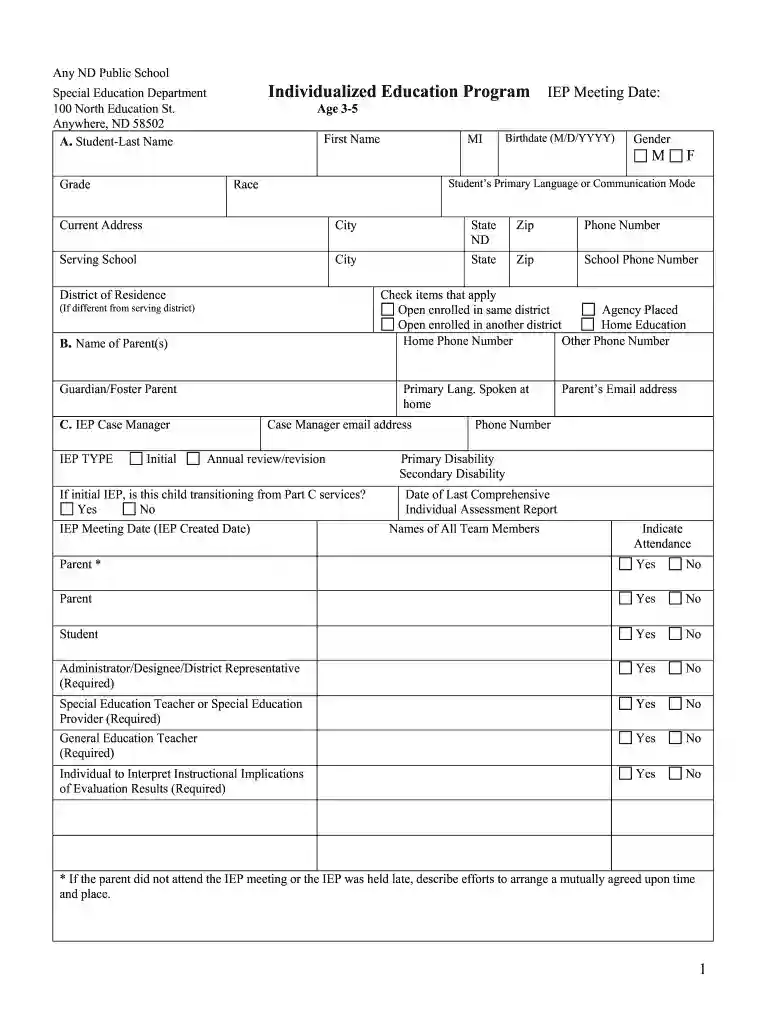
Blank iep template 2026

Get Form
iep examples pdf Preview on Page 1

Here's how it works

01. Edit your iep examples pdf online
Type text, add images, blackout confidential details, add comments, highlights and more.

02. Sign it in a few clicks
Draw your signature, type it, upload its image, or use your mobile device as a signature pad.

03. Share your form with others
Send iep template pdf via email, link, or fax. You can also download it, export it or print it out.

Definition and Meaning of a Blank IEP Template

A blank Individualized Education Program (IEP) template serves as a foundational document for detailing the specific educational needs and goals of students with disabilities. It is designed to outline individualized support and resources to ensure these students can achieve academic success in a manner tailored to their unique requirements. The template includes critical components such as student information, relevant disability categories, present levels of performance, annual goals, specific services and accommodations, and progress monitoring strategies.

The IEP template is not just a formality; it adheres to federal guidelines under the Individuals with Disabilities Education Act (IDEA), which mandates that schools create tailored educational plans for eligible students. This legally binding document ensures that the student receives the necessary services and supports, fostering an environment conducive to their learning and development.

Key Elements of the Blank IEP Template

Several essential components should be included in a blank IEP template to ensure comprehensiveness:

  • Student Information: Personal details such as name, date of birth, and identification numbers.
  • Present Levels of Academic Achievement: An overview of the student’s current performance in various subjects or areas.
  • Annual Goals: Specific, measurable objectives that the student aims to achieve within a year.
  • Special Education Services: Description of the services required, including tutoring, speech therapy, or physical therapy.
  • Accommodations and Modifications: Adjustments to teaching strategies or assessments that cater to the student’s needs.
  • Transition Planning: Strategies to prepare the student for a successful transition to post-secondary education or employment.
  • Progress Monitoring: Methods for assessing the student’s progress towards goals, including timelines for evaluation.

These elements provide a structured approach to ensure that the IEP accurately reflects the support necessary for the student’s academic and personal growth.

Steps to Complete the Blank IEP Template

Completing a blank IEP template involves several clear steps to ensure that all necessary information is included and accurately documented:

  1. Gather Documentation: Collect any existing assessments, reports, and notes from previous meetings that provide insight into the student’s needs.
  2. Fill in Student Information: Enter the student’s details, including name, date, school, and relevant educational codes.
  3. Assess Present Levels: Collaborate with educators, parents, and specialists to outline the student’s current performance in academics and behavioral areas.
  4. Define Annual Goals: Create SMART (Specific, Measurable, Achievable, Relevant, Time-bound) goals that align with the student’s needs.
  5. Specify Services and Accommodations: Identify the special education services required and any accommodations or modifications necessary for the student to access the curriculum effectively.
  6. Develop a Progress Monitoring Plan: Determine how progress towards meeting the goals will be tracked and who will be responsible for monitoring.

By following these steps, the completed IEP template will effectively represent the student’s educational plan, ensuring that all stakeholders understand their roles and responsibilities.

Who Typically Uses the Blank IEP Template

The blank IEP template is utilized by a variety of stakeholders involved in a student’s education. Key users include:

  • Special Education Teachers: They play a pivotal role in developing and implementing IEPs, ensuring that the educational plan aligns with state and federal guidelines.
  • General Education Teachers: These educators must understand the accommodations and modifications specified in the IEP to support the student effectively within the mainstream classroom.
  • Related Service Providers: Professionals such as speech or occupational therapists utilize the IEP to design and deliver appropriate services tailored to the student’s needs.
  • Parents and Guardians: They are essential collaborators in the IEP process, providing insights into their child’s strengths and challenges.
  • School Administrators: They ensure that the IEP complies with educational regulations and that resources are allocated appropriately.

Engaging each of these parties in the IEP process fosters a supportive environment where students with disabilities can achieve their full potential.


decoration image ratings of Dochub

Legal Use of the Blank IEP Template

The blank IEP template must comply with the legal requirements set forth by the Individuals with Disabilities Education Act (IDEA) and state regulations governing special education. Key legal considerations include:

  • Eligibility Determination: Students must meet specific criteria to qualify for special education services, outlined in the IDEA.
  • Parent Involvement: Parents have the right to participate in all IEP meetings and decision-making processes, ensuring their child's needs are adequately represented.
  • Confidentiality Protections: Any information contained within the IEP must be kept confidential and shared only with individuals directly involved in the student’s educational plan.
  • Review and Revision: The IEP must be reviewed at least annually, and it can be revised as necessary if the student’s needs change.

Adhering to these legal requirements not only ensures compliance but also promotes a collaborative approach to effective educational planning.

Examples of Using the Blank IEP Template

Examples illustrate how a blank IEP template can effectively address diverse student needs:

  • Example for a Student with Autism: The IEP may include goals aimed at enhancing social skills, using behavioral therapies, and including accommodations such as extended time on tests or the use of assistive technology to support learning.
  • Example for a Student with Dyslexia: The annual goals might focus on improving reading fluency and comprehension. Accommodations could include the use of audiobooks and specialized reading programs.
  • Example for a Student with ADHD: The IEP can specify strategies for managing attention difficulties, such as seating arrangements that minimize distractions and the provision of frequent breaks during lessons.

These examples demonstrate the flexibility of the IEP template in catering to individual student profiles and their unique educational requirements.

be ready to get more

Complete this form in 5 minutes or less

Get form

Got questions?

We have answers to the most popular questions from our customers. If you can't find an answer to your question, please contact us.
Contact us

You need to use only trustworthy software solutions with strong data protection compliance to approve your documents electronically. DocHub is just the type of software you need! It stores data on Amazon Web Servers and complies with all essential security standards and eSignature regulations, so it’s a reliable way to electronically sign your blank iep template pdf or other forms with this tool.

You can find and modify your blank iep template online with the help of DocHub. Its simple yet feature-rich design allows you to begin effective work immediately after you sign up your account. Create your profile and add your document, and then our interface will guide you via our stress-free form completion experience.

The three parts of an IEP goal: current level of performance, specific and measurable goal, and service delivery all need to support each other.
How to write an effective IEP Step 1: Define the learning team. Step 2: Present levels of academic achievement, functional performance, strengths, and needs. Step 3: Set goals. Step 4: Understand accommodations and modifications, and decide how to use them.

Security and compliance

At DocHub, your data security is our priority. We follow HIPAA, SOC2, GDPR, and other standards, so you can work on your documents with confidence.

Learn more
ccpa2
pci-dss
gdpr-compliance
hipaa
soc-compliance

People also ask

An Individualized Education Plan (or Program) is also known as an IEP. This is a plan or program developed to ensure that a child with an identified disability who is attending an elementary or secondary educational institution receives specialized instruction and related services.
An IEP is a legal document written to ensure success, as well as an equitable learning experience. It needs to be reflective of the students strengths and need areas, with goals that set high expectations and allow for appropriate accommodations and modifications.
Tips for Writing a Successful IEP Craft a Strong PLAAFP Statement. Develop Ambitious, Observable and Measurable Goals. Focus on the Service Details: Special Education, Related and Supplementary Services. Appoint a Facilitator to Lead the Collaborative IEP Process. Make IEPs Work in Your Classroom.
Some examples of possible IEP goal focus areas identified within the present levels are: Reading comprehension, fluency skills, communication, time-management, self-advocacy, self-regulation, organization, independent travel, interpersonal and social skills, college and career exploration, math skills, fine motor
The three parts of an IEP goal: current level of performance, specific and measurable goal, and service delivery all need to support each other.

iep format for special education