Behavior rating scale template 2025

Get Form
behavior rating scale Preview on Page 1

Here's how it works

01. Edit your behavior rating scale online
Type text, add images, blackout confidential details, add comments, highlights and more.

02. Sign it in a few clicks
Draw your signature, type it, upload its image, or use your mobile device as a signature pad.

03. Share your form with others
Send behavior rating scale adalah via email, link, or fax. You can also download it, export it or print it out.

How to use or fill out behavior rating scale template with our platform

Form edit decoration
9.5
Ease of Setup
DocHub User Ratings on G2
9.0
Ease of Use
DocHub User Ratings on G2
  1. Click ‘Get Form’ to open the behavior rating scale template in the editor.
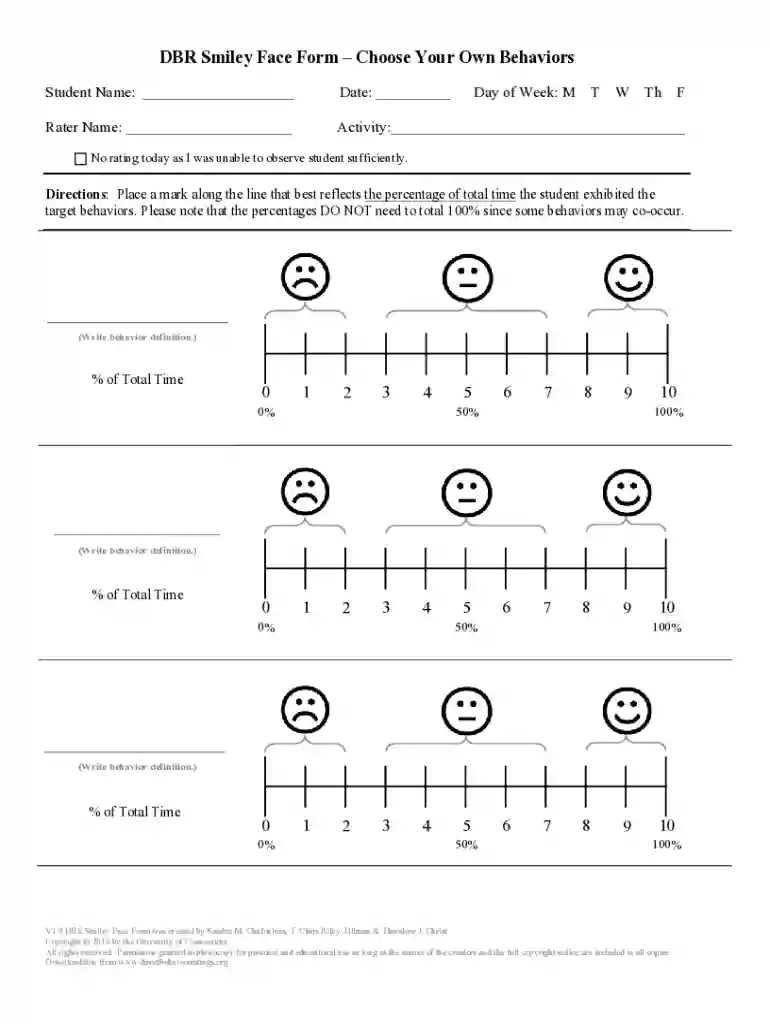
  2. Begin by entering the student's name and date at the top of the form. This ensures that you have a clear record of who is being evaluated and when.
  3. Select the day of the week by marking the appropriate box. This helps in tracking behaviors over time.
  4. Fill in your name as the rater, which adds accountability to your observations.
  5. In the 'Activity' section, describe the context or activity during which you observed the student. This provides clarity on what behaviors are being rated.
  6. For each behavior definition provided, place a mark along the line that best reflects the percentage of total time the student exhibited that behavior. Remember, percentages do not need to total 100%.

Start using our platform today for free to streamline your document editing and form completion!

be ready to get more

Complete this form in 5 minutes or less

Get form

Got questions?

We have answers to the most popular questions from our customers. If you can't find an answer to your question, please contact us.
Contact us

Signing documents on a mobile device is fast, straightforward, and doesn’t require software installation if you have an account with DocHub. Sign in from any browser, fill in your empty fields with your information, and click on Sign → Create your signature. You can draw your eSignature the same way you usually do on paper, add its image to your behavior rating scale template, or type in your name and stylize its look. Whatever option you choose, your documentation will be valid.

When you go for analog methods of completing your behavior rating scales, it is simple to download your file for printing. Search DocHub’s Forms & Templates catalog to locate the exact document template you need and open it for editing or download it on your gadget in the format of your liking. It is possible to complete your form electronically and place your handwritten signature on it right after printing or eSign your document with DocHub.

The Likert scale is an extremely useful rating scale to measure customer opinions. For example, a company may use the Likert scale to determine the effectiveness of its customer support team. They offer respondents the opportunity to respond from Extremely responsive to Not responsive at all.
A behaviorally anchored rating scale is a tool for measuring employee performance by measuring them based on predefined behavioral patterns. The process typically uses a vertical scale with ratings ranging from five to nine that represent various degrees of performance, from poor to very good.
Developing a Behaviorally Anchored Rating Scale (BARS) involves several steps. Step 1: Identify Critical Behaviors. Step 2: Develop a List of Performance Dimensions. Step 3: Generate Behavioral Anchors. Step 4: Conduct a Validation Study. Step 5: Train Raters. Step 6: Implement the BARS.

Security and compliance

At DocHub, your data security is our priority. We follow HIPAA, SOC2, GDPR, and other standards, so you can work on your documents with confidence.

Learn more
be ready to get more

Complete this form in 5 minutes or less

Get form

People also ask

Behavior rating scales are defined as assessment tools that measure childrens self-regulation, attention, task completion, and self-control, typically through teacher ratings in educational settings. These scales are supported by evidence of strong reliability and validity across diverse samples of young children.
Tips for designing a rating scale Some basic goals. Use a limited number of scale points. Always include a middle or neutral alternative in the middle. Display answers in order. A clear description of what each of the answers means on the scale. What to keep in mind.
Examples of behavior rating scales include the Achenbach Scales, the Conners instruments, the Behavior Rating Profile (BRP-2), the Burks Behavior Rating Scales (BBRS), and the Behavior Assessment System for Children (BASC-2).

behaviour rating scale