




01. Edit your abc data sheet checklist online
Type text, add images, blackout confidential details, add comments, highlights and more.

Type text, add images, blackout confidential details, add comments, highlights and more.

Draw your signature, type it, upload its image, or use your mobile device as a signature pad.

Send printable abc data sheet checklist via email, link, or fax. You can also download it, export it or print it out.
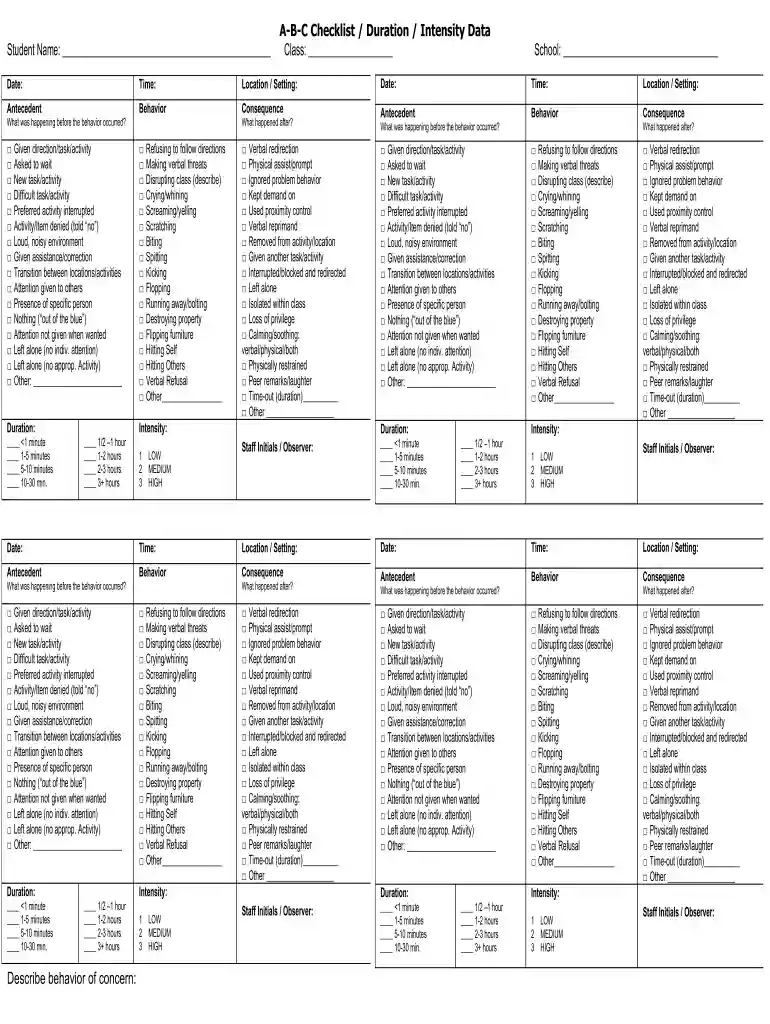
The ABC data sheet checklist, often referred to as an ABC checklist, is a structured tool used to track behavior in educational and behavioral settings. It focuses on three key components: Antecedent, Behavior, and Consequence, thereby allowing educators, therapists, and caregivers to document specific incidents of behavior alongside their context and outcomes. This systematic approach provides a framework for analyzing behavioral patterns to inform interventions and support strategies that can enhance a person's learning or behavioral adjustment.
Antecedents: These are events or circumstances that occur before a behavior. Understanding what triggers specific behaviors can help in addressing and modifying them effectively. For example, if a student tends to disrupt the class when they are seated near a friend, the seating arrangement may need to be reassessed.
Behavior: This refers to the actual actions exhibited by the individual. Accurate documentation of behavior is crucial for effective analysis. For instance, noting the frequency, duration, and intensity of a behavior can help educators develop responsive strategies that are tailored to the student's needs.
Consequences: These are the responses that follow the behavior, which can reinforce or deter the behavior from occurring again. For example, if a student is given a reward for completing an assignment, this positive reinforcement could encourage similar future behavior.
To fully leverage the potential of the ABC data sheet checklist, users should engage in a systematic process of filling out the form. This involves:
Gathering Initial Context: Start by documenting the antecedents—identify what happens before the behavior occurs. This could involve observing the environment or interactions that may influence the behavior.
Behavior Documentation: Carefully record the observed behavior using specific, clear language. Avoid generalizations; instead of stating "the student acted out," describe the behavior with precision, such as "the student yelled during the group work."
Analyzing Consequences: After noting the behavior, it’s essential to document the immediate consequences. Identify whether the response was reinforcing or punitive and how it affected the behavior in the future.
Reviewing Data Regularly: Periodically analyze the collected data for patterns or trends. Look for recurring antecedents, typical behavioral responses, and the effectiveness of consequences used, as this will inform the necessary adjustments in intervention strategies.
Educational Settings: Teachers may use the ABC data sheet to track student behavior in the classroom, helping to tailor instructional strategies that meet individual needs.
Behavioral Therapy: Therapists can utilize this checklist to document and assess behaviors over time, aiding in the development of more effective treatment plans.
Parenting: Parents may employ the ABC data sheet to monitor their child’s behaviors at home, helping them respond with appropriate techniques that promote positive behavior changes.
When designing or selecting an ABC data sheet template, several key elements should be considered:
User-Friendly Layout: The form should allow for easy data entry, with sections clearly labeled for antecedents, behaviors, and consequences.
Scalability: It should be printed or digital in format, enabling users to fill out multiple sheets if necessary, supporting thorough ongoing data collection.
Reporting Features: If possible, the checklist should integrate with data analysis software or have built-in features for summarizing trends over specific time periods, aiding in quick analysis.
Compatibility: Ensure the ABC data sheet is easily transferable between formats (PDF, print, etc.), allowing for maximum flexibility in usage.
Recognizing the advantages and limitations of both formats can enhance decision-making for users:
Printable Formats: Printed ABC data sheets are beneficial for in-person observations, allowing hassle-free use in classrooms where digital devices may not be accessible. However, they lack the instantaneous data analysis capabilities.
Digital Formats: Digital versions, such as those in PDF or web-based applications, facilitate easier data sharing and analysis. They can often include features like filtering and sorting, making it easier to identify behavioral trends. Also, they provide backup options to protect against data loss.
In a classroom, a teacher implements the ABC data sheet checklist to address a student's disruptive behavior during lessons. By meticulously tracking instances where the student interrupts, the teacher can identify common triggers, such as a lack of engaging activities or peer interactions. With this information, tailored strategies, like differentiated instruction, can be developed to maintain the student’s attention and reduce disruptive behavior.
A behavioral therapist utilizes the ABC checklist during sessions with a client exhibiting anxiety-driven avoidance behaviors. By consistently filling out the ABC data sheet, the therapist can gather profound insights about the antecedents leading to these behaviors. This information is leveraged to create a more effective, individualized support plan that addresses the unique needs of the client.
Using the ABC data sheet checklist provides valuable insights into behavioral patterns, which are critical in educational and behavioral contexts. By meticulously tracking antecedents, behaviors, and consequences, practitioners can make informed decisions that facilitate effective interventions and support strategies, ultimately leading to positive behavioral outcomes.
At DocHub, your data security is our priority. We follow HIPAA, SOC2, GDPR, and other standards, so you can work on your documents with confidence.
ABC data can be done in narrative form or via checklists. This data collection helps in developing effective interventions aimed at reducing or eliminating theRead more
ABC Chart for Function Based Thinking. Date. Time. Activity. Antecedent. Behavior. Consequence. Purpose of. Behavior. Page 2. Purpose of Behavior. Each day, aRead more
Jul 20, 2021 The purpose of the interconnection is to deliver the XYZ database to. Organization Bs Data Analysis Department and to deliver the ABC databaseRead more


