






Definition and Meaning of the 172 Weight Balance Form
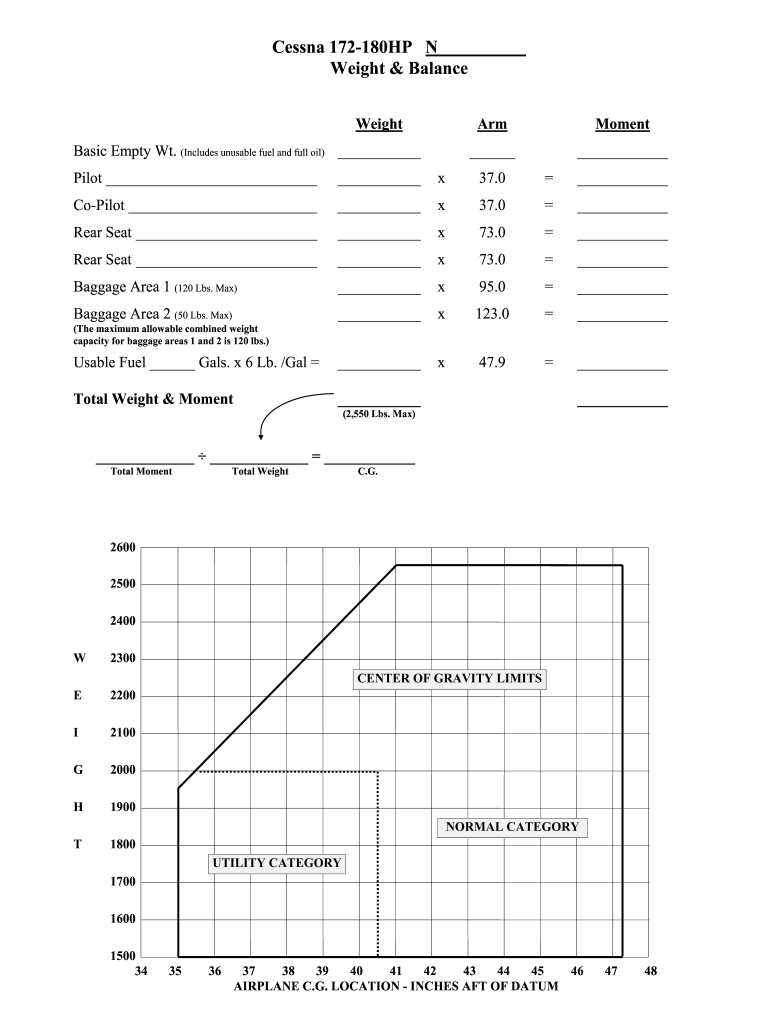
The 172 weight balance form is a critical document used in aviation to ensure the proper loading of a Cessna 172 aircraft. This form serves to calculate the weight and balance of the aircraft, defining the overall loading parameters necessary for safe flight operations. It provides essential data regarding the aircraft's maximum allowable weight limits, including empty weight, pilot and passenger weights, baggage limitations, and fuel calculations.
Understanding weight and balance is crucial in aviation, as it affects the aircraft's center of gravity (CG) and stability. The form assists pilots in adhering to a range of guidelines set forth by aviation authorities regarding maximum weight capacities and CG locations. Variations in loading can significantly influence aircraft performance, making it imperative for operators to accurately complete and assess the form before any flight.
Key Components of the Weight Balance Form
- Basic Empty Weight (BEW): This is the weight of the aircraft without any usable fuel or payload.
- Maximum Gross Weight: The highest weight limit for safe aircraft operation, including passengers, baggage, and fuel.
- Moment Calculation: It considers the distribution of weight within the aircraft, which is essential for determining the CG.
- Load Limits: A clear indication of the maximum weight that can be placed in each baggage area to maintain safety protocols.
How to Use the 172 Weight Balance Form
Using the 172 weight balance form requires a systematic approach to ensure that all necessary data is accurately captured. The following steps outline a typical process for effectively utilizing the form:
-
Gather Required Information: Collect details on the aircraft's basic empty weight, the weight of each passenger, baggage, and fuel. Ensure that all weights are within permissible limits.
-
Fill in Weight and Moment Information: Enter the weight and corresponding moment values for all components, including the pilot, passengers, baggage, and fuel quantity. These calculations help ascertain the overall loading configuration.
-
Calculate Total Weight and Moment: Sum the total weight and moment to find the overall weight of the aircraft. This includes all individuals and items aboard.
-
Determine the Center of Gravity: Use the weight and moment data to compute the CG of the aircraft. This is critical for confirming that the CG remains within specified limits stated by the aircraft manufacturer.
-
Review and Finalize: Ensure all entries are accurate, and the total weight does not exceed the maximum gross weight. The final review is essential for ensuring safety.
Example Calculation Procedure
- If the basic empty weight is 1,600 pounds, you might have:
- Pilot weight: 180 pounds
- Passenger weight: 160 pounds
- Baggage weight: 50 pounds
- Fuel (usable): 40 gallons (potentially 240 pounds assuming 6 lbs/gallon)
After entering these values, calculate the total weight and moment accordingly, ensuring that the CG lies within safe limits for flight.
Steps to Complete the 172 Weight Balance Form
Completing the 172 weight balance form can be straightforward when following these organized steps:
-
Collect Weight Information:
- Input the aircraft’s basic empty weight.
- Record individual weights for each occupant and any baggage.
-
Estimate Fuel Weight:
- Calculate the weight of the fuel based on the quantity of fuel filled, considering that common aviation fuel weighs approximately six pounds per gallon.
-
Complete Calculation Chart:
- Enter these figures into the designated fields on the form that typically include sections for weight and moment calculations, allowing for clear visibility of contributions to the total weight and CG.
-
Review Maximum Weight Limits:
- Check the total weight against the aircraft’s maximum gross weight. This ensures that the aircraft remains compliant with safety regulations.
-
Check CG Limits:
- Verify that the calculated CG falls within allowable limits specified in the aircraft's flight manual.
Who Typically Uses the 172 Weight Balance Form
The 172 weight balance form is primarily utilized by various groups within the aviation sector. These include:
- Private Pilots: Individuals who operate Cessna 172s for personal or recreational flying often complete this form to ensure safe loading.
- Flight Schools: Instructors and students use the form as part of their pre-flight checklist to guarantee compliance with aircraft loading regulations.
- Aircraft Operators: Companies that rent or lease Cessna 172s are required to use the form for flight planning and safety verification.
- Maintenance Technicians: These professionals may reference the form during weight and balance checks, ensuring aircraft integrity before service.


Important Terms Related to the 172 Weight Balance Form
Understanding key terminology associated with the 172 weight balance form enhances clarity and mastery of its use:
- Moment: A measure of the force that causes the aircraft to rotate around its center of gravity, calculated as weight multiplied by the distance from the reference point (arm).
- Center of Gravity (CG): The point where the aircraft’s total weight is thought to act; essential for maintaining stability.
- Useful Load: The total weight designated for the passengers, baggage, and cargo, excluding the aircraft’s empty weight.
- Load Factor: A ratio reflecting the force experienced by the aircraft in relation to its weight, critical for performance assessments.
The precise use of these terms and concepts allows for effective communication within the aviation industry and ensures that all personnel involved are adequately informed about weight and balance considerations.