




01. Edit your dochub extension online
Type text, add images, blackout confidential details, add comments, highlights and more.

Type text, add images, blackout confidential details, add comments, highlights and more.

Draw your signature, type it, upload its image, or use your mobile device as a signature pad.

Send it via email, link, or fax. You can also download it, export it or print it out.
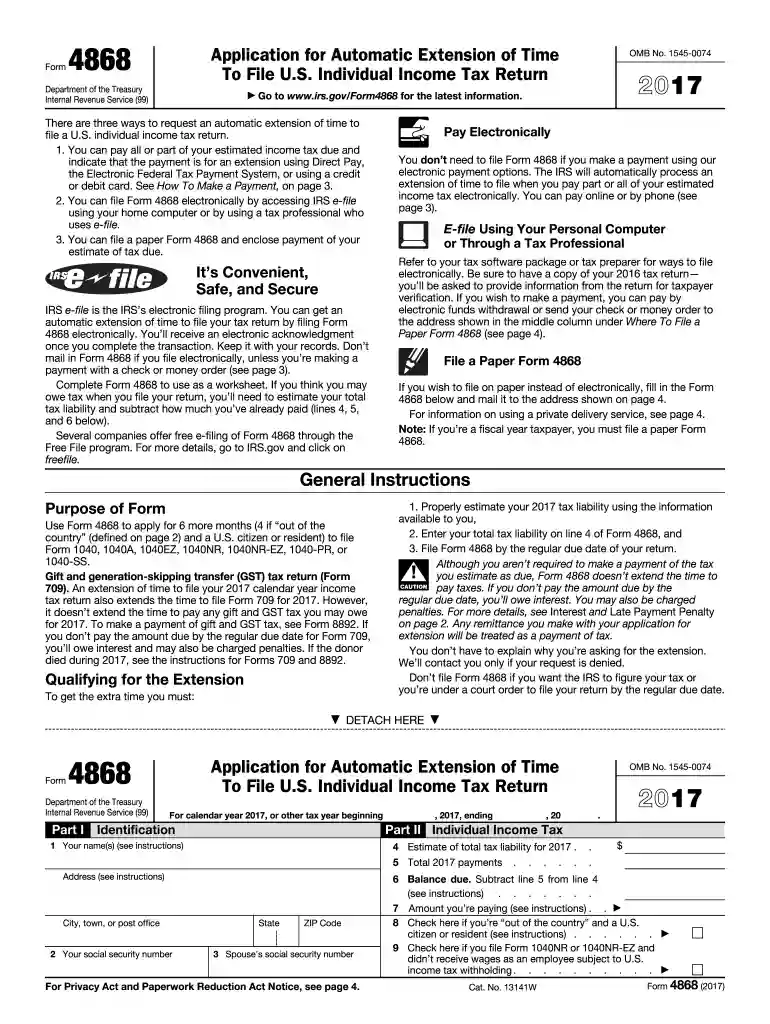
Form 4868, commonly referred to in the context of the "extension form 2017," is an application used by U.S. taxpayers to request an automatic extension of time for filing their individual income tax returns. This form is vital for taxpayers who need more time to gather necessary documents or organize their financial information, thus postponing their filing deadline. However, it's important to note that while Form 4868 grants an extension to file the paperwork, it does not extend the deadline for paying any taxes owed. The payment remains due by the original tax filing deadline.
Acquiring Form 4868 is a straightforward process. Taxpayers can download a digital version directly from the Internal Revenue Service (IRS) website. Alternatively, physical copies of the form can be found at most local libraries or post offices. For those who prefer digital solutions, tax preparation software such as TurboTax and QuickBooks also offer integrated options to file the extension electronically. This ensures accessibility and convenience, allowing taxpayers to choose the method that best fits their needs and preferences.
Completing Form 4868 involves several key steps to ensure all necessary information is accurately provided. Taxpayers should:
After completing the form, retain a copy for personal records and submit it via the chosen method—either electronically or via mail.
Utilizing Form 4868 offers several advantages, primarily allowing additional time without incurring late filing penalties. This can be particularly beneficial for individuals facing unexpected circumstances, such as medical emergencies, requiring more time to compile necessary documentation. It also helps taxpayers avoid the rushed filing that can lead to errors or omissions, potentially leading to more significant issues with the IRS.
Understanding specific terms associated with Form 4868 is essential for proper filing. Common terms include:
Recognizing these terms can enhance comprehension and accuracy when filing.
Form 4868 serves a legal purpose by providing the taxpayer with an official extension to file their tax return, as defined by the IRS guidelines. However, it is crucial that the taxpayer accurately estimates their tax liability and pays any amount due to avoid incurring interest or penalties. This form is compliant with the U.S. tax code, providing a heavy emphasis on accuracy and timely submission to ensure adherence to legal obligations.
The IRS provides specific instructions for filing Form 4868, emphasizing accuracy in tax liability estimation and timely submission. Adherence to these guidelines is essential as any misrepresentation or failure to submit can result in penalties or interest on unpaid taxes. Familiarity with IRS requirements can aid taxpayers in avoiding common pitfalls associated with extensions. It’s crucial to ensure that the form and any payments are submitted before the stipulated deadline to maintain compliance.
Ignoring the filing extension or failing to submit Form 4868 correctly can result in significant penalties. Common penalties involve:
Understanding these penalties underscores the importance of correctly filing the extension and managing financial responsibilities timely.
Taxpayers have the option to file Form 4868 either digitally or by paper. Digital filing is often praised for its convenience and speed, allowing immediate confirmation of receipt by the IRS. It also supports integration with tax preparation software, streamlining the process. Conversely, paper filing may suit those who prefer traditional methods or lack access to digital facilities. Each format has distinct features, and taxpayers should choose based on personal preference and technology accessibility.
We've got more versions of the dochub extension form. Select the right dochub extension version from the list and start editing it straight away!
| Versions | Form popularity | Fillable & printable |
|---|---|---|
| 2024 | 4.9 Satisfied (37 Votes) | |
| 2023 | 4.5 Satisfied (35 Votes) | |
| 2022 | 4.3 Satisfied (36 Votes) | |
| 2021 | 4.8 Satisfied (52 Votes) | |
| 2020 | 4.2 Satisfied (114 Votes) | |
| 2019 | 4.2 Satisfied (38 Votes) | |
| 2018 | 4.4 Satisfied (119 Votes) | |
| 2017 | 4 Satisfied (64 Votes) | |
| 2016 | 4.4 Satisfied (385 Votes) | |
| 2015 | 4 Satisfied (33 Votes) | |
| 2014 | 4.3 Satisfied (56 Votes) | |
| 2013 | 4 Satisfied (61 Votes) | |
| 2012 | 4.2 Satisfied (62 Votes) | |
| 2011 | 4 Satisfied (41 Votes) | |
| 2010 | 4 Satisfied (46 Votes) |
Sign in to your DocHub account and add your extension form 2017 to our editor using one of its upload methods - from your device, cloud storage, secure URL, or your DocHub folders if you have already processed your form before. Open our editor, click the Sign button in the upper toolbar, and choose your signing method. You can upload a picture of your handwritten signature, draw it, type in your name, or use a QR code as an alternative.
If you go for analog ways of completing your extension form 2017, you can easily download your file for printing. Search DocHub’s Forms & Templates catalog to get the exact file template you require and open it for editing or download it on your gadget in the format of your choice. It is easy to complete your form electronically and place your handwritten signature on it after printing or eSign your file with DocHub.
At DocHub, your data security is our priority. We follow HIPAA, SOC2, GDPR, and other standards, so you can work on your documents with confidence.



Please fill in the Return Label at the bottom of this page. 1. I request an extension of time until to file my income tax return for the calendar year 2017,.Read more
Use Form 4868 to apply for 6 more months (4 if out of the country (defined on page 2) and a U.S. citizen or resident) to file. Form 1040, 1040A, 1040EZ,Read more


