




01. Edit your chart audit template online
Type text, add images, blackout confidential details, add comments, highlights and more.

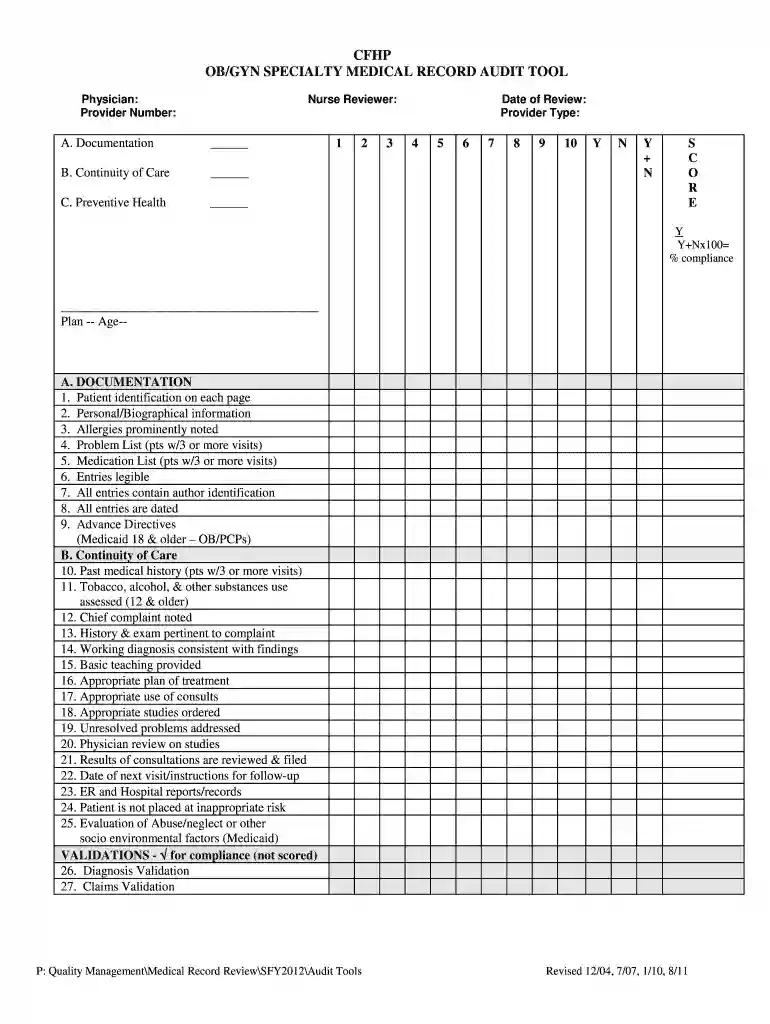
Type text, add images, blackout confidential details, add comments, highlights and more.

Draw your signature, type it, upload its image, or use your mobile device as a signature pad.

Send printable medical chart audit template via email, link, or fax. You can also download it, export it or print it out.
The printable medical chart audit template serves as a structured tool to ensure compliance and quality within healthcare documentation. It is particularly crucial for healthcare professionals auditing patient records to confirm accuracy, completeness, and adherence to established regulations.
The printable medical chart audit template is a vital instrument in optimizing documentation practices within healthcare settings. By providing a framework for systematic review, it helps promote accurate patient records, compliance with legal standards, and enhanced overall quality of care. Regular utilization of this template not only improves efficiencies but also fosters an organizational culture centered on accountability and quality assurance in healthcare documentation.
We've got more versions of the chart audit template form. Select the right chart audit template version from the list and start editing it straight away!
| Versions | Form popularity | Fillable & printable |
|---|---|---|
| 2011 | 4.9 Satisfied (33 Votes) |
Yes, a typed name is recognized as a legitimate electronic signature when you create it on your document utilizing a compliant solution like DocHub. Simply upload your medical chart audit template to our editor, click Sign in the top tool pane → Create your signature → Type your name in the appropriate tab, and decide how it will appear on your document.
Using a swift editing system like DocHub, you do not require anything but a web browser and connection to the internet to edit your nursing chart audit template on the internet swiftly. Add your document or get the appropriate form in DocHub’s catalog, open our editor with one click, and finish it digitally. To revise your forms anytime, sign up a free profile with DocHub.
At DocHub, your data security is our priority. We follow HIPAA, SOC2, GDPR, and other standards, so you can work on your documents with confidence.
Strategies for challenging deliberative process withholdings Records not predecisional Risk of Public Confusion Secret Law Foreseeable harm.Read more
This page is an at-a-glance resource for documentation checklist links. These checklists are helpful guides to compliant medical records.
Instructions for Filling Out the Chart Audit. Medical history. Check all conditions that the patient has listed in their medical record.Read more


