
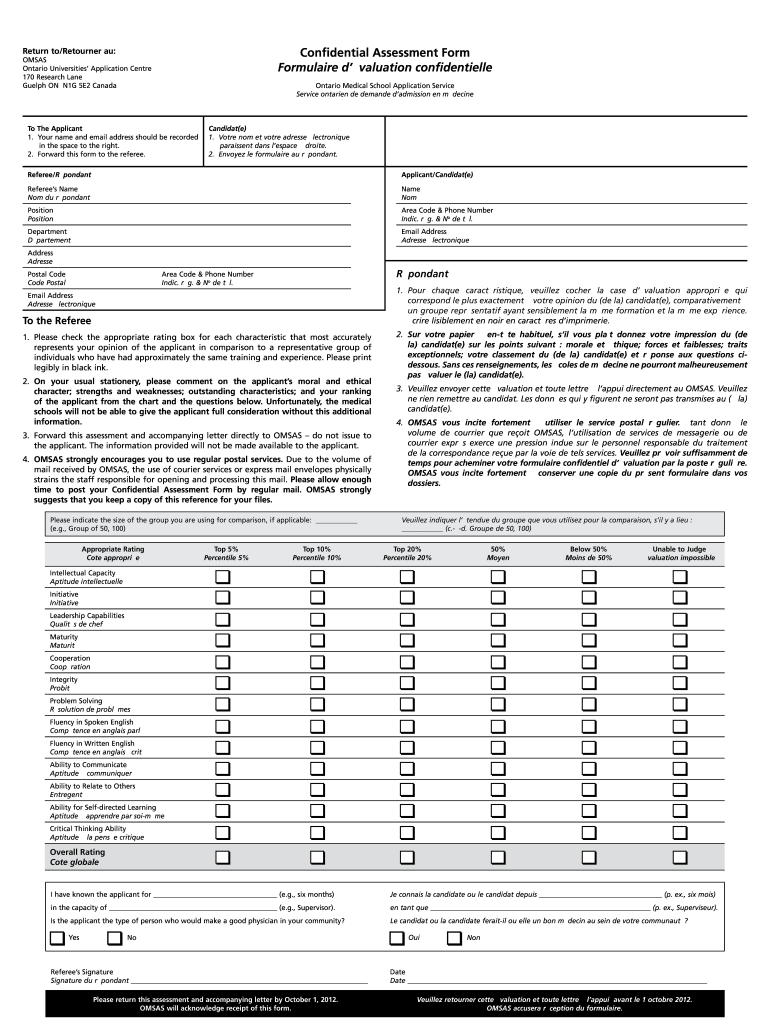







Definition & Meaning of the Confidential Assessment Form
The confidential assessment form, often referred to in the context of applications for programs such as medical schools, is a document designed to gather evaluations from referees about an applicant’s characteristics. Its main purpose is to provide admissions committees with insights into the applicant's moral and ethical character, strengths, weaknesses, and overall suitability for their intended field of study. The emphasis on confidentiality ensures that referees can provide honest and candid assessments, which is critical for evaluating the applicant comprehensively.
Purpose of the Confidential Assessment Form
- Evaluation of Personal Qualities: The form seeks to assess traits such as leadership, empathy, resilience, and teamwork, which are essential for success in fields such as medicine.
- Referee Insights: It allows referees to share their experiences with the applicant, offering anecdotes and examples that reveal the candidate's character beyond mere grades or test scores.
- Confidentiality Assurance: By design, the assessments collected are confidential, enhancing the reliability of the referrals provided without the fear of rebuttal by the applicant.
Typical Components of the Form
The components generally found in a confidential assessment form may include:
- Referee Contact Information: Essential for communication and validation of the assessment provided.
- Rating Scale Sections: Specific traits or competencies evaluated on a predefined scale (e.g., 1 to 5).
- Open-Ended Questions: These allow referees to elaborate on their thoughts regarding the applicant’s skills and character.
- Signature Field: Acknowledging that the referees consent to the sharing of their evaluations with the admissions committee.
How to Complete the Confidential Assessment Form
Completing a confidential assessment form involves careful consideration and attention to detail. For referees, it is important to approach this task with a reflective mindset.
Step-by-Step Instructions
- Read the Instructions Thoroughly: Understand the expectations outlined for completing the form, including deadlines for submission.
- Reflect on the Applicant's Qualities: Consider specific instances that showcase the applicant's strengths and weaknesses—this aids in providing heartfelt evaluations.
- Answer Rating Scale Questions: Assign appropriate scores based on the specified criteria, ensuring that the ratings reflect a fair assessment of the applicant’s abilities.
- Provide Detailed Comments: Use the open-ended sections to elaborate on the scores given; provide context, examples, or anecdotes that illustrate the applicant’s characteristics.
- Review for Clarity: Before submitting, ensure that all responses are clear, concise, and well-articulated, without any vague statements.
- Submit the Form Confidentially: Follow instructions for submitting the form, ensuring it reaches the intended destination securely and by the deadline.
Key Elements of the Confidential Assessment Form
Understanding key elements of the confidential assessment form can enhance the quality and utility of the assessment provided.
- Identification of Referee: The form should state who the referee is, including their qualifications to assess the applicant, which adds credibility to the evaluation.
- Criteria for Assessment: The specific qualities or skills that the committee seeks to learn about, such as ethical reasoning, peer interactions, and academic proficiency.
- Confidential Submission Options: Instructions on how to submit the completed form to maintain confidentiality, typically through a secure online portal or direct mail to the admissions office.
- Rating Scale Clarification: The form may define what different rating levels signify, ensuring referees have a standardized understanding of the scale used.
Example Questions Found on the Confidential Assessment Form
The types of questions included in the confidential assessment form can significantly influence the depth and relevance of the evaluations submitted.
Common Question Examples
- Character Evaluation: "In what ways has the applicant demonstrated integrity in their personal or academic life?"
- Interpersonal Skills: "Describe the applicant's ability to work collaboratively in team settings."
- Critical Thinking: "Can you provide an example of how the applicant approached a challenging situation or problem?"
- Motivation and Drive: "What drives this applicant to pursue a career in this field, based on your observations?"
These questions encourage referees to think critically about their experiences with the applicant and provide substantial insights to the admissions committee.
Legal and Ethical Considerations
Completing a confidential assessment form involves adherence to legal requirements and ethical considerations.
Confidentiality and Privacy
- Data Protection Compliance: Referees must handle the applicant's information sensitively, ensuring compliance with privacy laws.
- Ethical Responsibility: Providing honest evaluations is an ethical obligation. Referees should only provide information they can support with evidence.
Misrepresentation Consequences
Submitting false or misleading information can have severe repercussions, including:
- Rejection of Application: The applicant may face immediate rejection upon discovery of dishonesty.
- Repercussions for Referee: Referees may also face credibility issues if found providing false assessments, impacting future references.
The Importance of Timeliness in Submission
Timely submission of the confidential assessment form is crucial for both the applicant and the referee.
Impacts of Delayed Submissions
- Application Timelines: Delayed submissions can jeopardize the overall application process, leading to missed deadlines for admissions.
- Opportunity for Reflection: Timely submissions allow referees to reflect and refine their assessments without feeling rushed, resulting in more thoughtful evaluations.
Real-world scenarios illustrate that meeting deadlines is often as critical as the content of the evaluation itself, with institutions tightly managing their admissions timelines.




