M 938 map form 2026

Get Form
m 938 Preview on Page 1

Here's how it works

01. Edit your m 938 online
Type text, add images, blackout confidential details, add comments, highlights and more.

02. Sign it in a few clicks
Draw your signature, type it, upload its image, or use your mobile device as a signature pad.

03. Share your form with others
Send m938 via email, link, or fax. You can also download it, export it or print it out.

Overview of the M 938 Map Form

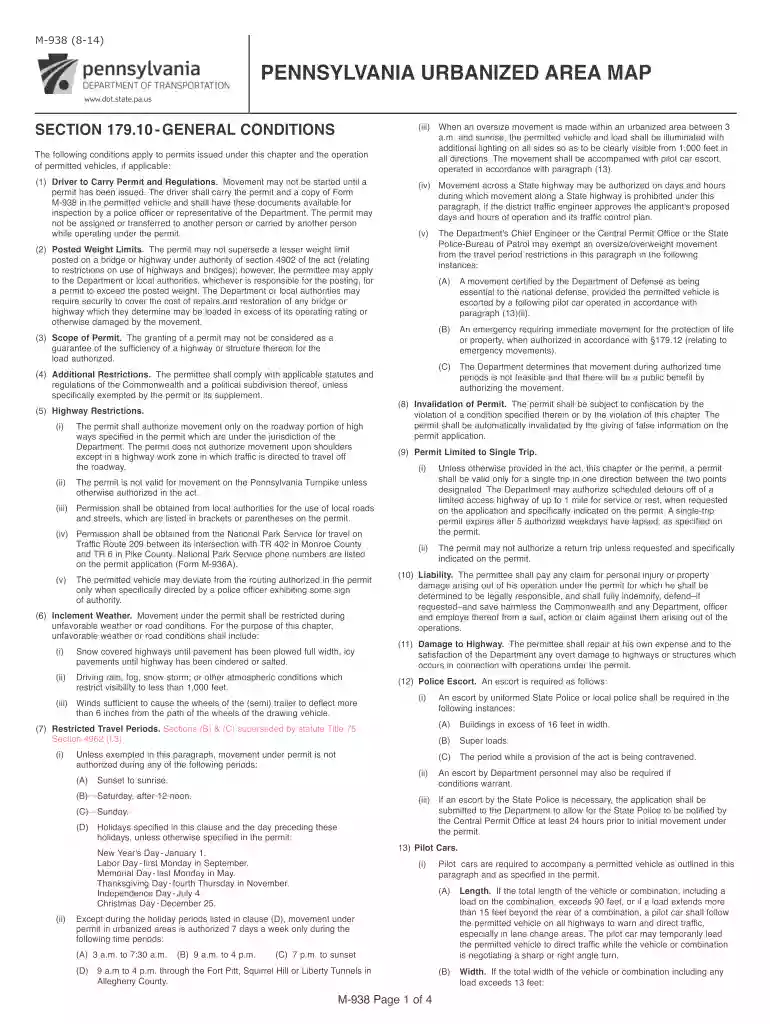
The M 938 map form serves a vital function in the context of managing oversized and overweight vehicles on Pennsylvania roads. This document includes guidelines and specifications critical for ensuring compliance with state regulations. Users must understand its importance in facilitating safe transportation practices while navigating legally permissible routes.

Purpose and Importance of the M 938 Map Form

The purpose of the M 938 map form is to provide a framework for transporting oversized and overweight loads safely across Pennsylvania. When correctly filled out, the form helps transport companies and drivers adhere to state regulations, avoiding potential fines and ensuring road safety. Additionally, it assists in the planning of travel routes that accommodate such loads, minimizing disruption to public highways.

  • Legal Compliance: Utilizes the M 938 map form to ensure compliance with state transportation laws regarding oversized vehicles.
  • Safety: Promotes safe transport practices, reducing risks associated with oversized and overweight vehicles.
  • Route Planning: Enables effective route planning that considers height and weight restrictions and any necessary permits.

Key Elements of the M 938 Map Form

The M 938 map form includes several critical sections and fields that users must navigate carefully. Understanding these elements is essential for accurately completing the form.

  • Header Section: Displays the title "M 938 Map Form" and may include the issuing authority.
  • Vehicle Information: Captures details about the vehicle, including its weight, dimensions, and type.
  • Load Description: Describes the nature of the load being transported, including specifications of oversized or overweight attributes.
  • Route Information: Declares the intended route for travel, including specific roadways or highways that are permissible.

Steps to Complete the M 938 Map Form

Filling out the M 938 Map form involves several systematic steps to ensure all information is correctly captured. This process, which may differ based on specific needs, typically follows these guidelines:

  1. Gather Required Information:

    • Collect vehicle specifications, load details, and route information.
  2. Fill in Vehicle Information:

    • Include details such as the vehicle type, overall dimensions, and registered weight.
  3. Provide Load Details:

    • Clearly outline the characteristics of the load, ensuring that dimensions and weight align with state regulations.
  4. Input Route Information:

    • List all relevant roadways along the planned route, checking for any specific restrictions that may apply.
  5. Review and Submit:

    • Confirm that all entries are accurate and complete before submitting the form to the appropriate authority.

Who Typically Uses the M 938 Map Form?

The M 938 map form is predominantly used by professionals involved in the transportation industry, particularly those dealing with oversized and overweight vehicles.


  • Truck Drivers: Utilize the form to confirm their routes before starting transport.
  • Logistics Managers: Require this form to plan deliveries encompassing oversized items.
  • Regulatory Authorities: Review submitted forms to ensure compliance with state transportation laws.
decoration image ratings of Dochub

Key Terms Related to the M 938 Map Form

Familiarity with specific terms related to the M 938 map form is essential for effective communication and operational success within the transportation sector. Common terms include:

  • Oversized Load: Refers to items that exceed legal size limits specified by the state.
  • Weight Limit: The maximum allowable weight for vehicles and their loads, regulated by state law.
  • Permit: A document granting permission to transport certain types of loads under specified conditions.

Important Considerations for the M 938 Map Form

When using the M 938 form, several important considerations must be kept in mind to avoid legal complications.

  • State Regulations: Users should familiarize themselves with state regulations regarding oversized vehicles, which may differ from one state to another.
  • Renewal of Permits: Ensure that all permits associated with the transportation of oversized loads are up-to-date.
  • Compliance Checks: Be prepared for inspections that may verify the accuracy of information on the M 938 map form.

Examples of Using the M 938 Map Form

The practical application of the M 938 map form can be observed in various scenarios.

  • Transporting Construction Equipment: A construction company requires a M 938 form to legally transport excavators which exceed standard size limits.
  • Deliveries of Modular Homes: Logistics personnel use the M 938 map form to outline safe routes for delivering modular housing units.
  • Agricultural Machinery Transport: Farmers needing to transport large farming equipment utilize the form to remain compliant with Pennsylvania transportation laws.

State-Specific Rules for the M 938 Map Form

Given that the M 938 map form pertains to Pennsylvania, it is essential to recognize that state-specific rules govern its use.

  • Permit Processes: Pennsylvania may have specific processes in place for obtaining permits for oversized loads based on the details provided in the M 938 form.
  • Route Restrictions: Certain roadways may have restrictions on vehicle size or weight, highlighted in the form submission.
  • Fines for Non-Compliance: Understanding the legal ramifications and potential fines for failing to comply with the rules outlined in the M 938 is crucial for users.

By recognizing the importance of the M 938 form and complying with its requirements, individuals and organizations can ensure safer and more efficient operations when transporting oversized and overweight vehicles in Pennsylvania.

See more m 938 map form versions

We've got more versions of the m 938 map form form. Select the right m 938 map form version from the list and start editing it straight away!
Versions Form popularity Fillable & printable
2021 4.8 Satisfied (164 Votes)
2019 4.4 Satisfied (64 Votes)
2014 4.3 Satisfied (49 Votes)
2005 4 Satisfied (35 Votes)
be ready to get more

Complete this form in 5 minutes or less

Get form

Got questions?

We have answers to the most popular questions from our customers. If you can't find an answer to your question, please contact us.
Contact us

Managing your forms with DocHub this way is extremely simple once you have downloaded its extension for Google Chrome. Go to the Chrome Web Store and set up DocHub - Sign PDF from Gmail to get it. Give our tool access to your Google account, and then open an email with the pa m 938 attached and point to the file with your cursor - the DocHub extension key will automatically show up there. Click on it to open your file in our editor. Make any essential adjustments, fill out the blanks, and click Sign to create your legally-binding electronic signature.

If you are using Chrome, there are two simple ways to modify your m 938 form online. First, go to the DocHub site, add your file, and modify it utilizing our toolbar. You can also set up our Chrome extension and modify any document by dragging and dropping it in your web browser window.

Well get the oversize permit you need in just an hour or two.
When hauling oversized items, truck drivers must follow the rules set by the Federal Highway Administration, since permits are mandatory for wide loads and must be obtained from each state the load will pass through. Standard Legal Limits: Width: 8.5 feet (102 inches)
The general rule is that legal vehicle combinations exceeding a gross weight of 80,000 pounds must obtain a transportation permit and that the legal gross weight imposed on a single axle shall not exceed 20,000 pounds.
be ready to get more

Complete this form in 5 minutes or less

Get form

People also ask

Vehicles and loads that exceed legal size or weight limits need an oversize/overweight (OS/OW) permit and route from the TxDMV to travel on Texas roads. Note: You must verify the size and weight limits needed BEFORE seeking a special permit.

form m 938