






Understanding Time Sampling Methodology
Time sampling is a technique utilized primarily in observational studies within various fields, including psychology, education, and behavioral research. It involves systematic observation of subjects at predefined intervals to ascertain behaviors, actions, or events over time. This method allows researchers to collect data in a structured manner, offering insights into patterns and trends that might otherwise go unnoticed.
Defining Time Sampling
Time sampling refers to recording observations of a subject or group at regular intervals. This can take various forms, including momentary time sampling, where the observer notes behaviors at specific time points. The purpose is to create a clear picture of the subject's behavior within a set period.
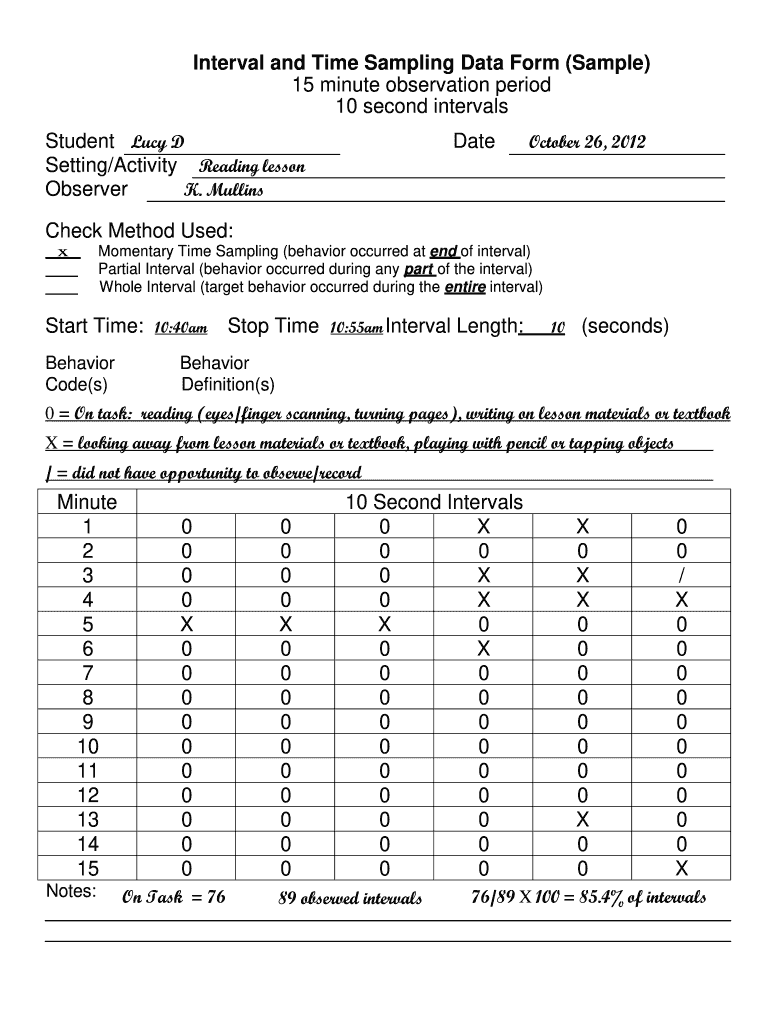
- Momentary Time Sampling: This variant focuses on observation at predetermined moments, capturing the occurrence of specific behaviors during those intervals. For example, if an observer checks every ten seconds, they note whether a subject is on task or engaged in another behavior.
- Continuous vs. Non-continuous Observation: In time sampling, data collection can be continuous (observing every moment) or non-continuous (observing at specific intervals). The choice depends on research goals and resource availability.
Implementing Time Sampling: Steps and Examples
Employing time sampling requires careful planning and execution. Here's a detailed look at how to implement this method effectively.
- Identify the Behavior(s) to Observe: Clearly define what behaviors are of interest. This might include engagement levels, specific actions, or interactions among individuals.
- Choose an Observation Interval: Decide how frequently observations will be made. Common intervals include every ten seconds, one minute, or five minutes, depending on the research focus.
- Record Observations: Use a structured form to document observations. A time sampling recording sheet can assist in capturing data systematically.
- For instance, during a classroom observation, a teacher may record whether a student is engaged, distracted, or off-task every ten seconds during a 15-minute lesson.
- Analyze the Data: After collecting the observations, analyze the data to identify patterns in behavior. The data collected can be presented in percentages or graphs for clearer insights.
Types of Time Sampling Observations
There are several key variations of time sampling, each catering to different research needs:
- Interval Recording: Observations are made within specific intervals, noting whether a behavior occurred during that time frame.
- Frequency Recording: Counts the number of times a behavior occurs during the designated observation period, rather than noting it at specific intervals.
- Duration Recording: Measures how long a specific behavior lasts during the observation.
Practical Application Scenarios
Time sampling is frequently utilized in various contexts. Below are some scenarios highlighting its usefulness:
- Educational Settings: Observers may use time sampling to assess student engagement during lessons, determining how often students interact or focus on tasks.
- Health Research: In studies examining patient activity, researchers may record how frequently patients perform certain exercises in a rehabilitation program.
- Psychological Research: Researchers studying behaviors in social situations may analyze interactions within groups by documenting participant actions at defined time points.
Advantages of Using Time Sampling
Adopting time sampling methodology offers numerous benefits, including:
- Efficiency in Data Collection: Researchers can gather substantial amounts of data in a short period.
- Structured Observations: The systematic approach reduces biases by providing a clear framework for documentation.
- Quantitative Data: Time sampling produces precise, quantifiable data that can facilitate statistical analysis.
Limitations to Consider
While powerful, time sampling does have some limitations:
- Observer Bias: Observers may unconsciously influence the data through their expectations.
- Missed Behaviors: Certain behaviors may not be recorded if they do not occur within the observation intervals.
- Contextual Factors: External factors affecting behavior during observation periods may skew results.
By carefully considering these advantages and limitations, researchers can utilize time sampling effectively to capture a comprehensive view of specific behaviors, contributing significantly to various fields of study.