Art handout 2026

Get Form
art critique form Preview on Page 1

Here's how it works

01. Edit your art critique form online
Type text, add images, blackout confidential details, add comments, highlights and more.

02. Sign it in a few clicks
Draw your signature, type it, upload its image, or use your mobile device as a signature pad.

03. Share your form with others
Send it via email, link, or fax. You can also download it, export it or print it out.

How to use or fill out art handout with our platform

Form edit decoration
9.5
Ease of Setup
DocHub User Ratings on G2
9.0
Ease of Use
DocHub User Ratings on G2
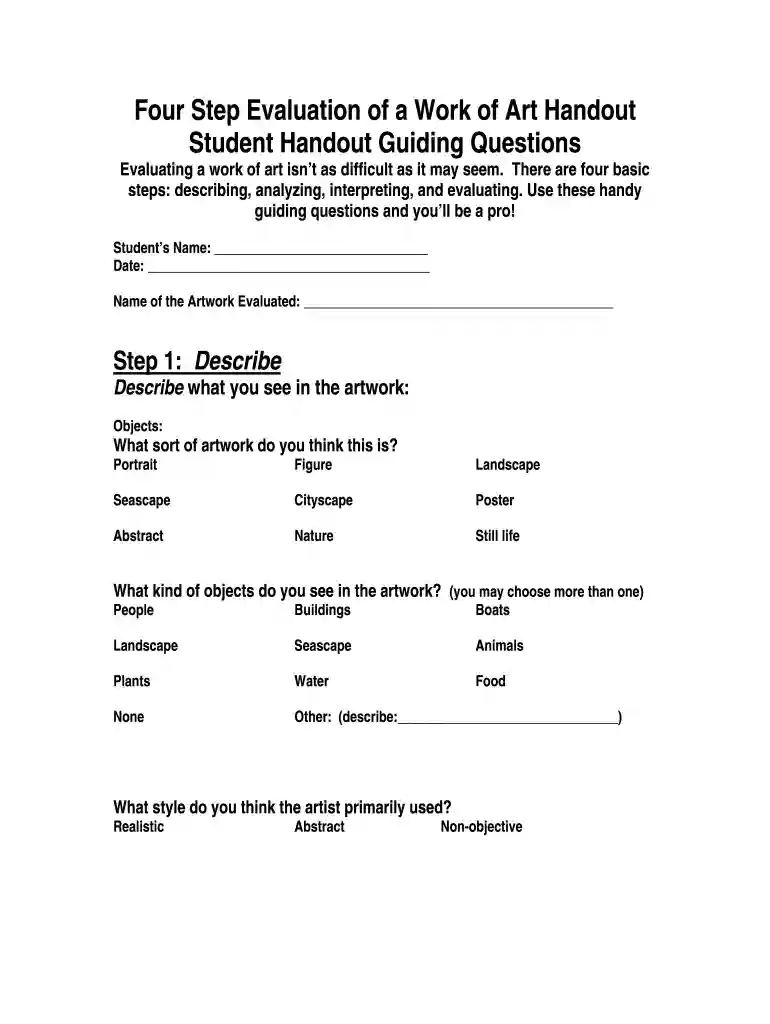
  1. Click ‘Get Form’ to open the art handout in the editor.
  2. Begin by entering your name and the date at the top of the form. This personalizes your evaluation.
  3. In Step 1, describe what you see in the artwork. Select the type of artwork and list any objects present. Use checkboxes for multiple selections.
  4. Move to Step 2 for analysis. Identify lines, shapes, colors, and textures in the artwork. Use descriptive terms from the provided options to articulate your observations.
  5. In Step 3, interpret the meaning behind the artwork. Reflect on its purpose and how it resonates with you personally.
  6. Finally, in Step 4, evaluate your thoughts on the artwork's value. Write a brief narrative that includes both positive perceptions and constructive criticism.

Start using our platform today to enhance your art evaluation experience for free!

be ready to get more

Complete this form in 5 minutes or less

Get form

Got questions?

We have answers to the most popular questions from our customers. If you can't find an answer to your question, please contact us.
Contact us
The five basic shapes in art are the geometric shapes: triangles, squares, rectangles, circles and ellipses. From these five basic shapes you can create other more complex shapes such as polygons or combinations of circles and rectangles.
The rule of thirds means that the subject isnt centered; rather, the main focal point can be to one side or at the top or bottom of the image. Its a tool to help artists draw the viewers eye into the composition, rather than just glancing at the center.
What is the comparative study? COMPARE AND CONTRAST THE WORK OF 3 ARTWORKS, BY AT LEAST 2 ARTISTS, FROM DIFFERENT CULTURAL CONTEXTS. A Comparative Study in art is not an extended essay, it does not have to even be an essay. It is an investigation that strikes a balance between written and visual content.
Collection, community, culture, collaboration, and creativity these are the five Cs of art in design.
Artwork Copyright Laws Legally, you can copy the art of others if youre a skilled artist and want to create a replica for your home. However, selling the painting as if it were an original by that artist is illegal.

Security and compliance

At DocHub, your data security is our priority. We follow HIPAA, SOC2, GDPR, and other standards, so you can work on your documents with confidence.

Learn more
ccpa2
pci-dss
gdpr-compliance
hipaa
soc-compliance

People also ask

Thats why weve identified the Five Cs of Critical Thinking, Creativity, Communication, Collaboration and Leadership, and Character to serve as the backbone of a Highland education.
Weve compiled a list of the best websites offering free images that can be turned into art prints. Unsplash. Dont expect to find any cheesy stock photography here (think, a smiling businessman in suit giving a thumbs up). The Met Museum Collection. Nasa Galleries. Pixabay. Pexels. Kaboompics. Stocksnap. Life of pix.
PRINCIPLES OF ART: Balance, emphasis, movement, proportion, rhythm, unity, and variety; the means an artist uses to organize elements within a work of art.

Related links