Police report template 2026

Get Form
jail release papers pdf Preview on Page 1

Here's how it works

01. Edit your jail release papers pdf online
Type text, add images, blackout confidential details, add comments, highlights and more.

02. Sign it in a few clicks
Draw your signature, type it, upload its image, or use your mobile device as a signature pad.

03. Share your form with others
Send discharge jail release papers pdf via email, link, or fax. You can also download it, export it or print it out.

Definition and Importance of a Police Report Template

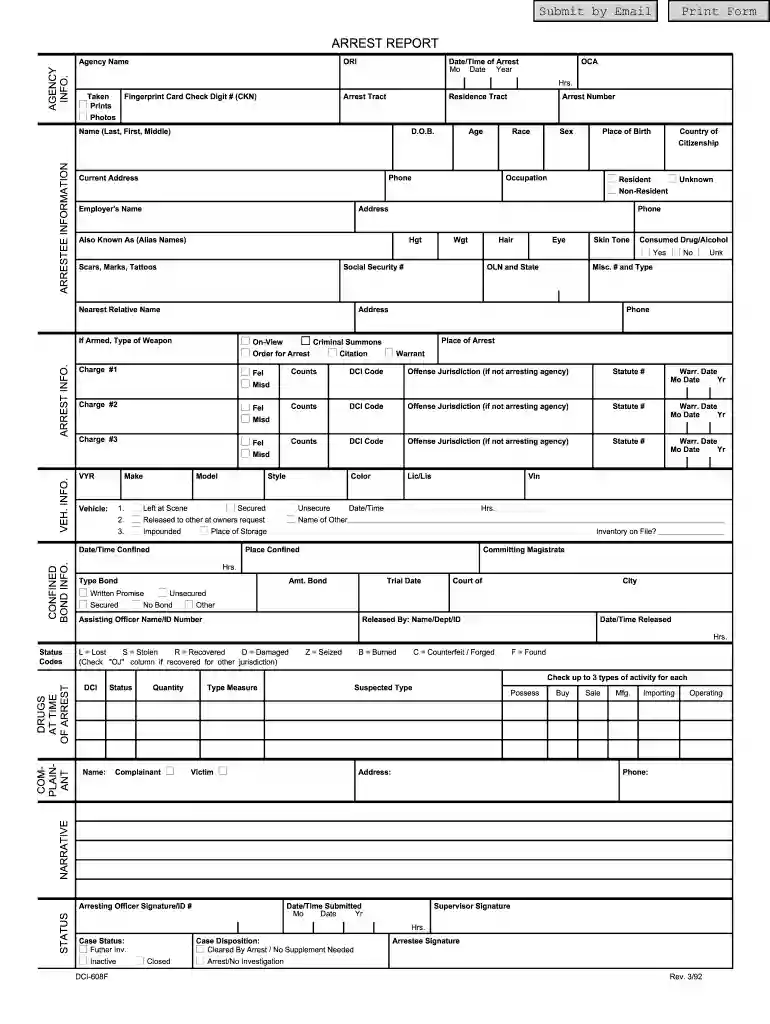
A police report template is a standardized document used by law enforcement agencies to record essential information about incidents, arrests, or any law enforcement engagement. This template serves as a crucial tool in ensuring that all necessary details are documented systematically.

Key Information Captured

  • Incident Details: Date, time, and location of the incident.
  • Involved Parties: Names, addresses, and contact information for victims, witnesses, and suspects.
  • Officer Information: The names and badge numbers of officers responding to the scene.
  • Narratives: Detailed accounts of the events leading to an arrest or incident.

Having a well-structured police report template ensures that all pertinent information is collected, which can be vital in investigations, court proceedings, and maintaining accurate public records. Clear documentation supports the integrity of law enforcement processes and facilitates transparency.

How to Use the Police Report Template

Utilizing a police report template effectively involves several key steps to ensure comprehensive data collection.

Step-by-Step Guide

  1. Access the Template: Obtain a copy of the police report template through your law enforcement agency or its website.
  2. Fill in Basic Information: Enter foundational data including the date, time, and location of the incident.
  3. Document Involved Parties: Record the details of all individuals involved—victims, witnesses, and suspects—using full names and accurate contact information.
  4. Detail the Incident:
    • Provide a timestamped narrative of the events.
    • Include any evidence gathered such as photographs, descriptions of items recovered, or witness statements.
  5. Review and Complete: Thoroughly review the completed report for accuracy before submission.

Best Practices

  • Use clear and concise language to avoid ambiguity.
  • Always ensure the report is factual; opinions or assumptions should be avoided.
  • Make use of available digital tools to streamline the documentation process.

Steps to Complete the Police Report Template

Completing a police report template requires diligence and attention to detail. Below are essential steps to follow:

Detailed Steps

  1. Open the Template: Use a digital format for easy editing or print a blank version if preferred.
  2. Fill Out Incident Information:
    • Date and Time: Enter when the incident occurred.
    • Location: Specify the precise address or location details.
  3. Fill in Officer Information:
    • List the names, badge numbers, and precinct of officers involved.
  4. Storm on Involved Parties:
    • List full names, contact information, and roles (victim, witness, suspect).
  5. Narrative Section:
    • Write a clear, factual account of the events leading up to the incident, addressing how the incident unfolded, any actions taken by officers, and outcomes.
  6. Evidence Section:
    • Note any physical evidence and attach supplementary materials if necessary.
  7. Final Review:
    • Ensure all information is accurate and complete before finalizing the document.

Key Elements of the Police Report Template

The effectiveness of a police report template lies in its structure, which includes specific elements designed to capture critical information succinctly.

Essential Components

  • Header Section:
    • Agency name and logo.
    • Document title: Police Report.
  • Clear Sections for Data Entry:
    • Fields for incident details.
    • Separate areas for victim, witness, and suspect information.
  • Narrative Field: A dedicated area for documenting a detailed account of events.
  • Evidence Collection: Space for listing any evidence or supporting materials.
  • Signature Line: Area for officers to sign and date the report.

This structured format minimizes errors and ensures that officers provide comprehensive and coherent documentation of incidents.

Legal Use of the Police Report Template

Understanding the legal implications of utilizing a police report template is vital for law enforcement professionals.

Compliance and Legal Considerations

  • Admissibility in Court: Well-structured reports can be used as evidence in legal proceedings.
  • Confidentiality: Certain information may be sensitive and should be handled with discretion, ensuring compliance with privacy laws.
  • Retention Policies: Familiarize with local regulations concerning how long police reports must be kept and how they should be stored.

It is crucial that those completing the reports are trained in the legal aspects to ensure the templates are used correctly and responsibly.

Examples of Using the Police Report Template

Practical applications of the police report template illustrate its versatility and importance within law enforcement agencies.

Common Scenarios

  • Traffic Incidents: Documenting details of vehicular accidents, including parties involved and witness accounts.
  • Theft Reports: Capturing information on stolen property, victim statements, and any suspect descriptions.
  • Arrest Records: Recording details surrounding an arrest, including charges, arrest circumstances, and any pertinent interactions with suspects.

Illustrative Case Studies

  • Domestic Dispute: A report captures all relevant facts, providing law enforcement with a clear narrative to assess risk and safety.
  • Robbery Incident: Law enforcement can document the sequence of events leading up to, during, and after the crime, forming the basis for investigations.

In many instances, these reports serve as foundational documents that guide subsequent legal actions and decisions.

Who Typically Uses the Police Report Template

A variety of stakeholders utilize police report templates depending on context and need.

decoration image ratings of Dochub

Primary Users

  • Law Enforcement Agencies: Officers and investigators rely on templates to maintain accurate records.
  • Legal Professionals: Lawyers may reference reports in preparing for cases and prosecuting offenders.
  • Insurance Companies: Claims adjusters may request police reports to understand incidents tied to insurance claims.

In summary, police report templates have a fundamental role in various sectors, making accurate documentation accessible for ongoing processes and legal scrutiny.

See more police report template versions

We've got more versions of the police report template form. Select the right police report template version from the list and start editing it straight away!
Versions Form popularity Fillable & printable
1992 4.9 Satisfied (368 Votes)
be ready to get more

Complete this form in 5 minutes or less

Get form

Got questions?

We have answers to the most popular questions from our customers. If you can't find an answer to your question, please contact us.
Contact us
Yes, police can use AI tools similar to ChatGPT to draft reports from body camera audio, but its a tool for drafting and requires DocHub human oversight, editing for accuracy, and strict data security protocols, with concerns raised about transparency and bias in the justice system. Departments use enterprise-level AI to transcribe and turn audio into narratives, saving time, but officers must verify facts and ensure legal compliance before final submission, especially for critical documents like probable cause affidavits. This video shows how a police department uses AI to generate reports: 57sKXANYouTube Aug 30, 2024How it works Transcription Drafting: Body camera audio is fed into an AI system (like Axons Draft One, based on GPT), which transcribes it and converts it into a first-person narrative report. Officer Review: The AI-generated draft is presented to the officer for review, editing, and approval, ensuring accuracy and adding necessary details. Force Multiplier: Its seen as a force multiplier, DocHubly reducing the time officers spend on paperwork, allowing more focus on policing. Watch this video to see how AI is used in a traffic stop scenario: 56sCBS ColoradoYouTube Aug 6, 2025Key concerns and considerations Human Oversight is Crucial: AI cannot replace human judgment; officers must confirm facts and details, as errors could have serious legal consequences. Data Security: Sensitive criminal justice information (CJIS) should never be entered into public AI tools; agencies must use secure, private enterprise versions where data isnt used for training external models. Legal Scrutiny: Prosecutors are wary, especially for probable cause affidavits, and the technology requires approvals to ensure it holds up in court. Bias Transparency: Concerns exist that AI could perpetuate biases or lack transparency, affecting fairness in the justice system. Other uses in law enforcement Data Analysis: Analyzing large datasets like emails, social media, or chat transcripts for patterns. Checklists: Generating quick, tailored checklists for complex scenarios (e.g., sexual assault protocols). AI can make mistakes, so double-check responsesPolice officers are starting to use AI chatbots to write crime reports. Will Aug 26, 2024 Exchange wrote for certified or signed off on and nothing in your story changes. These reports arent going direRReddit r/technologyUsing AI to Write Police Reports - COPS OfficeThe AI generative software that supports this technology is currently available from two companies, AXON and Truleo. AXONs voice Department of Justice (.gov)
Every police report must be well researched, concise and contain factual information. A sound report should be objective, accurate and clear enough to paint the picture of what happened to the reader twenty years in the future.
To file a police report, first call 911 for emergencies, then gather details like time, location, suspect/victim info, and property descriptions for non-emergencies, and check if your local police allow online filing for incidents like theft or vandalism where the suspect isnt present, otherwise, file in person or by phone at the non-emergency line. Always confirm if your specific incident (e.g., hit-and-run, serious injury) is eligible for online reporting first. This video explains when you should and shouldnt use online reporting: 57sBellingham Police Department (WA)YouTube Nov 23, 2021Before you start (Gather information) Incident Details: Date, time, and exact location. Your Info: Name, date of birth, contact info. Suspect/Victim Info: Names, descriptions, contact info (if known). Witness Info: Names, descriptions, contact info (if known). Property Info: Make, model, serial numbers, estimated value for stolen/damaged items. Vehicle Info: License plate, VIN, make, model (for vehicle-related incidents). How to File This video provides a walkthrough of the online reporting process: 59sPhoenix Police DepartmentYouTube Nov 1, 2024Emergency (Call 911): For crimes in progress or immediate danger. Online (Check Local Police Website): For non-emergencies with no known suspect, such as petty theft, vandalism, lost property, or harassment. In-Person or Phone (Non-Emergency): For incidents not suitable for online reporting (like car accidents or hit-and-runs) or if you need assistance, call your local polices non-emergency line. After Filing Youll usually get a case number immediately for your records. The report will be reviewed, and police may contact you for more information. Filing a false police report is a crime. AI can make mistakes, so double-check responsesFile A Police Report - LAPD OnlineLAPD OnlineFiling a Report | Las Vegas Metropolitan Police DepartmentGather as much information as you can prior to filing your report. Date, time, and location of incident. Your personal identifyingLas Vegas Metropolitan Police Department
While some expectations for police report writing may differ depending on the police department, certain basic guidelines universally apply. Police reports are written in first person, past tense and organized in chronological order. The conclusion should include the final actions as the reporting officer.
The structure of a report typically includes an executive summary, introduction, body, and conclusion, often supplemented by a title page, table of contents, and references.Jan 24, 2025

Security and compliance

At DocHub, your data security is our priority. We follow HIPAA, SOC2, GDPR, and other standards, so you can work on your documents with confidence.

Learn more
ccpa2
pci-dss
gdpr-compliance
hipaa
soc-compliance
be ready to get more

Complete this form in 5 minutes or less

Get form

People also ask

To file a police report, search online for the local law enforcement agencys contact information where the crime occurred. Most local law enforcement agencies accept anonymous tips or crime reports online or by phone. They may also have an online system or dedicated phone line to report a non-emergency crime.Dec 22, 2025
Template A: Quick incident report (all types) Header: report ID, date/time, location, severity. People: involved, witnesses, supervisor notified (time). Narrative: 68 lines describing sequence and conditions. Immediate actions: response taken, isolation, medical care. Evidence: photos, sketches, logs (attach list). Jul 11, 2025
Police reports are written in first person, past tense and organized in chronological order. The conclusion should include the final actions as the reporting officer. It should always end with There is nothing further to report.

arrest report template