




01. Edit your pemat auto scoring form online
Type text, add images, blackout confidential details, add comments, highlights and more.

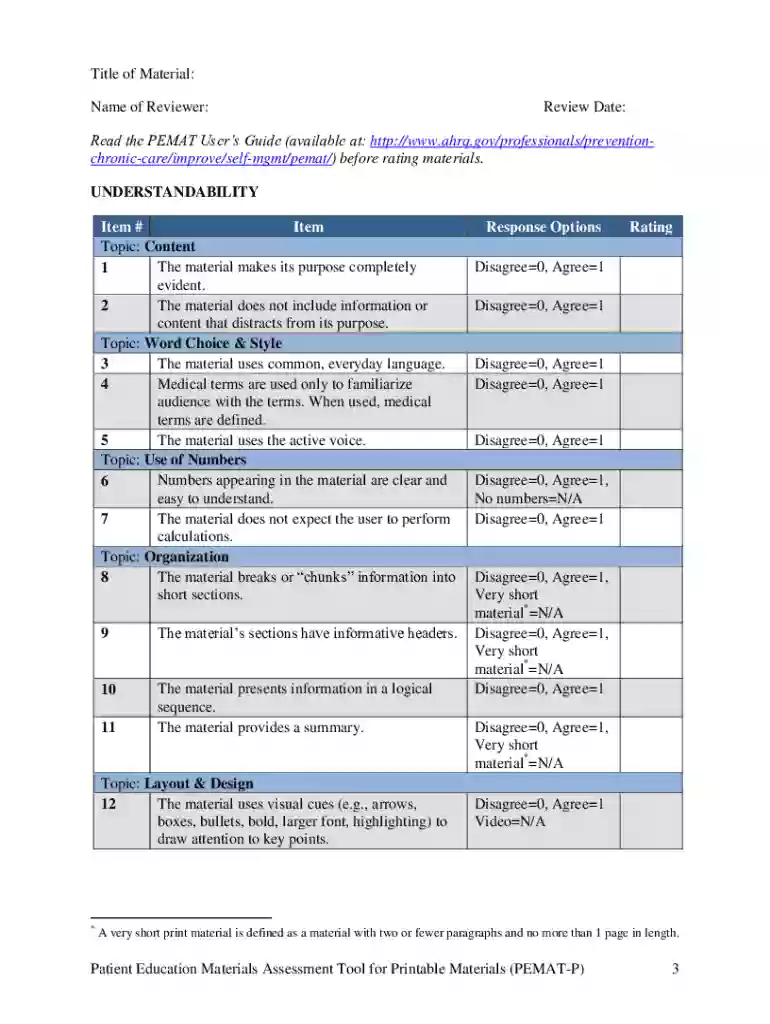
Type text, add images, blackout confidential details, add comments, highlights and more.

Draw your signature, type it, upload its image, or use your mobile device as a signature pad.

Send pemat via email, link, or fax. You can also download it, export it or print it out.
The Patient Education Materials Assessment Tool for Printable Materials (PEMAT-P) is designed to evaluate the quality and effectiveness of patient education materials. This tool is crucial for healthcare providers aiming to create or select educational resources that promote better understanding and adherence among patients. PEMAT-P considers two main criteria: understandability and actionability, emphasizing the patient's perspective in healthcare communication.
Utilizing the PEMAT-P can significantly enhance patient engagement and health literacy, leading to improved health outcomes.
Implementing the PEMAT-P involves a systematic approach to assess educational materials comprehensively. The following steps outline how to effectively use this tool:
Following these steps ensures a thorough evaluation of patient education materials, ultimately improving the resources provided to patients.
Understanding the essential components of the PEMAT-P is vital for conducting a successful assessment. Each section of the tool focuses on critical aspects that impact patient understanding:
These elements drive the score received on the PEMAT-P, informing healthcare providers about the effectiveness of their communication strategies.
The use of the PEMAT-P tool is critical for several reasons:
Incorporating PEMAT-P into patient education initiatives can dramatically enhance the healthcare experience.
The PEMAT-P is applicable across various healthcare settings, beneficial for both providers and patients:
Different healthcare environments leverage the PEMAT-P to ensure that all patient education efforts are effective, relevant, and engaging, ultimately improving patient outcomes across the board.
We've got more versions of the pemat auto scoring form form. Select the right pemat auto scoring form version from the list and start editing it straight away!
| Versions | Form popularity | Fillable & printable |
|---|---|---|
| 2014 | 4.8 Satisfied (24 Votes) |
At DocHub, your data security is our priority. We follow HIPAA, SOC2, GDPR, and other standards, so you can work on your documents with confidence.
by PAS Form Step 3: Decide which PEMAT to use. Choose the PEMAT-P for printable materials or the. PEMAT-A/V for audiovisual materials. Step 4: Go through each PEMATRead more
No information is available for this page.
The pipeline runs from San Jos de Chiquitos, Bolivia to Cuiab, Brazil. Starting at a junction with the Gasbol gas pipeline at the Estacin ChiquitosRead more


