
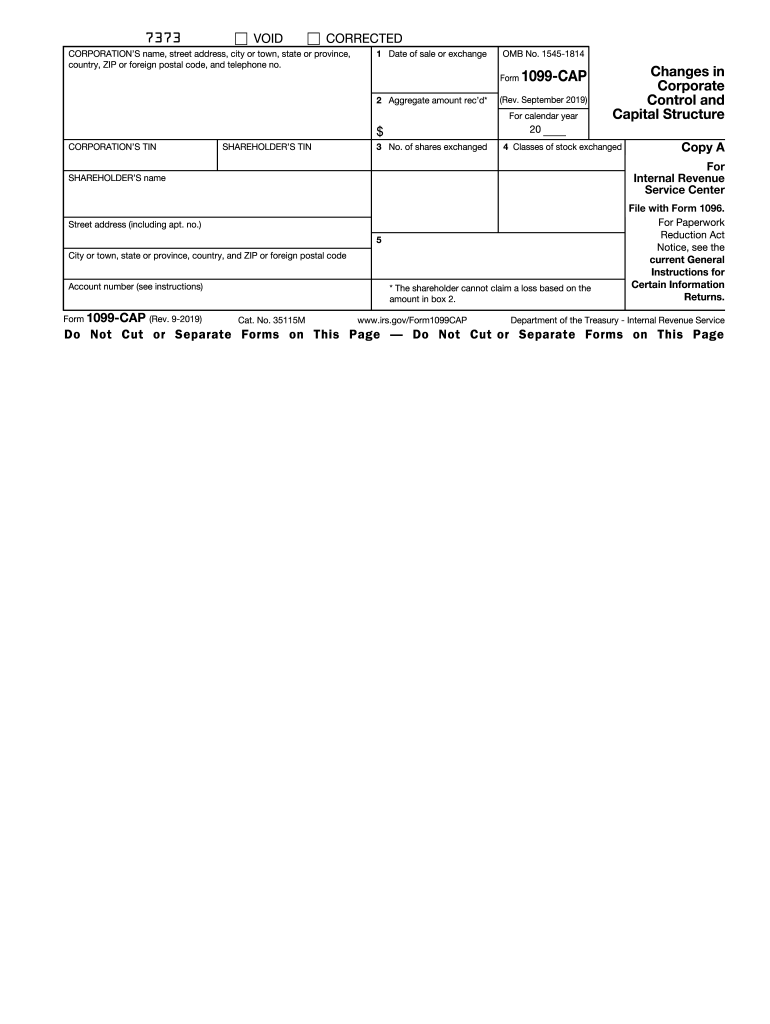







Definition and Meaning of Form 1099-CAP
Form 1099-CAP is a tax document used by corporations to report significant changes in control or capital structure to both shareholders and the Internal Revenue Service (IRS). Specifically, it captures transactions where shareholders receive cash, stock, or other property as a result of such corporate changes. This form is a vital instrument for maintaining transparency between corporations, their shareholders, and tax authorities.
Transactions Covered by Form 1099-CAP
- Changes in corporate control where a significant portion of stock changes ownership.
- Modifications in capital structure that impact the entity's stock value or ownership distribution.
- Events where shareholders receive taxable distributions resulting from corporate transactions.
Importance for Shareholders
For shareholders, the Form 1099-CAP provides essential details about the transaction, including the date of the event, identifiable data about the received stock or cash, and implications for their tax filings. It's crucial for shareholders to understand that any gains arising from these transactions must be reported on Form 8949.
How to Use Form 1099-CAP
Using Form 1099-CAP involves several key steps to ensure compliance and proper filing with the IRS. This section provides a foundational understanding of how to navigate the form.
Reviewing Transaction Details
- Verify that the corporate transaction meets the criteria for a Form 1099-CAP filing.
- Ensure that all details, such as the date of sale or exchange and the amounts received, align with your records.
Reporting and Compliance
- Shareholders need to use the information on Form 1099-CAP to report any gain or loss derived from the transaction on Form 8949.
- Corporations must also adhere to IRS guidelines for distributing the form to both shareholders and the IRS by applicable deadlines.
Steps to Complete Form 1099-CAP
Completing Form 1099-CAP requires attention to detail and adherence to IRS instructions. Below are the main steps involved.
- Enter Identifying Information: Start with the corporation's name, address, and federal identification number.
- Detail the Transaction: Include specifics like the date of change in control or capital structure.
- Identify Shareholder Data: Provide the shareholder's name, address, and taxpayer identification number.
- Specify the Exchange Details: Clearly state the number of shares exchanged and the cash or property received.
- File the Form: Submit copies to both the shareholders and the IRS by the required deadlines.
IRS Guidelines and Filing Requirements
IRS guidelines prescribe how corporations should complete and distribute Form 1099-CAP. These guidelines ensure that all necessary details are accurately captured and reported.
Filing Obligations
- Corporations must distribute the form to shareholders and file a copy with the IRS.
- Ensure tracking of any forms sent and received for future reference in case of discrepancies or audits.
Important Deadlines
- Forms must generally be furnished to shareholders by January 31 of the year following the transaction.
- Certain exceptions or extensions might apply under specific conditions.
Key Elements of Form 1099-CAP
Understanding the key elements of Form 1099-CAP is critical for both corporations and shareholders. Each section of the form serves a distinct purpose.
- Distributing Entity Information: Identifies the corporation and helps connect the transaction to a particular entity.
- Transaction and Control Change Dates: Important for tax year classification.
- Details of Received Stock or Cash: Outlines the types of distribution components shareholders receive.
Legal Use and Compliance
The legal framework surrounding Form 1099-CAP emphasizes compliance with federal regulations to avoid penalties for both corporations and shareholders.
Legal Obligations
- Corporations are legally required to report any significant changes in control or capital structure to maintain transparency.
- Shareholders must accurately use the form data to adjust their tax filings, ensuring they report any gains or losses.
Penalties for Non-Compliance
Failing to comply with filing requirements can result in penalties. Both corporations and individuals might face financial repercussions for inaccurate or late submissions.
Who Typically Uses Form 1099-CAP
Form 1099-CAP is predominantly used by corporations undergoing shifts in control or capital structure. The following are typical users:
Corporate Users
- Public companies experiencing mergers, acquisitions, or significant shareholder investments.
- Private companies opting for capital restructuring to enhance shareholder value.
Shareholder Recipients
- Individuals receiving distributions resulting from corporate changes.
- Institutional investors active in corporate stock exchanges.
Common Scenarios and Examples
To illustrate the application of Form 1099-CAP, consider these scenarios:
Scenario 1: Merger Event
A public corporation undergoes a merger, transferring a significant percentage of its stock to a new controlling entity. As a result, shareholders receive cash and additional stock in the new company.
Scenario 2: Capital Restructuring
A corporation engages in a stock split, resulting in current shareholders receiving additional shares. This transaction is reported on Form 1099-CAP, delineating the number of shares exchanged.
State-Specific Rules and Variations
While the 1099-CAP is governed by federal tax laws, corporations must also stay informed about any state-specific rules or variations that may affect reporting obligations.
- Certain states may have additional requirements or forms to accompany federal submissions.
- Companies operating in multiple states should consider consulting with tax professionals to ensure full compliance.
By focusing on these key areas, users of Form 1099-CAP can navigate their reporting obligations effectively, ensuring both accuracy and regulatory compliance.




