Partial interval recording 2026

Get Form
partial interval recording Preview on Page 1

Here's how it works

01. Edit your partial interval recording online
Type text, add images, blackout confidential details, add comments, highlights and more.

02. Sign it in a few clicks
Draw your signature, type it, upload its image, or use your mobile device as a signature pad.

03. Share your form with others
Send partial interval recording aba via email, link, or fax. You can also download it, export it or print it out.

Understanding Partial Interval Recording

Partial interval recording is a data collection method widely used in behavior analysis to monitor specific behaviors over set time intervals. This approach allows practitioners to document the occurrence of behaviors, such as tantrums, aggression, or self-stimulatory actions, in a structured manner. The primary goal of this technique is to gain insights into the frequency and duration of behaviors, which can inform interventions and modifications executed by professionals in Applied Behavior Analysis (ABA).

Key Components of Partial Interval Recording

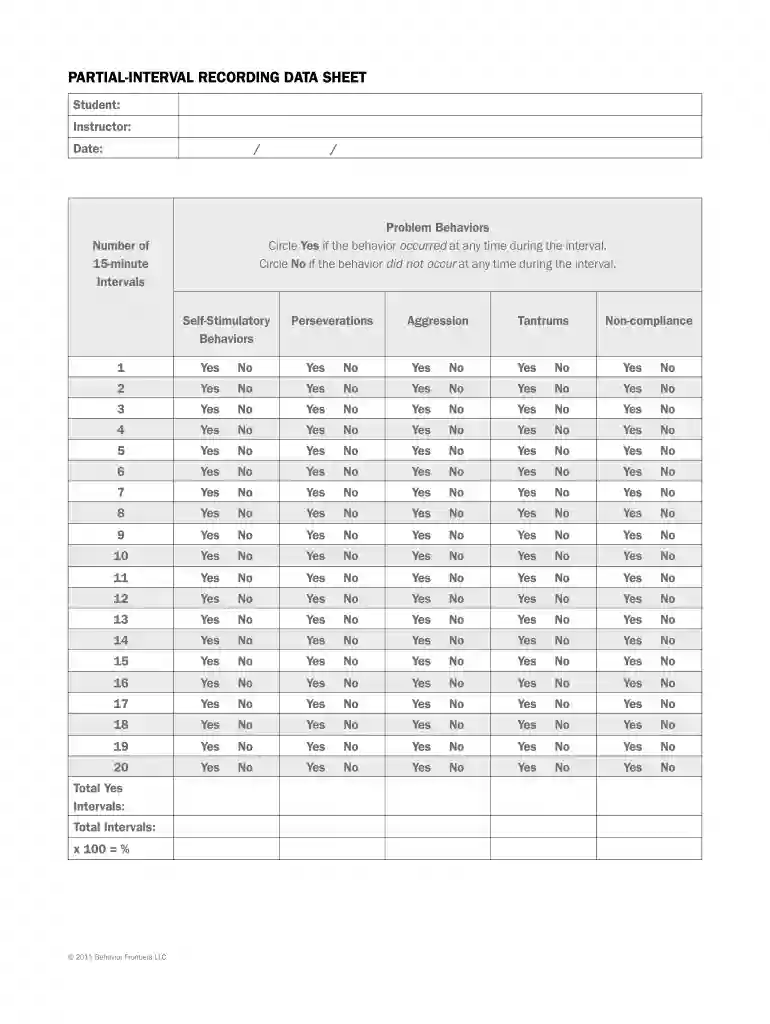
A Partial Interval Recording Data Sheet typically consists of the following elements:

  • 15-Minute Intervals: The data sheet is organized into segments that allow practitioners to observe and record behaviors during brief time blocks.
  • Behavior Marking: Users can indicate whether a specific behavior occurred at any point within each interval. This marking does not require the behavior to last for the entire interval, simply that it was present.
  • Outcome Calculation: After recording, the percentage of intervals where the behaviors occurred can be computed to analyze trends and patterns over time.

Advantages of Using Partial Interval Recording

Implementing partial interval recording offers several notable benefits:

  • Focus on Occurrence: This method enables practitioners to concentrate on whether a behavior occurred, making it simpler to document intermittent behaviors that might not happen continuously.
  • Versatility: It can be applied across different settings and for various behaviors, providing flexibility in behavioral assessments.
  • Data Utility: As behavior analysts gather data, the percent occurrence can highlight relevant behavioral trends, assisting in decision-making and planning interventions.

Practical Applications in Behavior Analysis

Behavior analysts often utilize partial interval recording in various contexts, including:

  • Analyzing Attention-Seeking Behaviors: By having observers mark intervals where individuals display behaviors aimed at gaining attention, practitioners can assess what triggers these actions.
  • Tracking Compliance Issues: This method helps in understanding non-compliance during tasks or activities, as practitioners can analyze how often refusal occurs and in which contexts.
  • Identifying Patterns in Self-Stimulatory Behaviors: Users may track specific self-stimulatory actions, such as hand-flapping or rocking, to understand their frequency and potential triggers.

Differentiating Between Partial and Whole Interval Recording

It is essential to distinguish partial interval recording from whole interval recording, as they serve different functions:

  • Partial Interval Recording: Focuses on whether a behavior occurs at any time during the interval; it tends to capture a higher frequency of occurrences.
  • Whole Interval Recording: Requires the behavior to occur throughout the entire interval to count it as present; this method may overlook intermittent behaviors.

Example Scenarios for Effective Use

Consider the following examples to understand how partial interval recording operates in practice:

  1. Classroom Environment: A teacher records every interval during which a student raises their hand to answer questions to assess their level of participation.
  2. Therapy Sessions: A therapist observes a child with Autism Spectrum Disorder and marks intervals where the child engages in self-injurious behavior, analyzing patterns to inform intervention strategies.

Creating a Partial Interval Recording Data Sheet

When designing a partial interval recording data sheet, it generally comprises these sections:

  • Date and Time: Document when the recording takes place, facilitating tracking across different sessions.
  • Target Behaviors: Clearly define the behaviors that are being observed to ensure consistency during data collection.
  • Interval Chart: A grid or table to input observations for each 15-minute segment, often formatted for easy, immediate marking.

Conclusion on Effective Practice of Partial Interval Recording

Utilizing partial interval recording effectively requires careful planning and attention to detail. By understanding its mechanics and applications, behavior analysts can leverage this method to gather critical data that underpins their strategies to promote positive behavioral change.

be ready to get more

Complete this form in 5 minutes or less

Get form

Security and compliance

At DocHub, your data security is our priority. We follow HIPAA, SOC2, GDPR, and other standards, so you can work on your documents with confidence.

Learn more
ccpa2
pci-dss
gdpr-compliance
hipaa
soc-compliance