



01. Edit your 2021 form 4972 online
Type text, add images, blackout confidential details, add comments, highlights and more.

Type text, add images, blackout confidential details, add comments, highlights and more.

Draw your signature, type it, upload its image, or use your mobile device as a signature pad.

Send it via email, link, or fax. You can also download it, export it or print it out.
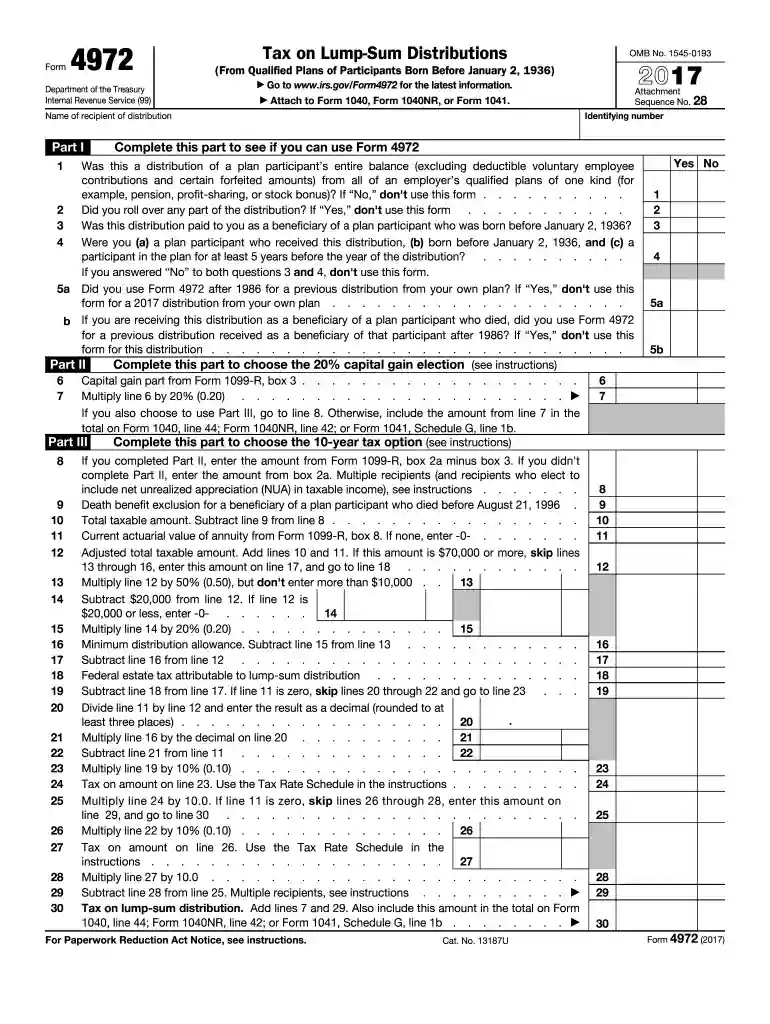
Form 4972, for the year 2017, is designed to help taxpayers calculate the tax on lump-sum distributions from qualified plans. These distributions typically come from retirement or pension plans, and this form is essential for taxpayers born before January 2, 1936. By using Form 4972, eligible individuals can opt for special tax treatments like the 20% capital gain election and the 10-year tax option. Such choices often result in lower tax liabilities than reporting the distribution as ordinary income. This section provides clarity on who can use it and explains its importance alongside enhancing retirement financial planning.
Accessing the correct version of Form 4972 is crucial, especially for accuracy in tax filing. For the 2017 version, it can be downloaded directly from the IRS website. Additionally, numerous tax preparation software includes this form, making it accessible to those using digital platforms. Physical copies are available through libraries, IRS offices, and should be obtained well in advance of the filing deadline to ensure ample time for completion. Both online and physical access points help ensure that taxpayers meet required deadlines without compliance issues.
Completing Form 4972 requires careful attention to detail and an understanding of tax terms:
By taking these steps, taxpayers can ensure that Form 4972 is completed efficiently and correctly.
The IRS provides specific guidelines for accurate completion and submission of Form 4972. These include understanding the eligibility criteria, complying with filing deadlines, and knowing the available tax options. The IRS also details how to report capital gains and outlines the potential benefits of the 10-year tax option. Understanding IRS guidelines helps taxpayers avoid mistakes that could lead to penalties or higher tax liabilities, making it a critical aspect of the process.
Timely submission of Form 4972 is crucial. For the 2017 tax year, the form is typically due by April 15, 2018, unless extensions apply. Understanding this deadline ensures taxpayers avoid late filing penalties. Additionally, keeping track of any state-specific deadlines is essential, as some states may require additional documentation or have separate filing requirements. Timely filing is not just about avoiding penalties but ensuring the taxpayer takes full advantage of the tax options available.
Filing Form 4972 requires specific documentation to accompany the completed form:
These documents verify the distribution details and help calculate the correct tax treatment options. Comprehensive document gathering ensures that all financial elements are accounted for, supporting accurate form completion and submission.
Form 4972 can significantly lower tax obligations under the right circumstances. For example, a retired individual receiving a large distribution from their pension may opt for the capital gain treatment on a portion and apply the 10-year averaging on the remainder. This strategic choice can reduce their overall taxable income more effectively than declaring the entire sum as ordinary income. Real-world usage scenarios help illustrate the form’s benefits and guide similar strategies for different financial situations.
Failing to file Form 4972 correctly or on time can result in notable penalties. Taxpayers may incur interest charges on unpaid taxes, and late fees can accrue if the form is not submitted by the deadline. Understanding these penalties highlights the importance of compliance and timely filing. Properly following IRS rules also ensures taxpayers avoid additional financial burdens beyond the primary tax obligations.
Eligibility to use Form 4972 primarily depends on the taxpayer’s birthdate and the type of distribution received. Taxpayers must have been born before January 2, 1936, to qualify for the specific tax options related to lump-sum distributions outlined in this form. The form is not suitable for everyone receiving such a distribution, emphasizing the need to verify eligibility before attempting to file. Correct eligibility checks protect against incorrect filings and ensure taxpayers utilize appropriate forms for their situations.


Form 4972 can be submitted in multiple ways:
Each method has its advantages and deadlines, and selecting the most convenient option helps taxpayers meet filing requirements efficiently, ensuring compliance and minimizing complications come tax season.
We've got more versions of the 2021 form 4972 form. Select the right 2021 form 4972 version from the list and start editing it straight away!
| Versions | Form popularity | Fillable & printable |
|---|---|---|
| 2025 | 4.7 Satisfied (40 Votes) | |
| 2024 | 4.5 Satisfied (30 Votes) | |
| 2023 | 4 Satisfied (50 Votes) | |
| 2022 | 4.5 Satisfied (53 Votes) | |
| 2021 | 4.9 Satisfied (37 Votes) | |
| 2020 | 4.3 Satisfied (193 Votes) | |
| 2019 | 4.2 Satisfied (36 Votes) | |
| 2018 | 4.3 Satisfied (60 Votes) | |
| 2017 | 4.4 Satisfied (242 Votes) | |
| 2016 | 4.4 Satisfied (677 Votes) | |
| 2015 | 4 Satisfied (30 Votes) | |
| 2014 | 4.2 Satisfied (25 Votes) | |
| 2011 | 4.3 Satisfied (66 Votes) |
At DocHub, your data security is our priority. We follow HIPAA, SOC2, GDPR, and other standards, so you can work on your documents with confidence.
CHM 4972. CHANGE(S) ARE TO BE EFFECTIVE (LIST TERM). SPRING 2017. CHANGE TITLE TO: RI: HONORS THESIS IN CHEMISTRY. TO: CHANGE PREFIX FROM: TO: CHANGE COURSE NORead more
Use Form 4972 to figure the tax on a qualified lump-sum distribution (defined below) you received in 2017 using the 20% capital gain election, the 10-year tax.Read more
Jan 23, 2018 For more detailed information on lump-sum distributions, see Pub. 575 or Form 4972, Tax on Lump-Sum Distributions. Tax on Early Distributions.Read more


