







Definition & Meaning
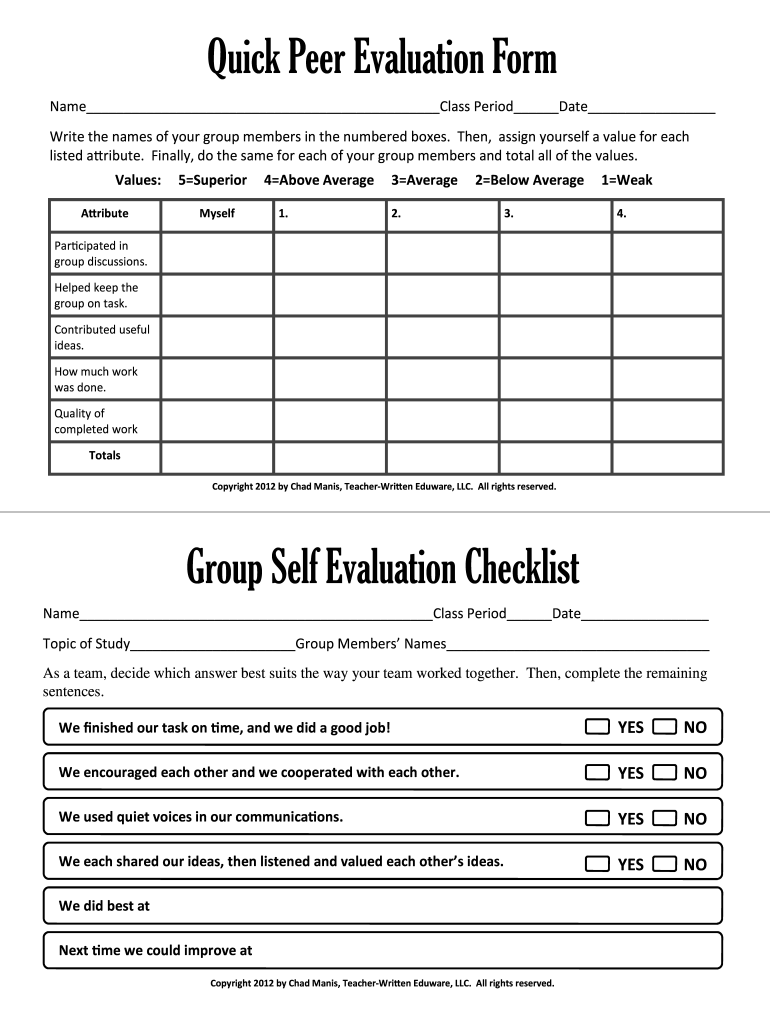
The Quick Peer Evaluation Form is a tool used primarily to assess the contributions and teamwork of individuals within a group project. This form allows participants to provide feedback on various aspects of their peers' performance, including participation levels, quality of work, and overall collaboration. It typically contains sections for self-evaluation and peer assessment, encouraging individuals to reflect on their contributions and those of their teammates. This structured approach to feedback helps identify strengths and areas for improvement, making it essential for fostering a constructive team environment.
Peer evaluations on this form often cover specific attributes such as:
- Participation: How actively the individual engaged in project activities.
- Task Management: Ability to manage assigned responsibilities and meet deadlines.
- Idea Contribution: Quality and quantity of ideas presented by the individual during discussions.
- Work Quantity and Quality: Assessment of the amount and standard of work completed.
Overall, using a Quick Peer Evaluation Form supports transparency and accountability within teams, promoting effective collaboration.
How to Use the Quick Peer Evaluation Form
To effectively utilize the Quick Peer Evaluation Form, follow these steps:
-
Distribute the Form: Provide each team member with a copy of the form, either in physical form or as a digital file. Ensure everyone understands the purpose and importance of the evaluation process.
-
Set Evaluation Criteria: Clearly define what each section of the form measures. For example, outline the expectations for participation, task management, and communication skills. Providing a rubric or example responses can facilitate more accurate evaluations.
-
Complete the Evaluation: Each team member should fill out the form, reflecting on their own contributions as well as those of their peers. This step is crucial for promoting constructive feedback and self-awareness.
-
Submit Evaluations: Once completed, collect the forms and ensure confidentiality in the feedback process. Participants may submit forms anonymously, depending on group preferences.
-
Review and Discuss: Organize a meeting to discuss the evaluations. This is an opportunity for team members to reflect on feedback received and to make collective decisions about how to improve team dynamics and project outcomes.
-
Implement Changes: Use insights gained from the evaluation to adjust team roles, enhance communication strategies, or implement new collaboration tools, ensuring ongoing progress in future projects.
Key Elements of the Quick Peer Evaluation Form
Understanding the structure and components of the Quick Peer Evaluation Form can enhance its effectiveness. Key elements typically include:
-
Self-Evaluation Section: Allows individuals to assess their own contributions, giving insights into their perceptions of their performance relative to others in the team.
-
Peer Assessment Section: Provides space for evaluating teammates, focusing on collaboration, reliability, and overall contributions to the project.
-
Rating Scales: Use numerical scales or qualitative descriptors (e.g., Excellent, Good, Fair, Poor) to standardize feedback, making it easier to quantify results.
-
Comments Field: Encourages elaboration on ratings by allowing evaluators to provide specific examples or suggestions for improvement.
-
Overall Team Reflection: A summary section where teams can collectively chart out their strengths and areas needing attention, fostering a culture of open communication.
By incorporating these elements, the Quick Peer Evaluation Form encourages detailed feedback and provides a clearer framework for evaluating team performance.
Why Should You Use the Quick Peer Evaluation Form?
Using a Quick Peer Evaluation Form offers several benefits for teams engaged in collaborative projects:
-
Enhanced Accountability: The form promotes individual ownership of contributions within the team, making members more aware of their impact on group success.
-
Constructive Feedback: Structured evaluations help create a safe environment for providing and receiving feedback. This can lead to improved communication skills among team members.
-
Increased Engagement: Encouraging self and peer evaluations can foster a sense of investment in the project’s success, leading to higher levels of engagement from all participants.
-
Identify Skills and Development Needs: The evaluation process can highlight areas where team members may require additional support or training, enabling more focused professional development.
-
Facilitate Team Reflection: The collective discussion of peer evaluations serves as a platform for teams to reflect on their collaboration process and make informed decisions on how to improve in future projects.
Incorporating a Quick Peer Evaluation Form into team dynamics can significantly enhance performance and collaboration.
Important Terms Related to Quick Peer Evaluation Form
Having a clear understanding of key terminology can facilitate effective use of the Quick Peer Evaluation Form. Important terms include:
-
Self-Assessment: The process by which individuals evaluate their own contributions and performance, helping to foster self-awareness.
-
Feedback Loops: The ongoing process of providing and receiving evaluations to enhance performance and collaboration continually.
-
Collaboration: Working together towards a common goal, which is essential for the success of group projects.
-
Peer Review: An evaluation conducted by fellow team members, aimed at assessing contributions, promoting accountability, and improving work quality.
-
Rubric: A scoring tool used to articulate expectations for an assignment by listing its criteria and describing levels of quality.
Understanding these terms provides a solid foundation for engaging with the evaluation process, ensuring clarity and effectiveness in assessments.
Each of these sections outlines the structure, usage, and context of the Quick Peer Evaluation Form in a detailed and informative manner, serving as a practical guide for users in a variety of settings, especially educational and professional environments.




