




01. Edit your sds register template online
Type text, add images, blackout confidential details, add comments, highlights and more.

Type text, add images, blackout confidential details, add comments, highlights and more.

Draw your signature, type it, upload its image, or use your mobile device as a signature pad.

Send hazardous substance register template via email, link, or fax. You can also download it, export it or print it out.
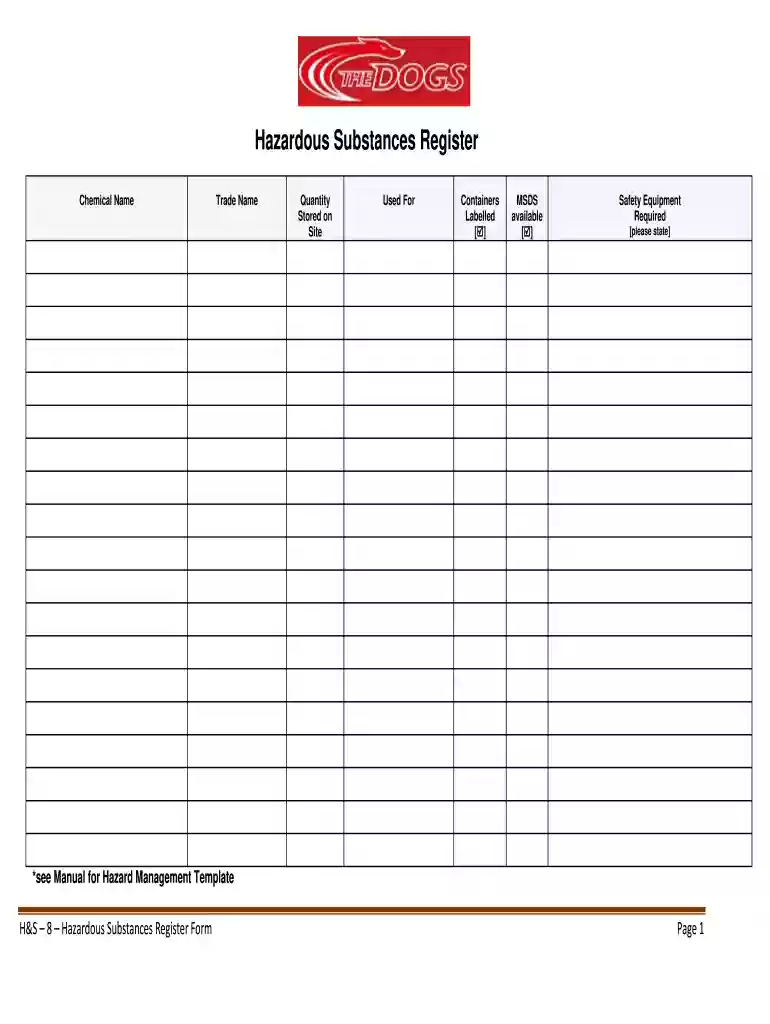
The hazardous register form serves as a critical document for organizations responsible for the management of hazardous substances. It is a comprehensive tool designed to document essential information about these substances, including their names, trade names, quantities stored, intended uses, and compliance with the required safety data sheets (SDS). This register not only aids in maintaining an inventory of hazardous materials but also ensures that proper safety measures are enacted in accordance with regulatory standards.
Using the hazardous register form requires careful consideration and adherence to a structured process. This form is utilized to create an inventory of hazardous substances that an organization manages or stores.
Completing the hazardous register form involves multiple steps to ensure accuracy and compliance with regulations.
Gather Necessary Information: Collect information on all hazardous substances, focusing on:
Fill Out the Form: Use a digital template or a paper form to enter the gathered information. Each field should be filled out clearly:
Review for Accuracy: Before finalizing, have a supervisor or a safety officer review the completed form to ensure all information is correct and complete.
Submit and Store: Once completed, submit the form as required by local regulations. It should also be maintained in both digital and hard copy formats for easy access.
The hazardous register form should contain several key elements to ensure its effectiveness and compliance.
The legal framework surrounding the hazardous register form is governed by various federal and state regulations aimed at ensuring the safe management of hazardous materials.
Failure to maintain an accurate hazardous register can result in legal penalties, including fines or sanctions from regulatory agencies. Additionally, it may lead to increased safety risks and potential liability in the event of an incident. Ensuring legal compliance is not only a regulatory obligation but also a fundamental aspect of workplace safety practices.
At DocHub, your data security is our priority. We follow HIPAA, SOC2, GDPR, and other standards, so you can work on your documents with confidence.
Apr 24, 2013 TITLE IHAZARDOUS SUBSTANCES RELEASES, LIABILITY,. COMPENSATION. Sec. 101. Definitions. Sec. 102. Reportable quantities and additionalRead more
For all other chemicals needing registration, please complete the High Hazard Chemical Registration Form. If a lab is using toxic gases, pyrophoric, explosiveRead more


