
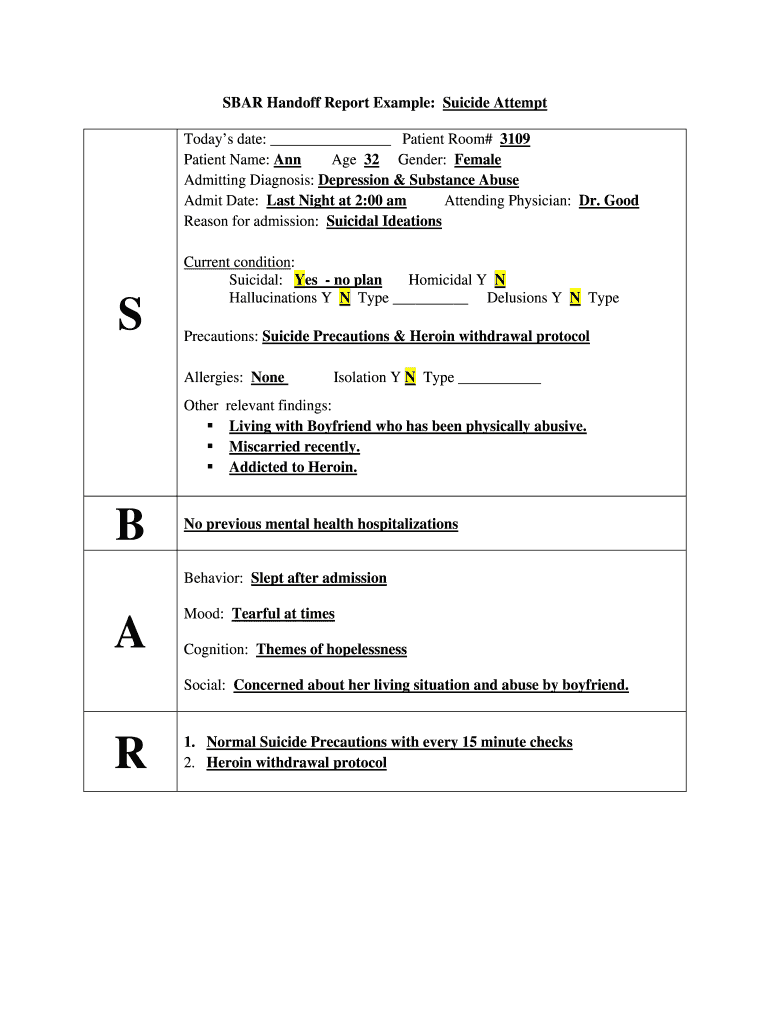







Definition and Significance of SBAR Report
The SBAR report, an acronym for Situation, Background, Assessment, and Recommendation, is a structured communication tool widely used in healthcare settings to facilitate clear and concise exchanges of information about a patient. Its primary purpose is to enhance the quality of patient handoffs and improve communication among healthcare providers, thereby reducing the risks of misunderstandings during critical transitions. The SBAR report format is particularly essential in high-pressure environments, such as emergency rooms or during shift changes, where concise and accurate information sharing is crucial for patient safety.
Key Components of SBAR Report
-
Situation: This section provides a brief overview of the current clinical situation that necessitated the report. It should answer the fundamental questions, such as who the patient is, their main health concerns, and the immediate context.
- Example: "A 32-year-old female patient is presenting with suicidal ideations due to a recent miscarriage."
-
Background: This part gives pertinent medical history and background information to frame the situation. This may include previous hospitalizations, relevant diagnoses, and treatments that have been administered.
- Example: "The patient has a history of major depressive disorder and substance abuse."
-
Assessment: Here, the sender provides their evaluation of the patient's current condition, including vital signs, mental status, and any other relevant clinical observations.
- Example: "The patient is agitated, exhibits a flat affect, and shows increased impulsivity."
-
Recommendation: This section concludes the report by stating what actions or interventions are suggested. It's critical that the recommendation be specific and actionable.
- Example: "I recommend a psychiatric evaluation and close monitoring for further suicidal ideations."
How to Use the SBAR Report Effectively
Using the SBAR report effectively involves several steps, with an emphasis on clarity, conciseness, and context.
-
Gather Information: Before composing the SBAR report, gather all necessary information regarding the patient. Ensure you have the latest data on their medical history and current status.
-
Structure Your Report: Follow the SBAR format closely to structure your document:
- Clearly label each section (Situation, Background, Assessment, Recommendation) for easy reference.
- Aim for brevity but include all necessary details to aid understanding.
-
Share with Relevant Parties: Distribute the completed SBAR report to necessary healthcare providers involved in the patient’s care. This can be done verbally during shift changes or in written form, depending on the setting.
-
Review and Update: Continuously update the SBAR report as new information becomes available or as the patient's condition changes. Regular reviews help maintain accurate and effective communication.
Steps to Complete an SBAR Report
Completing an SBAR report involves a straightforward sequence of actions. Following these steps will help ensure that each report is complete and informative.
-
Identify the Patient and Situation: Start with the patient’s name or ID and the current medical situation or concern.
-
Provide Relevant Background: Compile necessary background information, including the patient’s medical history, current medications, and notable past interventions.
-
Evaluate the Patient: Conduct an assessment based on your observations and any relevant tests or vital signs. Ensure that you present a clear summary of the patient’s status.
-
Draft Recommendations: Formulate your recommendations based on your assessment. Make sure they are actionable and relevant to the current situation.
-
Employ Clear Communication: When delivering the report, whether in person or in writing, use straightforward language to avoid misinterpretations.
Importance of SBAR Reports in Healthcare
SBAR reports play a crucial role in enhancing the communication framework within healthcare teams. Their significance can be outlined through several key factors:
- Improved Patient Safety: By standardizing communication, SBAR helps to minimize the chances of errors due to miscommunication or incomplete information.
- Efficiency in Handoffs: The structured format of SBAR aids healthcare professionals in transferring crucial patient information smoothly and effectively during shift changes.
- Enhancing Team Collaboration: SBAR reports foster better collaboration among healthcare staff by establishing a common language and framework for sharing patient concerns.
- Training and Education: SBAR serves as an educational tool for both students and seasoned professionals, promoting effective communication practices across disciplines.
Examples of SBAR Reports in Practice
Real-world applications of SBAR reports demonstrate their effectiveness in clinical settings. Here are examples that illustrate the format and its practical implications:
-
Example 1 - Mental Health:
- Situation: "A 29-year-old male diagnosed with Bipolar I is in a manic state."
- Background: "The patient has a history of aggressive behavior and was admitted after a bar fight."
- Assessment: "He is currently agitated and demands discharge, showing signs of decreased insight into his condition."
- Recommendation: "I recommend a psychiatric consultation and further assessment of his medication regimen."
-
Example 2 - Post-Surgical:
- Situation: "A 45-year-old female post-operative day two following laparoscopic cholecystectomy is experiencing increased pain."
- Background: "She has a history of anxiety and is currently on pain management protocol."
- Assessment: "Vital signs are stable, but the patient rates her pain as an eight out of ten despite medication."
- Recommendation: "Consider adjusting her pain management plan and evaluating for any complications at the surgical site."
Employing these examples, healthcare professionals can effectively develop and communicate SBAR reports tailored to specific patient scenarios.




