Nh btla a 12 2026

Get Form
nh btla a 12 Preview on Page 1

Here's how it works

01. Edit your form online
Type text, add images, blackout confidential details, add comments, highlights and more.

02. Sign it in a few clicks
Draw your signature, type it, upload its image, or use your mobile device as a signature pad.

03. Share your form with others
Send it via email, link, or fax. You can also download it, export it or print it out.

How to use or fill out nh btla a 12 with our platform

Form edit decoration
9.5
Ease of Setup
DocHub User Ratings on G2
9.0
Ease of Use
DocHub User Ratings on G2
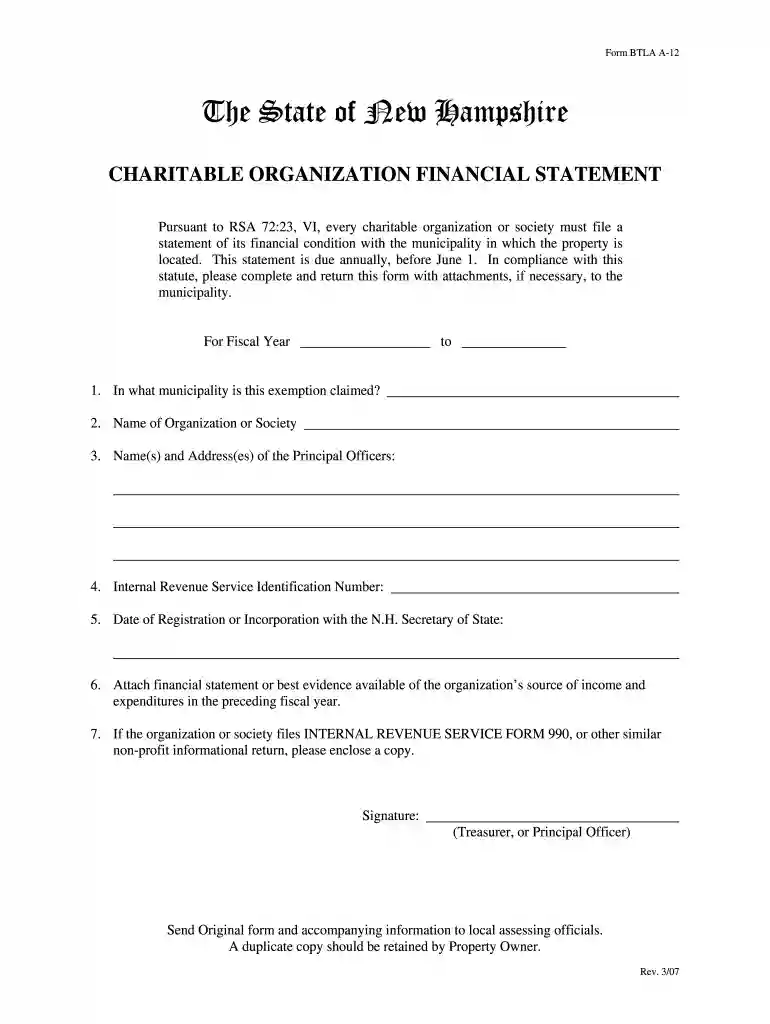
  1. Click ‘Get Form’ to open the nh btla a 12 in the editor.
  2. Begin by entering the fiscal year for which you are filing the statement at the top of the form.
  3. In section 1, specify the municipality where the exemption is claimed. This is crucial for local processing.
  4. Provide the name of your organization or society in section 2, ensuring it matches official records.
  5. List the names and addresses of principal officers in section 3. Accurate information here is essential for verification.
  6. Enter your Internal Revenue Service Identification Number in section 4, as this links your organization to federal records.
  7. Indicate the date of registration or incorporation with the N.H. Secretary of State in section 5.
  8. Attach any financial statements or evidence of income and expenditures from the previous fiscal year as required in section 6.
  9. If applicable, enclose a copy of IRS FORM 990 or similar returns as mentioned in section 7.
  10. Finally, ensure that a designated officer signs the form before submission to local assessing officials.

Start using our platform today to complete your nh btla a 12 form easily and for free!

See more nh btla a 12 versions

We've got more versions of the nh btla a 12 form. Select the right nh btla a 12 version from the list and start editing it straight away!
Versions Form popularity Fillable & printable
2007 4.9 Satisfied (505 Votes)
be ready to get more

Complete this form in 5 minutes or less

Get form

Got questions?

We have answers to the most popular questions from our customers. If you can't find an answer to your question, please contact us.
Contact us
You must own a homestead subject to the state education property tax; have resided in such homestead on April 1 of the year for which the claim for relief is made; have a total household income of (1) $37,000 or less if a single person or (2) $47,000 or less if married or head of a New Hampshire household.
Must be a New Hampshire resident for 3 consecutive years. Must be 65 on or before April 1st (or spouse) The property for which the exemption is applied must be the legal residence of applicant(s) Property Transfers: the property cannot be transferred within the last 5 years from a blood relative or marriage.
New Hampshire has a 1.61 percent effective property tax rate on owner-occupied housing value. New Hampshire does not have an estate tax or inheritance tax. New Hampshire has a 23.83 cents per gallon gas tax rate and a $1.78 cigarette excise tax rate.
To qualify you must be: 65 years of age on or before April 1st. Must reside at property where exemption is claimed.
If after 2 years from the lien date, the lien amount is still unpaid, the municipality may begin the deeding process to acquire the property by Tax Collector Deed for delinquent taxes. This process is also regulated by NH State laws and requires a series of notices and costs associated with them.

Security and compliance

At DocHub, your data security is our priority. We follow HIPAA, SOC2, GDPR, and other standards, so you can work on your documents with confidence.

Learn more
ccpa2
pci-dss
gdpr-compliance
hipaa
soc-compliance
be ready to get more

Complete this form in 5 minutes or less

Get form

People also ask

For transactions in which the consideration paid is $4,000 or less, the minimum tax due is ($20 from the buyer and $20 from the seller). For transactions between related parties in which the consideration stated is unsupported, the tax will be assessed on the fair market value of the property.
A non-profit organization whose mission is of a religious, educational or charitable nature, may qualify for a property tax exemption. The property must be owned, used and occupied by the organization (RSA 72:23) as of April 1 of the year the application is made.
To qualify you must be: 65 years of age on or before April 1st. Must reside at property where exemption is claimed. Applicants owning fractional property interest can receive a tax credit and/or exemption in proportion to their percentage of ownership interest.

Related links