




Definition and Purpose of the 2015 Form 106
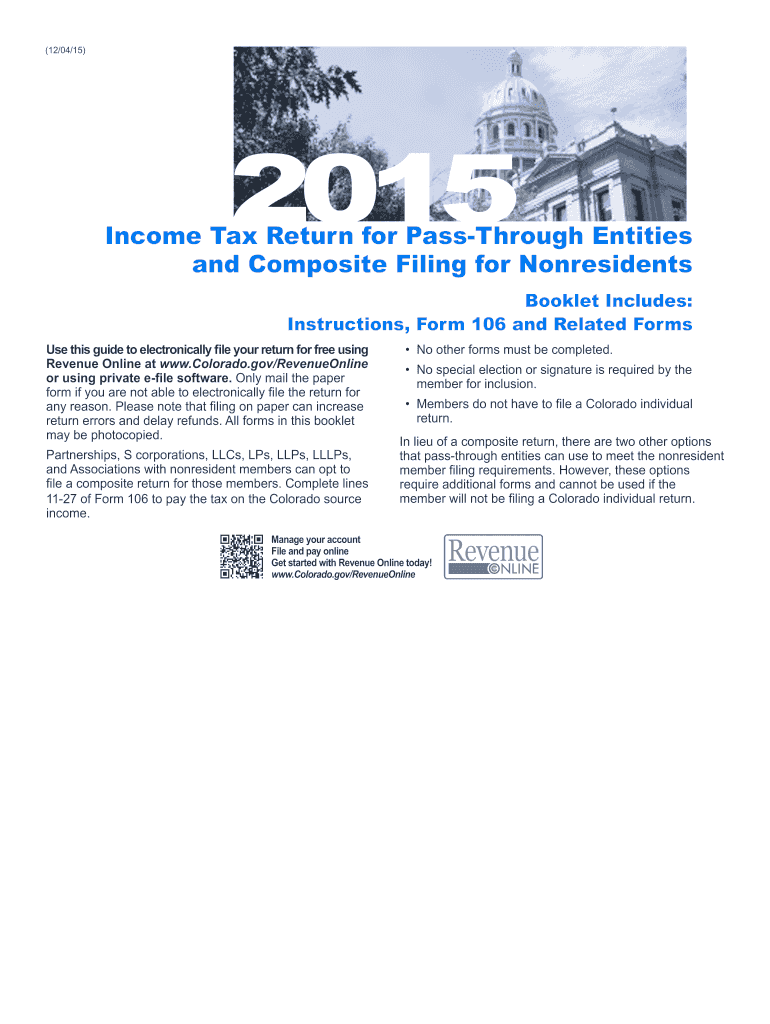
The 2015 Form 106 is an essential document for the filing of the Colorado Income Tax Return for Pass-Through Entities and Composite Filing for Nonresidents. This form is used by partnerships, S corporations, limited liability companies, and other qualifying entities that have Colorado-source income. The purpose of this form is to consolidate tax returns for these entities, simplifying the tax reporting process for both resident and nonresident members.
Legal Framework and Compliance
The use of Form 106 is governed by specific legal requirements under Colorado state tax law. For partnerships and other pass-through entities, the form serves as a mechanism to report income that originates from Colorado-based sources. Compliance involves adhering to state guidelines regarding income reporting and tax obligations. Nonresident members of these entities may be subject to composite filing rules, which allow them to remit taxes attributable to their portion of state income.
Steps to Complete the 2015 Form 106
Completing the 2015 Form 106 requires attention to detail and a good understanding of the structure of the form. Here are key steps to accurately complete this form:
- Gather Required Documents: Ensure all financial documents, including income statements and expense reports, are ready for reference.
- Enter Entity Information: Include the name, federal employer identification number (FEIN), and address of the entity.
- Report Income and Deductions: Fill out sections detailing Colorado-source income and any applicable deductions.
- Calculate Tax Liability: Use the provided instructions to ascertain the taxable amount and compute any credit offsets available.
- Complete Composite Filing (if applicable): Report information for nonresident members and calculate composite taxes due.
- Review and Submit: Verify all details for accuracy, then submit the form electronically via Revenue Online or by traditional mail.
Detailed Instructions for Composite Filing
The composite filing option entails including nonresident members in a single tax payment. To properly execute this, entities must:
- List each nonresident member’s share of Colorado-source income.
- Apply any pertinent credit for prior payments or overpayments from previous years.
- File separate forms, such as DR 0107, for specific individual nonresident filings.
How to Obtain the 2015 Form 106
Acquiring the 2015 Form 106 can be achieved through multiple channels. Ensure you have the most current instructions and forms by:
- Downloading from the Department of Revenue: Visit the official Colorado Department of Revenue website to download and print the form.
- Third-party Software Providers: Utilize tax software programs like TurboTax or QuickBooks, which may have integrated access to state tax forms, including the 2015 Form 106.
- Professional Tax Services: Consult with a Certified Public Accountant (CPA) or tax professional who can provide electronic copies and simultaneously assist with form preparation.
Important Terms Related to the 2015 Form 106
Understanding the terminology used within the 2015 Form 106 is crucial for accurate filing. Key terms include:
- Pass-through Entity: This refers to businesses like LLCs, partnerships, and S corporations where profits pass directly to the owners and are taxed at their individual rates.
- Composite Filing: A tax process allowing nonresident members of a pass-through entity to file jointly, simplifying their tax obligations.
- Colorado-source Income: Any income earned that is attributable directly to Colorado, including sales, services, and transactions performed within state lines.
Variations in Form 106 Usage
Several variations or alternatives to the 2015 Form 106 may apply depending on changes in the tax year or specific industry requirements. Entities performing multi-state operations should ensure correct form usage and adherence to jurisdictional guidelines.
who Typically Uses the 2015 Form 106
The primary users of the 2015 Form 106 include partnerships, limited liability companies, and S corporations operating within or deriving income from Colorado. Specifically, businesses with nonresident partners needing a collective tax filing solution benefit greatly from utilizing this form.

Notable Examples
- Small LLC Services Firm: An LLC providing contracted services within Colorado uses Form 106 to report income earned from local contracts.
- Multi-state Partnership: A partnership operating in multiple states with Colorado clientele files Form 106 to ensure compliance with state income tax laws.
Filing Deadlines and Important Dates
The filing deadline for the 2015 Form 106 is usually April 15 of the following year. However, the deadline may differ based on extensions or state-specific stipulations. Understanding these timelines is essential to avoid penalties associated with late filings.
- Extensions: Automatic extensions may be granted, provided obligations, such as filing for an extension by April 15, are met.
- Quarterly Payments: Entities may be required to make quarterly estimated tax payments to mitigate their annual tax burden.
Penalties for Non-Compliance
Failure to file the 2015 Form 106 accurately or on time can result in several penalties. Common penalties include:
- Late Filing Fees: Late submissions generally incur a percentage-based fee on the tax due.
- Underpayment Penalties: Inadequately paid taxes throughout the year attract interest and additional charges.
- Audit Risks: Non-compliance can lead to audits, complicating and potentially increasing tax liability.
Understanding these penalties ensures that entities remain compliant and manage their tax affairs responsibly.