




01. Edit your form online
Type text, add images, blackout confidential details, add comments, highlights and more.

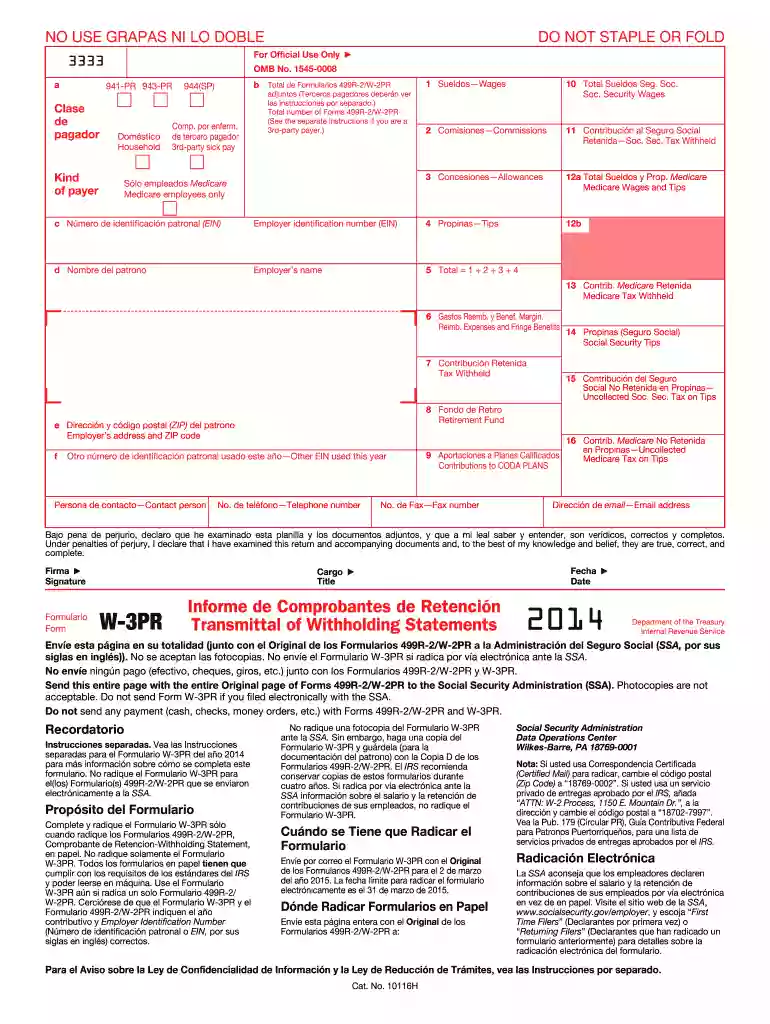
Type text, add images, blackout confidential details, add comments, highlights and more.

Draw your signature, type it, upload its image, or use your mobile device as a signature pad.

Send it via email, link, or fax. You can also download it, export it or print it out.
The 2014 Form W-3 (PR) is a transmittal form used to submit Forms 499R-2/W-2PR to the Social Security Administration (SSA). Its primary function is to compile the wage and tax information reported to employees and provide an annual reconciliation of payment amounts employees received. This form specifically caters to employers in Puerto Rico filing taxes with the SSA and not with the IRS. Ensuring accurate completion and timely submission of this form is crucial for maintaining compliance with federal wage reporting requirements.
Using the 2014 Form W-3 (PR) involves several key steps to ensure accurate and efficient filing. First, gather all Forms 499R-2/W-2PR, as the W-3 (PR) will summarize these documents. Next, complete the form by transcribing relevant figures, such as total wages and tax withholding, from each W-2PR. Double-check entries for accuracy to ensure that both employee and SSA records match. Once completed, submit the W-3 (PR) along with the W-2PR forms to the SSA as dictated by applicable filing deadlines.
Employers can obtain the 2014 Form W-3 (PR) in several ways. The SSA's official website is the primary source, providing printable versions for free. Alternatively, forms can be ordered from the IRS by calling their designated forms line. Employers must ensure they have the original form, as photocopies or unofficial sources could lead to discrepancies in processing. Using the correct form version, validated directly from official sources or paper requests, is essential to avoid processing delays.
Completing the 2014 Form W-3 (PR) requires careful attention to detail:
The 2014 Form W-3 (PR) has precise deadlines to adhere to, promoting timely reflection in government records. The paper filing must be completed by March 2, 2015, while electronic submissions extend slightly to March 31, 2015. Meeting these deadlines is essential to avoid penalties and ensure that wage data aligns with year-end records.
Failing to file the 2014 Form W-3 (PR) accurately and on time can result in penalties. The IRS imposes fines for incorrect or late submissions, which can escalate based on severity and delay length. Penalties increase progressively with the number of returns affected. Employers need to address any identified errors promptly to mitigate potential repercussions and ensure compliance with federal wage reporting obligations.
Before filing the 2014 Form W-3 (PR), employers must compile several essential documents:
The IRS provides comprehensive guidelines for accurately completing and filing the 2014 Form W-3 (PR). Instructions cover step-by-step completion, including special considerations for corrections and amendments. Employers should regularly consult the IRS guidelines and updates to maintain compliance with current filing standards. Additionally, FAQ sections and contact support are available, enhancing understanding and assisting employers throughout the filing process.
Submission options for the 2014 Form W-3 (PR) cater to different preferences and resources:
Employers should choose the submission method aligning best with their organizational structure and capabilities, ensuring compliance with appropriate deadlines.
We've got more versions of the 2014 Form W-3 (PR) form. Select the right 2014 Form W-3 (PR) version from the list and start editing it straight away!
| Versions | Form popularity | Fillable & printable |
|---|---|---|
| 2025 | 4.2 Satisfied (56 Votes) | |
| 2024 | 4.7 Satisfied (42 Votes) | |
| 2023 | 4.4 Satisfied (27 Votes) | |
| 2022 | 4.2 Satisfied (36 Votes) | |
| 2021 | 4.8 Satisfied (87 Votes) | |
| 2020 | 4.3 Satisfied (142 Votes) | |
| 2019 | 4.3 Satisfied (48 Votes) | |
| 2018 | 4.3 Satisfied (78 Votes) | |
| 2017 | 4.3 Satisfied (141 Votes) | |
| 2016 | 4.3 Satisfied (189 Votes) | |
| 2015 | 4.1 Satisfied (59 Votes) | |
| 2014 | 4 Satisfied (35 Votes) | |
| 2013 | 4 Satisfied (56 Votes) | |
| 2012 | 4 Satisfied (42 Votes) |
Sign in to your DocHub account and import your 2014 Form W-3 (PR) to our editor using one of its upload options - from your device, cloud storage, protected URL, or your DocHub folders if you have already managed your document before. Open our editor, click the Sign button in the top toolbar, and choose your signing method. You can use a picture of your handwritten signature, draw it, type in your name, or use a QR code instead.
You may quickly fill out, edit, and even eSign your 2014 Form W-3 (PR) using DocHub. Create a new account and begin your free trial. After that, you can add the document with the form and simply make all the required edits. No need to print on paper or use a third-party application to sign it, as you can put your electronic signature on your document faster via DocHub.
At DocHub, your data security is our priority. We follow HIPAA, SOC2, GDPR, and other standards, so you can work on your documents with confidence.
Jul 31, 2019 This report was prepared under contract to the Department of Defense Strategic. Environmental Research and Development Program (SERDP).Read more
Alphabetical Listing of Forms. AgriLife Forms. Most forms have been converted to PDF format. PDF files require DocHub Reader or DocHub.Read more
Vea las Instrucciones separadas para el Formulario W-3PR del ao 2014 Make sure that both Form W-3PR and Form. 499R-2/W-2PR show the correct taxRead more


