




01. Edit your under 5000 asset certification online
Type text, add images, blackout confidential details, add comments, highlights and more.

Type text, add images, blackout confidential details, add comments, highlights and more.

Draw your signature, type it, upload its image, or use your mobile device as a signature pad.

Send under 5 000 asset certification how to fill out via email, link, or fax. You can also download it, export it or print it out.
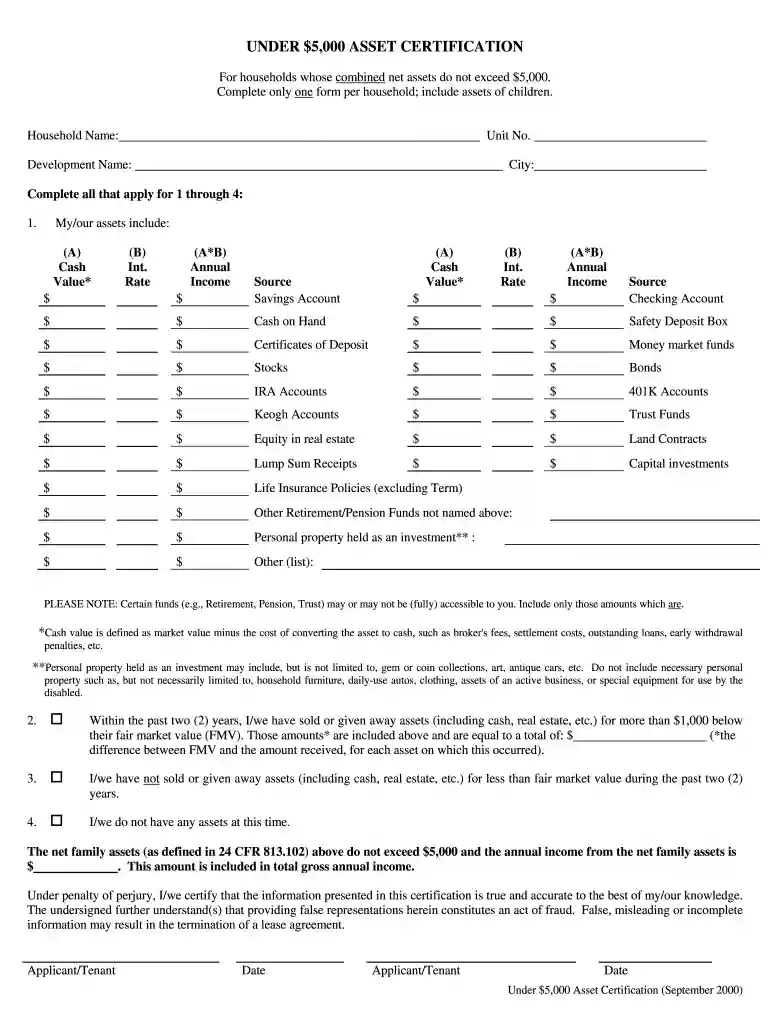
The Under $5,000 Asset Certification form plays a crucial role for households with combined net assets not exceeding $5,000. This form is essential for various applications, particularly when qualifying for certain assistance programs, and ensures that all asset disclosures are accurate and compliant. Knowing how to fill out this form effectively can streamline the process of securing necessary aid.
The Under $5,000 Asset Certification, also known as the asset certification form, is designed to gather the financial details of a household, including assets owned by children. The primary intent is to certify that the total value of these assets does not exceed the threshold of $5,000. Understanding the definition of asset certification is critical for both applicants and administrators to ensure compliance with applicable guidelines.
Filling out the Under $5,000 Asset Certification form requires specific attention to detail to avoid potential penalties for incorrect information. The following are the essential steps involved in completing this form:
By meticulously following these steps, applicants can enhance the accuracy of their submissions and avoid delays in processing.
Understanding the terminology associated with the Under $5,000 Asset Certification aids in comprehending the requirements and implications linked to the form. Familiar terms include:
Clarifying these definitions can prevent misunderstandings during the certification process.
To complete the Under $5,000 Asset Certification, applicants should ensure they meet specific eligibility criteria, which typically include:
The required documentation usually includes:
Gathering this documentation beforehand can simplify the form completion process.


Submitting an Under $5,000 Asset Certification with inaccuracies can have serious implications. Possible consequences include:
It's critical that every detail is accounted for to mitigate risks associated with submitting the form.
While the Under $5,000 Asset Certification is utilized widely, variations may exist based on state-specific regulations and federal guidelines, such as those outlined in 24 CFR 813.102. Applicants should be aware of local requirements that might affect their completion of the form, including:
Understanding these differences ensures compliance and enhances the likelihood of successful certification.
We've got more versions of the under 5000 asset certification form. Select the right under 5000 asset certification version from the list and start editing it straight away!
At DocHub, your data security is our priority. We follow HIPAA, SOC2, GDPR, and other standards, so you can work on your documents with confidence.
2. Check this box if the organization discontinued its operations or disposed of more than 25% of its net assets. 3. Number of voting members of theRead more
PLEASE CORRECT ALL MISSING OR INCORRECT DATA ON THE INVENTORY REPORT,. I.E. DESCRIPTION, MANUFACTURER, MODEL NUMBER, LOCATION CODE AND SERIAL. NUMBER.Read more
Complete one form per households with joint assets or on form per person with separate assets. If a household contains both joint and separate assets, useRead more


