01. Edit your form online
Type text, add images, blackout confidential details, add comments, highlights and more.

Type text, add images, blackout confidential details, add comments, highlights and more.

Draw your signature, type it, upload its image, or use your mobile device as a signature pad.

Send it via email, link, or fax. You can also download it, export it or print it out.
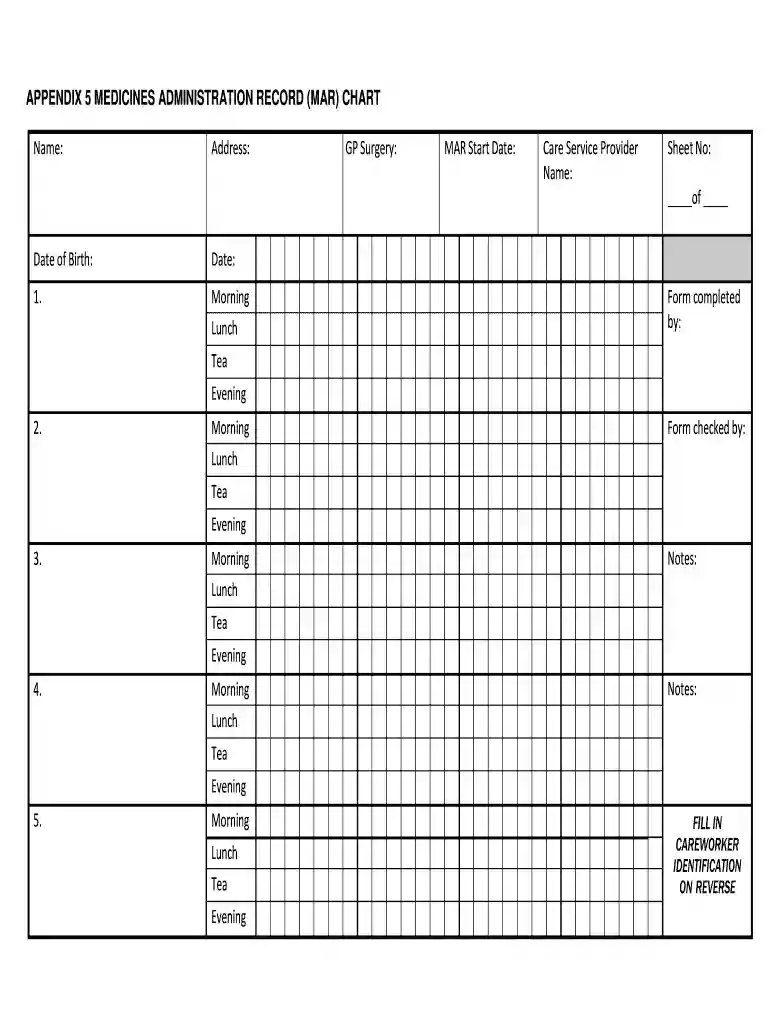
The APPENDIX 5 MEDICINES ADMINISTRATION RECORD (MAR) CHART is a critical document used in healthcare settings to systematically record the administration of medications to patients. It provides a thorough log of medicines given, the time of administration, and the healthcare professional administering them. This chart is not only integral to patient care but also serves as an important record for monitoring drug administration patterns, ensuring adherence to pharmaceutical protocols, and safeguarding against medication errors.
Medication Tracking: The MAR chart details what medications are prescribed, dosage, and frequency. This information is crucial for ensuring that a patient receives their medications accurately.
Accountability: By documenting the identity of the care professional responsible for administering the medication, it fosters accountability and provides a record for audit purposes.
Patient Safety: Ensures medication safety by minimizing the risk of missed doses and incorrect medication administration.
Utilizing the MAR chart involves careful attention to detail and adherence to established protocols to ensure accurate medication administration.
Preparation: Before administering medication, verify the patient's identity using two identifiers, such as name and date of birth, and cross-reference these with the MAR chart to confirm the correct delivery.
Documentation: Accurately record each medication administered, using the chart to log details such as medication name, dosage, and time of administration.
Review & Sign: After administering the medication, review the entry on the MAR chart for accuracy and sign your name to confirm that the entry is correct and complete.
Follow-up: Monitor the patient for any adverse reactions or side effects, and document any observations on the MAR chart for continuity of care.
Obtaining the MAR chart typically involves coordination with healthcare facilities or a designated care provider. It may vary slightly based on institutional policies or geographic location.
Healthcare Facility: Most healthcare institutions or care homes provide standardized MAR charts to their staff as part of routine patient care protocols.
Purchase: Some facilities may have the MAR chart available for purchase from medical supply companies that specialize in healthcare documentation tools.
Digital Access: In some cases, the chart may be available digitally through healthcare management software, allowing for electronic record-keeping which supports a paperless documentation approach.
Completing the MAR chart requires methodical documentation and adherence to best practices in medication management.
Identify Information: Ensure the patient's details such as name, address, and GP surgery are correctly filled at the top.
Medication Details: For each entry, document the specific medication administered, including its name, dose, and route (e.g., oral, intravenous).
Timing: Accurately note the time of administration, matching it precisely to scheduled doses.
Sign Off: Each entry must be signed by the administering healthcare professional to validate the record.
Special Instructions: Document any special instructions or considerations related to the medication (e.g., take with food) within the chart.
The MAR chart is integral to ensuring comprehensive patient care and operational efficiency within healthcare settings.
Prevention of Errors: By clearly listing medications and schedules, the chart minimizes the risk for medication discrepancies.
Legal Compliance: Maintains a legal record of all medication administered, which is crucial for compliance with healthcare regulations.
Coordinated Care: Facilitates communication among healthcare team members by providing a centralized record of all medication-related information.
Understanding the components of the MAR chart is crucial for its effective use. The chart is structured to capture all relevant details about medication administration.
Patient Identification: Includes name, date of birth, address, and GP surgery.
Medication Log: Detailed fields for documenting each medication, its dose, the method of administration, and the time of delivery.
Administration Schedule: Space to log each occurrence of medication given during different times of the day (morning, lunch, tea, and evening).
Signature Fields: Areas for healthcare providers to sign, verifying that the records are complete and accurate.
Care Provider Information: Details of the healthcare or care service provider responsible for the patient's medication management.
Familiarity with key terminology associated with the MAR chart enhances understanding and accuracy in its completion.
Dosage: The specific amount of medication prescribed for a patient, noted in milligrams or other relevant units.
Route of Administration: The path by which a drug is taken into the body (e.g., oral, injectable).
Frequency: Indicates how often a medication should be administered, necessary for maintaining therapeutic levels.
Adverse Reaction: Any undesired effect or symptom resulting from medication administration, which should be noted and reported.
The MAR chart is not only a tool for record-keeping but also serves legal purposes.
Compliance with Regulations: Helps organizations comply with laws governing medication administration and documentation.
Audit and Review: Provides a historical record that can be used during audits or reviews to verify proper procedure adherence.
Legal Evidence: In cases of disputes or investigations, the chart serves as evidence of the care and medication provided to the patient.
Various scenarios demonstrate how the MAR chart is used in practice to support effective healthcare delivery.
Residential Care Home: Use the MAR chart to track long-term administration schedules for patients with chronic conditions, ensuring adherence to prescribed therapies.
Hospital Settings: In acute care settings, MAR charts assist in coordinating complex medication regimens across multidisciplinary teams to manage patient treatment plans efficiently.
Home Health Care: When used in the home setting, the MAR chart guides non-professional caregivers, under supervision, to administer medications correctly and report on patient responses.
At DocHub, your data security is our priority. We follow HIPAA, SOC2, GDPR, and other standards, so you can work on your documents with confidence.