






Definition and Purpose of Sample Op-ed Outline docx
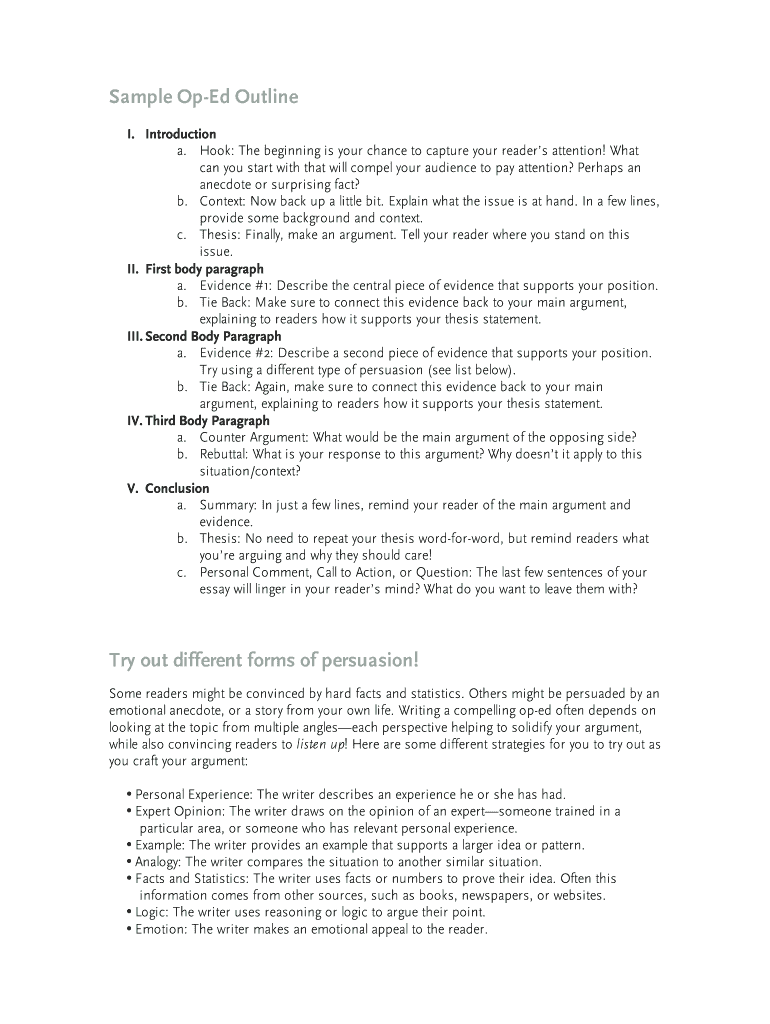
The Sample Op-ed Outline docx is a template designed to guide writers in structuring their opinion editorials effectively. This document sets out a clear framework to assist in organizing thoughts, ensuring that op-eds are compelling and logically organized. It serves as a blueprint for crafting arguments, presenting evidence, addressing counterpoints, and concluding with impactful summaries. The outline highlights essential components such as introductions, body paragraphs with supporting evidence, counterarguments, and calls to action, making it an invaluable tool for both experienced and novice writers.
Components of the Outline
-
Introduction: The introduction should start with a hook to grab the reader's attention. This section sets the stage by presenting the main argument or thesis of the op-ed.
-
Body Paragraphs: Each paragraph should focus on a single point that supports the thesis. Use facts, statistics, and quotes from experts to strengthen your arguments. Include examples to illustrate your points and make them relatable to the audience.
-
Counterarguments: Address potential opposing views to your argument. This section is critical for demonstrating that you have considered different perspectives, which strengthens your credibility.
-
Conclusion: Summarize the key points and restate the thesis in a powerful way. End with a call to action that encourages readers to take a specific step or change their perspective.
How to Use the Sample Op-ed Outline docx
Using the Sample Op-ed Outline docx is straightforward and can optimize the writing process of your opinion piece. Here’s how you can apply it:
-
Start with the Introduction: Draft a compelling introduction that sets the context of your op-ed and introduces the main argument succinctly.
-
Develop the Body: Flesh out each body paragraph based on your points. Refer to the outline to ensure each paragraph flows logically and supports the thesis effectively.
-
Address Counterarguments: Use this section of the outline to foresee objections that readers might have. Present these counterarguments and refute them logically.
-
Craft a Strong Conclusion: Use the template to distill your points into a concise conclusion, ensuring that the op-ed feels complete and impactful.
Steps to Complete the Sample Op-ed Outline docx
-
Gather Information: Collect data, quotes, and any relevant research that will support your thesis.
-
Draft an Outline: Use the template to organize your initial ideas and structure your arguments logically.
-
Write Each Section: Fill out each section of the template with detailed content, ensuring clarity and coherence.
-
Revise and Edit: Check for logical flow, factual accuracy, and grammatical correctness. Ensure each argument is presented strongly.
-
Finalize the Op-ed: Once satisfied, review your op-ed for any last-minute changes or enhancements.
Key Elements of the Sample Op-ed Outline docx
- Thesis Statement: A clear, concise statement that conveys the main point of your op-ed.
- Supporting Evidence: Utilize robust data and historical examples to reinforce your argument.
- Engagement Techniques: Use rhetorical questions, anecdotes, and vivid imagery to capture the reader’s interest.
- Logical Progression: Ensure there is a coherent flow from one section to the next, maintaining the reader’s attention.
Who Typically Uses the Sample Op-ed Outline docx
This document is typically used by journalists, academics, students, and professionals looking to contribute opinion pieces to media outlets. It is also valuable for anyone interested in effectively persuading an audience through writing. Educators may use it as a teaching tool to demonstrate effective op-ed writing strategies to their students.


Legal Implications of Using the Sample Op-ed Outline docx
While the Sample Op-ed Outline docx does not impose legal implications, it guides users in presenting arguments responsibly, potentially reducing the risk of defamation. Writers are encouraged to support their claims with factual evidence, which is key to avoiding legal disputes arising from false statements.
Examples of Using the Sample Op-ed Outline docx
Consider a writer who wants to address climate change through an op-ed. By leveraging the outline, the writer can structure the argument starting with a compelling introduction about recent global warming trends, followed by supporting evidence on its impact, refuting common myths, and concluding with actions individuals can take to reduce their carbon footprint.
Another example involves a student penning an op-ed on educational reforms. The outline guides the student to layout current educational challenges, propose feasible solutions, and debate counterpoints from the administration's perspective, culminating in a well-rounded opinion piece.
Online and Offline Version Comparison
The Sample Op-ed Outline docx is available in both digital and printable formats, allowing users flexibility in how they choose to engage with the content. The digital version enables easy edits and updates, making it ideal for collaborative projects or iterative revisions. The paper version, while less flexible for editing, provides a tangible format that some users might find more comfortable for drafting ideas or as a reference during the writing process.