
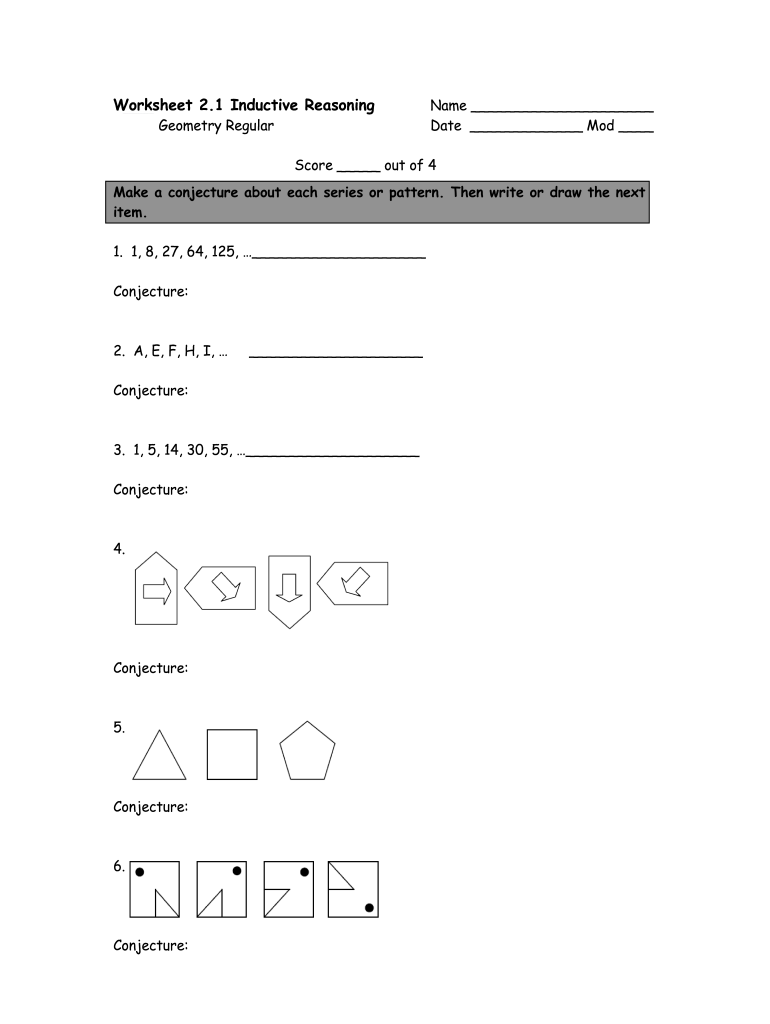







Definition & Meaning of Worksheet Inductive Reasoning
The worksheet for inductive reasoning is an educational tool designed to help students develop their logical reasoning skills by identifying patterns, making conjectures, and drawing conclusions based on specific examples or data sets. Inductive reasoning involves forming generalizations based on specific observations. In a mathematical context, it usually includes recognizing patterns in numbers or shapes and predicting future occurrences or outcomes based on those patterns.
Importance of Inductive Reasoning
- Foundation for Mathematics: This type of reasoning is essential in mathematics, as it allows students to form hypotheses and develop critical thinking.
- Problem-Solving Skills: It enhances problem-solving capabilities, preparing students for more complex logical reasoning challenges in higher education and real-world scenarios.
- Real-World Application: Inductive reasoning helps in various fields like science, economics, and everyday decision-making by teaching individuals how to infer general rules from specific observations.
How to Use the Worksheet Inductive Reasoning
To effectively utilize an inductive reasoning worksheet, follow these steps:
-
Familiarization: Begin by understanding the content of the worksheet. Identify the patterns and types of problems it includes (e.g., sequences, logical statements).
-
Pattern Recognition: Work through the examples provided. Focus on recognizing patterns in the numerical or alphabetical data presented.
-
Making Conjectures: Once patterns are identified, practice making conjectures based on these observations. Encourage students to explain their reasoning for stronger comprehension.
-
Answer Key Utilization: After attempting the exercises, refer to the answer key if available. This will help validate reasoning and clarify misunderstandings.
-
Discussion and Reflection: Engage in group discussions about different approaches taken during the worksheet exercises to reinforce learning and clarify different reasoning strategies.
Tips for Effective Use
- Encourage collaborative work to enhance peer learning.
- Use additional resources, such as textbooks or online lectures, for deeper insights.
- Regularly incorporate worksheets into the curriculum to develop consistent reasoning skills.
How to Obtain the Worksheet Inductive Reasoning
Worksheet inductive reasoning resources can be easily acquired through several methods:
- Educational Websites: Many educational platforms provide downloadable PDFs of worksheets tailored for different levels of instruction.
- Teaching Resources: Teachers often create or access worksheets from educational websites dedicated to mathematics resources, which can include both free and paid materials.
- School Curriculum: Check whether your school provides these worksheets as part of their curriculum, particularly in mathematics or logical reasoning courses.
- Print Options: Many PDFs come in print-friendly formats, making them easy to use in classroom or home settings.
Steps to Complete the Worksheet Inductive Reasoning
Completing an inductive reasoning worksheet involves a structured process to maximize learning outcomes. Consider the following steps:
- Read Instructions Carefully: Ensure understanding of what each exercise requires.
- Analyze Given Examples: Spend time reviewing the examples to see how conclusions are drawn.
- Attempt Exercises: Independently try to solve the problems before referring to any aids.
- Check Work with Answers: Use the answer key to compare answers and understand any discrepancies.
- Seek Feedback: If applicable, discuss results with peers or educators for additional insights.
Practical Applications
- Practice Exercises: Work on additional problems found online or in textbooks.
- Collaborative Learning: Share sheets with classmates or study groups to discuss different answers and reasoning strategies.
Key Elements of the Worksheet Inductive Reasoning
The worksheet typically includes several key components to foster comprehensive learning:
- Variety of Problems: Problems should range from simple pattern recognition to complex logical reasoning tasks.
- Answer Section: An answer key is beneficial for self-verification once the exercises are completed.
- Clear Instructions: Instructions for each section should be straightforward and easy to comprehend.
- Visual Aids: Including diagrams or visual representations can enhance understanding and engagement.
Usage in Educational Settings
- In-Class Assignments: Teachers frequently use these worksheets as part of classroom activities to enhance student engagement.
- Homework Assignments: They serve as effective homework that reinforces classroom learning.
- Assessment Tools: Worksheets can also be utilized to assess student understanding of inductive reasoning concepts.
Important Terms Related to Worksheet Inductive Reasoning
Familiarity with the following terms is essential when working with inductive reasoning worksheets:
- Conjecture: A conclusion based on inductive reasoning derived from patterns.
- Observation: Specific instances or examples that lead to a general rule.
- Pattern: A discernible regularity or theme present in data sets that facilitate reasoning.
- Logical Statement: A statement that can be evaluated as true or false, forming the basis of reasoning exercises.
Importance of Terms
Understanding these terms not only aids in successfully navigating worksheets but significantly enhances the depth of mathematical comprehension and reasoning skills.
Examples of Using the Worksheet Inductive Reasoning
Worksheets typically contain various exercises that serve as practical examples of inductive reasoning. Here are some common exercises:
- Number Patterns: Identify the next number in a series (e.g., 2, 4, 6, __).
- Alphabetical Patterns: Determine the next letter based on a specific rule (e.g., A, C, E, __).
- Logical Statements: Given a set of conditions, deduce whether certain statements hold true.
Incorporating Real-World Context
Real-life scenarios, such as analyzing trends in data or patterns in nature, can help students relate abstract concepts to practical applications, enhancing engagement and understanding.
Summary of Key Contributions
The worksheet for inductive reasoning serves not only as a learning tool but also as a means of developing critical thinking and problem-solving abilities essential for academic success. By effectively utilizing these worksheets, students can strengthen their ability to recognize patterns and draw logical conclusions, skills vital in higher levels of mathematics and various real-world situations.




