Form st 18 2026

Get Form
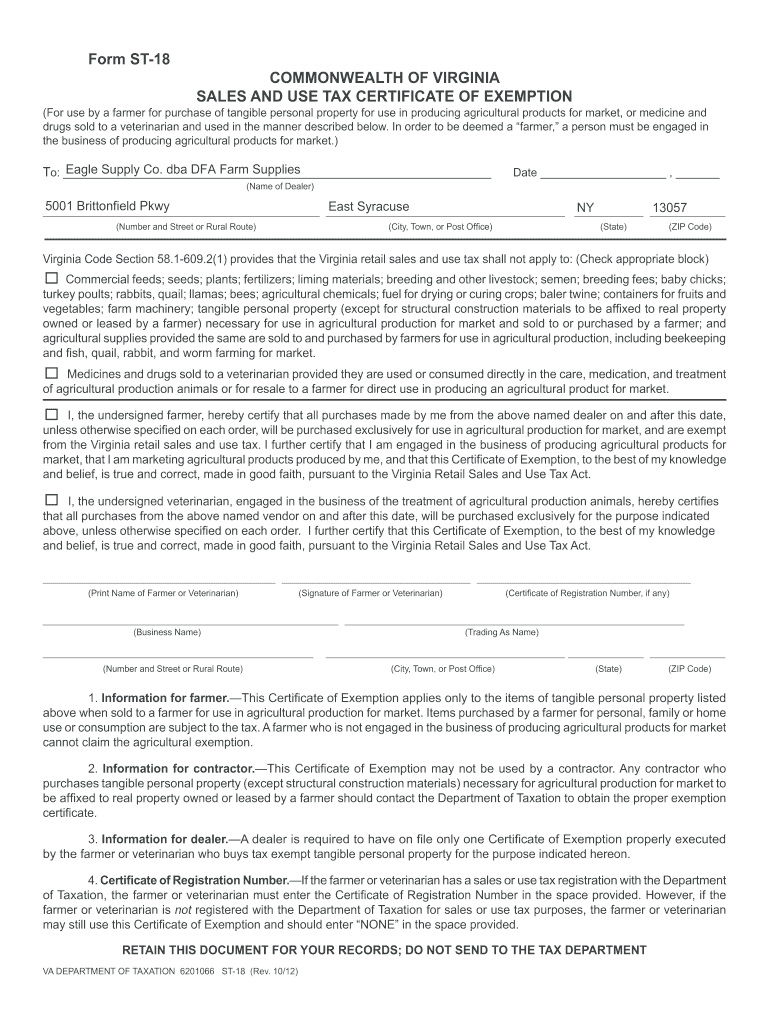
form st 18 Preview on Page 1

Here's how it works

01. Edit your form st 18 online
Type text, add images, blackout confidential details, add comments, highlights and more.
02. Sign it in a few clicks
Draw your signature, type it, upload its image, or use your mobile device as a signature pad.
03. Share your form with others
Send st 18 via email, link, or fax. You can also download it, export it or print it out.

How to use or fill out form ST-18 with our platform

Form edit decoration
9.5
Ease of Setup
DocHub User Ratings on G2
9.0
Ease of Use
DocHub User Ratings on G2
  1. Click ‘Get Form’ to open it in the editor.
  2. Begin by entering the name of the dealer in the designated field. This is crucial for identifying where your purchases will be made.
  3. Fill in the date of the transaction. Ensure this is accurate as it establishes the validity of your exemption.
  4. Complete your address details, including street number, city, state, and ZIP code. This information helps verify your identity as a farmer or veterinarian.
  5. Check the appropriate boxes that apply to your purchases. This section outlines what items are exempt from sales tax under Virginia law.
  6. Sign and print your name at the bottom of the form. If applicable, include your Certificate of Registration Number for verification purposes.
  7. Review all entered information for accuracy before saving or exporting your completed form.

Start using our platform today to streamline your form completion process for free!

be ready to get more

Complete this form in 5 minutes or less

Get form

Got questions?

We have answers to the most popular questions from our customers. If you can't find an answer to your question, please contact us.
Contact us
Examples of farming expenses that can be deducted: Business Use of Your Home (must use exclusively and regularly) Car and Truck expenses. Chemicals. Depreciation. Feed. Fertilizer. Gasoline, fuel and oil. Rent or lease of property or equipment.
Federal Qualifications First, ensure your operation is legally a farm as defined by the IRS. Generally, a farming business raises or grows a product and sells that product without further processing or modification. Examples of qualifying farm activities include: Raising and harvesting crops.
Federal Qualifications Generally, a farming business raises or grows a product and sells that product without further processing or modification. Examples of qualifying farm activities include: Raising and harvesting crops. Raising and managing livestock.
Commercial feeds; seeds; plants; fertilizers; liming materials; breeding and other livestock; ; breeding fees; baby chicks; turkey poults; rabbits; quail; llamas; bees; agricultural chemicals; fuel for drying or curing crops; baler twine; containers for fruit and vegetables; farm machinery; medicines and drugs
An exemption certificate is a document that allows tax-exempt purchases based on the status or circumstances of the purchaser. A resale certificate is a document that allows a business to make tax-exempt purchases based on the assumption the goods will be resold and the sales tax will be paid by the end consumer.

Security and compliance

At DocHub, your data security is our priority. We follow HIPAA, SOC2, GDPR, and other standards, so you can work on your documents with confidence.

Learn more
ccpa2
pci-dss
gdpr-compliance
hipaa
soc-compliance
be ready to get more

Complete this form in 5 minutes or less

Get form

People also ask

To qualify a property as a farm for tax purposes, there is no specific minimum number of animals required. Instead, the IRS defines a farm based on the activities conducted on the property. According to the IRS, a farm includes livestock, dairy, poultry, fish, fruit, and truck farms.
Another question that frequently comes up in this discussion is how big does my farm have to be to be considered a farm? Since property taxes are handled at the local level rather than the federal level, the answer will vary from state to state. Generally speaking, there is no minimum acreage for farm tax exemption.
Some customers are exempt from paying sales tax under Oklahoma law. Examples include government agencies, some nonprofit organizations, and merchants purchasing goods for resale. Sellers are required to collect a valid exemption or resale certificate from buyers to validate each exempt transaction.

Related links