




01. Edit your show jumping score sheet template online
Type text, add images, blackout confidential details, add comments, highlights and more.

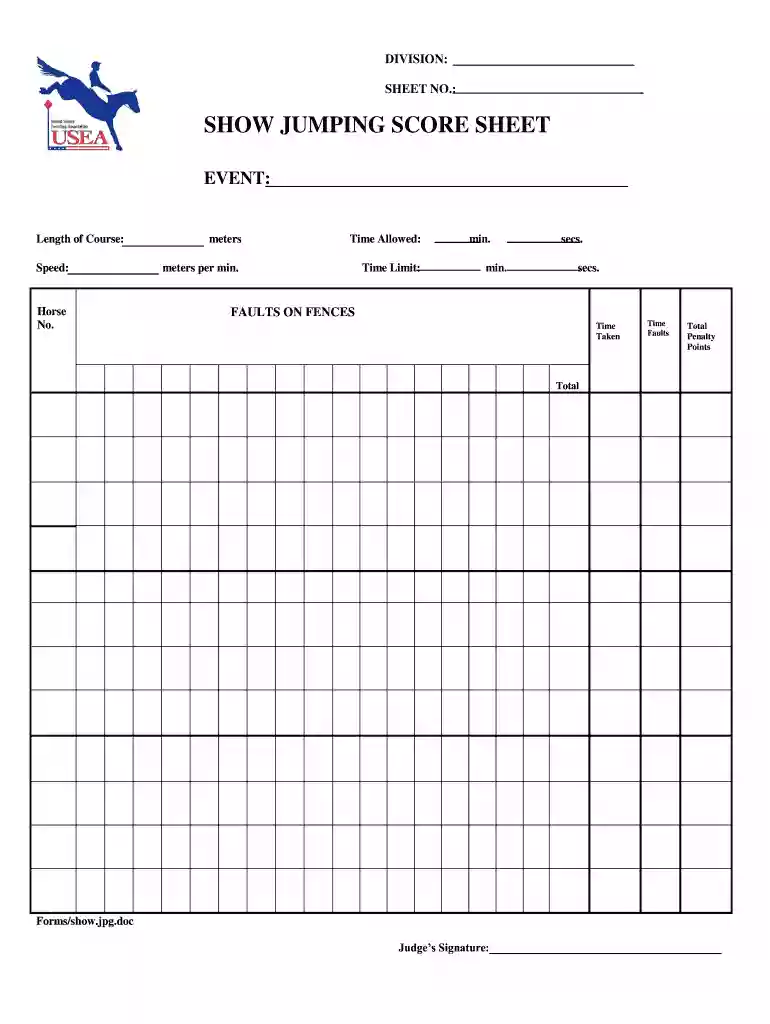
Type text, add images, blackout confidential details, add comments, highlights and more.

Draw your signature, type it, upload its image, or use your mobile device as a signature pad.

Send show jumping score sheets via email, link, or fax. You can also download it, export it or print it out.
The show jumping score sheet is a critical document used in equestrian competitions to assess and record a competitor's performance during a show jumping event. The sheet provides official documentation that judges use to evaluate each rider and horse pair based on various performance metrics, such as faults committed, penalties, and time taken to complete the course.
Typically, the score sheet details the course length, the time allowed, and penalties for faults at specific jumps or obstacles. It is instrumental in determining the overall standing of each competitor relative to others in the event.
Utilizing the show jumping score sheet effectively requires understanding its layout and the crucial elements it captures. This allows judges, competitors, and event organizers to accurately assess performance.
Understanding the terminology associated with the show jumping score sheet is vital for both judges and competitors. Here are key terms and their meanings:
Real-world applications of the show jumping score sheet illustrate its relevance in competitive settings. Below are examples of how to implement the sheet across different scenarios.
At a local show, a competitor rides their horse successfully but incurs one fault at their fourth jump, resulting in a penalty of four points. Their time is recorded as 75 seconds. On the score sheet, the judge notes:
During a state championship, competitors aim for precision as they navigate complex courses. One rider completes their round with two faults at different jumps. In this case:
The show jumping score sheet primarily serves various stakeholders within equestrian competitions. The key users include:
By familiarizing themselves with the score sheet's structure and purpose, these users can enhance the overall experience of show jumping events.


We've got more versions of the show jumping score sheet template form. Select the right show jumping score sheet template version from the list and start editing it straight away!
At DocHub, your data security is our priority. We follow HIPAA, SOC2, GDPR, and other standards, so you can work on your documents with confidence.
AQHA Trail Score Sheet Purpose: For horses with jumping experience showing Training Level Dressage or above -.Read more
This page provides a quick cheat sheet with commonly used stats etc. Show Jumping, Canter, back, shoulders, front legs, hindquarters, AccelerationRead more
SCORING: Scoring shall be on the basis of 0 to 100, with an approximate breakdown as follows: 90 100 Excellent Equitation, position and presentation;Read more


