
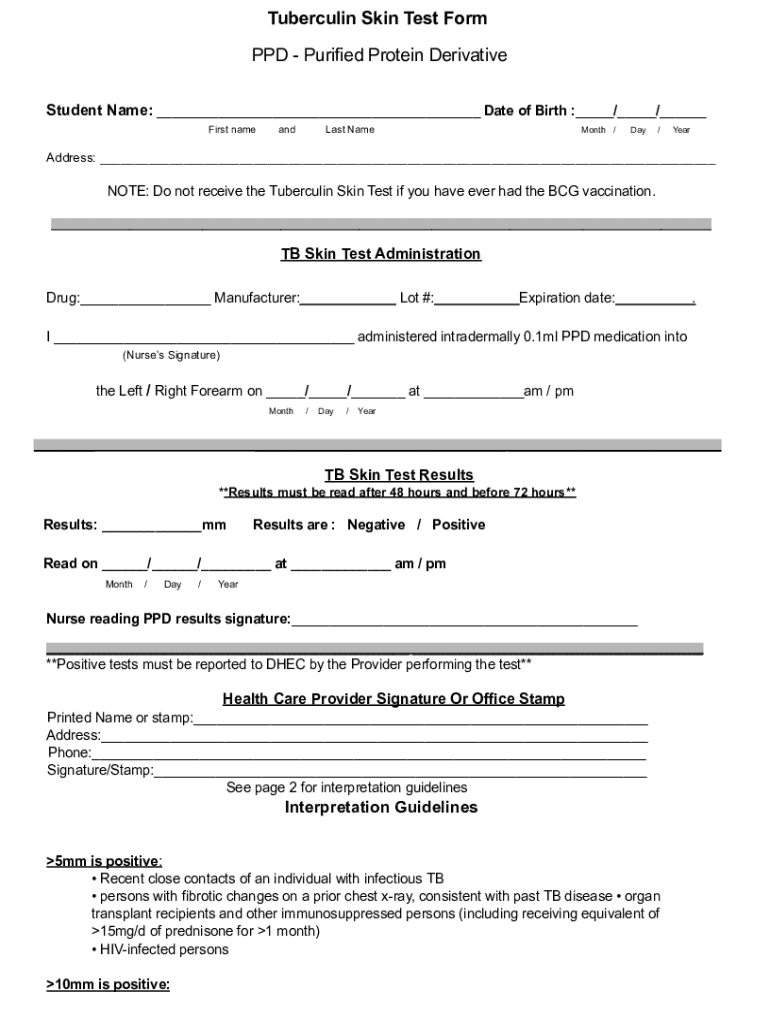







Definition and Purpose of the Provider TB Skin Test Form
The Provider TB Skin Test Form is a critical document used in healthcare settings to administer and record the results of a tuberculin skin test. This test is essential in diagnosing tuberculosis infections. The form contains various sections designed to capture comprehensive details about the patient and the testing process. These sections include patient information, administration details, interpretation guidelines, and mandatory reporting requirements for positive results. By standardizing data collection and interpretation, the form ensures that healthcare providers adhere to best practices in evaluating TB infection risks.
How to Use the Provider TB Skin Test Form
To effectively use the Provider TB Skin Test Form, healthcare providers must follow structured steps for accuracy and consistency. Begin by filling out the patient information section, which includes name, date of birth, and contact details. Next, document the test administration details such as the date of the test, specific testing site on the body, and the tuberculin strength used. After 48 to 72 hours, the test site should be evaluated for induration, and the measurement in millimeters should be noted on the form. The healthcare provider should also note any additional risk factors for TB infection that may influence interpretation. The completed form serves as an official record for both the patient and healthcare institution.
Steps to Complete the Provider TB Skin Test Form
-
Gather Necessary Information: Collect all relevant patient data, including medical history and potential risk factors for tuberculosis.
-
Administer the Test: Use a standard tuberculin syringe to inject the PPD solution intradermally and document the procedure date.
-
Read Test Results: Return to the patient within 48 to 72 hours to measure the induration at the test site. Record this measurement in millimeters.
-
Interpret Results: Refer to the form’s guidelines to determine the test result as positive or negative, incorporating any additional risk considerations.
-
Document and Report: Fill out the results section accurately, and if the test is positive, report to relevant health authorities as required by law.
Key Elements of the Provider TB Skin Test Form
The form comprises several key components:
-
Patient Information: Basic demographic details and medical histories, such as previous exposure to TB or immunocompromising conditions.
-
Test Administration: Details about the test procedure, including the date, the site of injection, and the type of tuberculin solution used.
-
Result Interpretation Guidelines: Criteria for determining positive or negative results based on millimeter measurements and risk assessment.
-
Reporting Instructions: Protocols for submitting positive results to health departments to help in public health monitoring and response.
Important Terms Related to the Provider TB Skin Test Form
Understanding specific terms is vital for the correct completion of this form:
-
Induration: The palpably rigid area around the injection site that is measured to determine the test result.
-
PPD (Purified Protein Derivative): The protein-derived solution used in the test to detect tuberculosis infection.
-
BCG Vaccine: A vaccination for TB that might influence the reaction to a tuberculin skin test.
-
Latent TB Infection (LTBI): A condition where the person is infected with Mycobacterium tuberculosis but does not show active symptoms.
Legal Use of the Provider TB Skin Test Form
The use of this form falls under various legal and regulatory frameworks to ensure public health safety and reliability. It must be completed and stored in accordance with privacy laws such as HIPAA, which protect patient information. Positive test results are often subject to mandatory reporting to state or local health departments. Healthcare providers are obligated to follow these legal guidelines to prevent the spread of tuberculosis and protect community health.
State-Specific Rules for the Provider TB Skin Test Form
Guidelines governing the use of the Provider TB Skin Test Form can differ by state. Some states might have additional requirements for reporting or specific protocols for interpreting results due to local epidemiological factors. Providers should verify state-specific regulations, as these can affect both the administration process and the subsequent actions on positive results. Compliance ensures that medical practices adhere to local public health standards while minimizing the risk of tubercular outbreaks.
Digital vs. Paper Version: Which to Use?
The availability of the Provider TB Skin Test Form in both digital and paper versions offers flexibility. Digital forms allow for easier data entry, storage, and sharing, ideal for integration into electronic health records. They often include interactive fields that streamline the documentation process. Paper forms, however, remain vital in settings with limited digital infrastructure or for those who prefer or require a physical document trail. Choosing the appropriate version depends on the facility’s capabilities and patient preferences.




