




01. Edit your form online
Type text, add images, blackout confidential details, add comments, highlights and more.

Type text, add images, blackout confidential details, add comments, highlights and more.

Draw your signature, type it, upload its image, or use your mobile device as a signature pad.

Send it via email, link, or fax. You can also download it, export it or print it out.
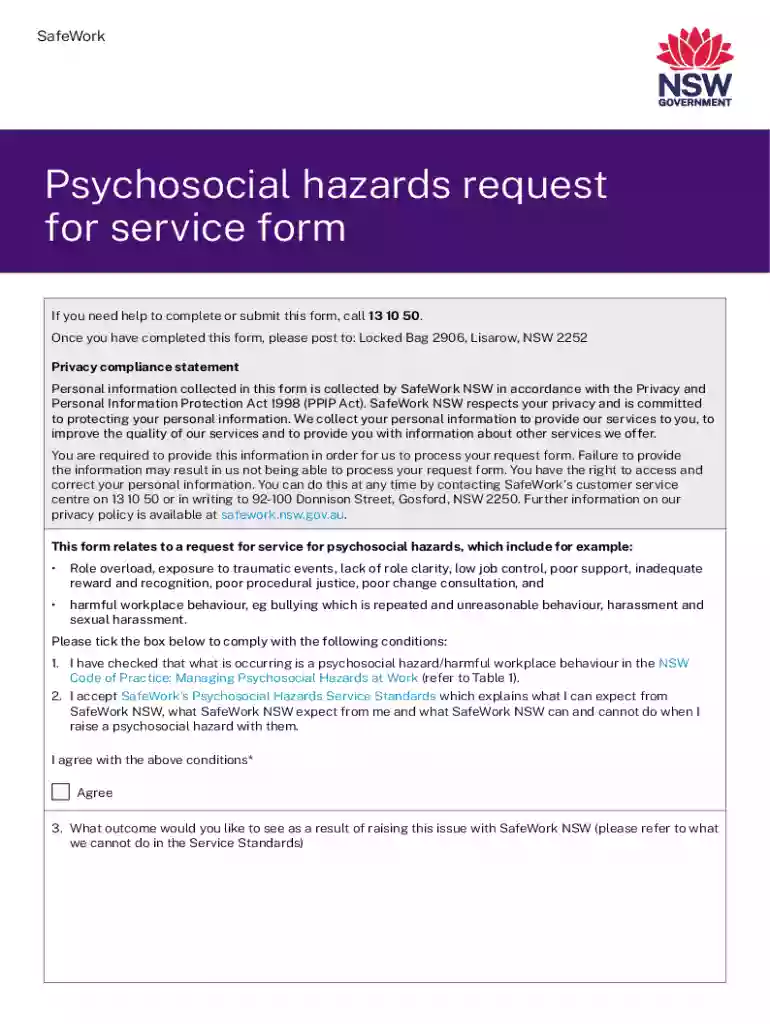
The Psychosocial Hazards Request for Service Form, issued by SafeWork NSW, is a formal document designed to report and address psychosocial risks in the workplace. These hazards can encompass a wide range of issues, including but not limited to role overload, workplace bullying, and harassment. The form is structured to capture detailed information about the psychosocial concerns, examples of incidents, and supporting evidence. By using this form, individuals ensure that their reports are taken seriously and handled in alignment with legal frameworks and privacy requirements. It acts as a critical tool in fostering safe work environments by enabling proper reporting and facilitating intervention when necessary.
Using the Psychosocial Hazards Request for Service Form requires understanding its structure to effectively communicate concerns. Here are the steps to utilize the form comprehensively:
Gather Necessary Information: Before filling out the form, collect all relevant details about the hazard, including dates, location, and individuals involved.
Document Specific Incidents: Clearly outline incidents with examples and evidence. This may include emails, eyewitness accounts, or logs of occurrences.
Follow Internal Procedures: Confirm that internal protocols have been pursued prior to submitting the form to SafeWork NSW. This might require speaking with HR or a direct supervisor.
Complete the Form Accurately: Ensure all fields are filled out accurately. Incorrect information can delay the process or lead to miscommunication.
Submit the Form to SafeWork NSW: Depending on the provided instructions, submit the form either digitally or physically to the appropriate SafeWork NSW department.
The Psychosocial Hazards Request for Service Form is available through several channels to ensure accessibility:
SafeWork NSW Website: The most direct method is to download the form from the official SafeWork NSW website, ensuring you have the latest version.
Contacting SafeWork NSW: If online access is not feasible, individuals can contact SafeWork NSW directly via phone or email to request a form.
Workplace Resources: In some cases, HR departments may have copies of the form or information on how to access it.
Filling out the Psychosocial Hazards Request for Service Form involves a step-by-step approach:
Personal Information Section: Begin by providing personal identifiers such as your name, position, and contact information.
Description of Hazards: Provide a comprehensive description of the hazards observed. This should be detailed and include all relevant circumstances.
Evidence and Documentation: Append any evidence that supports your claim. Lack of documentation might make it challenging to address the hazard effectively.
Acknowledgment and Signature: Finally, acknowledge your understanding of the process by signing the document where required, certifying that all information is truthful and complete.
This form is primarily used by employees and representatives within organizations who have observed or experienced psychosocial hazards. It is particularly relevant for:
Employees: Facing issues directly related to their mental wellbeing due to workplace conditions.
HR Professionals: Those tasked with ensuring a safe workplace environment and need formal documentation of reported issues.
Management and Supervisors: Individuals monitoring workplace culture and wanting to ensure compliance with safety standards.


When used correctly, the form serves a legal purpose in maintaining workplace safety. Its legal use includes:
Compliance: Ensuring organizations comply with workplace safety regulations as dictated by SafeWork NSW.
Evidence of Reporting: Acts as a documented record of report submission, which could be pivotal in investigations or legal proceedings.
Privacy Protection: Aligns with privacy laws, ensuring reported information is handled with confidentiality and only used for intended purposes.
The form is comprised of several critical elements to capture comprehensive data:
Identification of Hazard: A clear outline of the type of psychosocial hazard, such as bullying or role-related stress.
Impact Assessment: Detailed description of how the hazard affects employee wellbeing and work performance.
Action Taken: Document any steps already taken internally to address the issue before escalating it to SafeWork NSW.
Practical scenarios of using the form include:
Workplace Bullying: An employee submits the form to report consistent hostile behavior from a colleague, supported by emails detailing the exchange.
Role Overload: A team member reports excessive workload leading to stress and potential burnout, citing specific projects and deadlines as evidence.
Harassment Complaints: An individual submits the form after enduring unwanted remarks, accompanied by witness statements.
Implementing this structured approach with the Psychosocial Hazards Request for Service Form helps in documenting and mitigating workplace risks effectively.
At DocHub, your data security is our priority. We follow HIPAA, SOC2, GDPR, and other standards, so you can work on your documents with confidence.





Feb 19, 2020 We will undertake a psychosocial risk assessment to better understand the risks which exist across our business and our workforce. We will
by A Jain 2021 Cited by 128 Legal and policy context relating to occupational health services (OHS), psychosocial risks and mental health at work.
by E Laloo 2025 Psychosocial safety climate (PSC) is a construct that has been found to address psychosocial hazards at the organisational level (Dollard. Bakker, 2010;


