
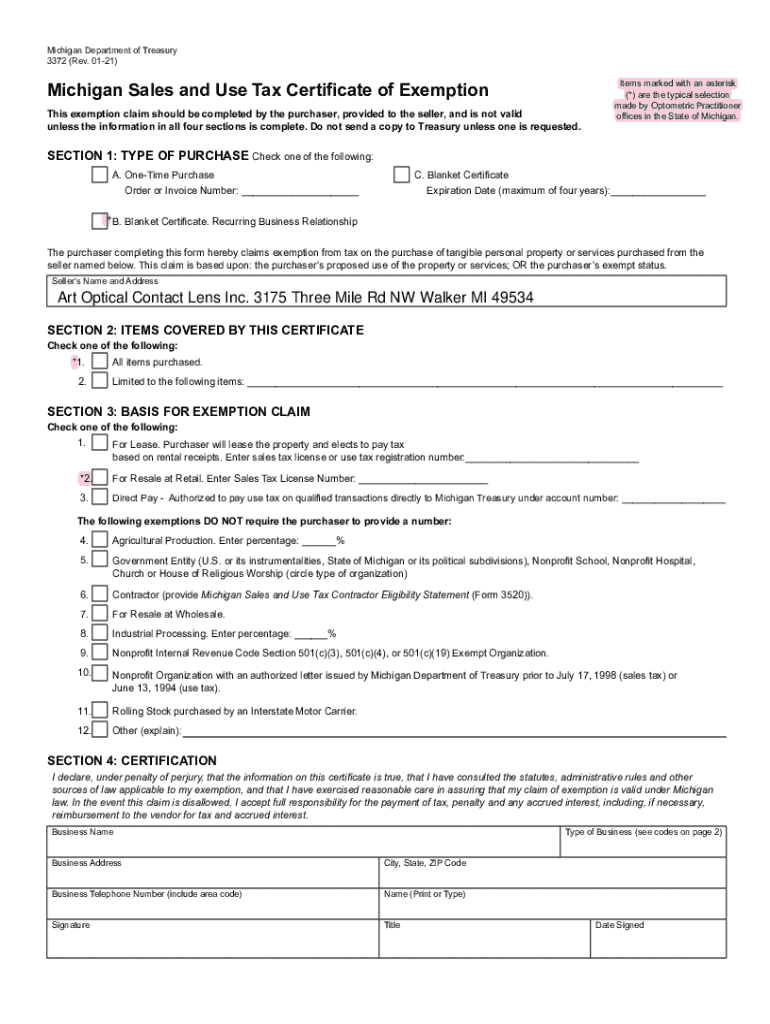







Definition and Purpose of the Tax Exempt Form Michigan
The Tax Exempt Form Michigan, formally known as the Michigan Sales and Use Tax Certificate of Exemption (Form 3372), is a crucial document for businesses and individuals engaged in certain transactions exempt from sales and use tax. This certificate is utilized to claim tax exemptions on qualified purchases, ensuring that the seller does not collect taxes on transactions covered by the exemption criteria.
Primary Features
- Exemption Qualification: The form is used to specify the criteria under which a purchase can be considered exempt from state taxes.
- Document Requirements: Purchasers must fill out specific sections detailing the nature of the purchase, the items involved, and the legal basis for claiming the exemption.
- Certification: The purchaser must certify and sign the form, affirming that the information provided aligns with state laws and regulations.
How to Use the Michigan Sales and Use Tax Certificate of Exemption
Utilizing the Tax Exempt Form Michigan correctly involves understanding the specific requirements laid out by the state regarding eligible transactions. Adherence to these guidelines is crucial for both compliance and validation of the tax exemption claim.
Steps to Utilization
- Identify Eligible Transactions: Determine if your purchase qualifies for an exemption under Michigan law. This typically includes certain business-related purchases, resales, or final sales stage transactions.
- Complete the Form: Enter accurate details in each section, ensuring the information corresponds to the type of exemption being claimed.
- Provide to Seller: Once filled, the form must be handed over to the seller during the time of purchase to avoid sales tax being applied.
Obtaining the Tax Exempt Form Michigan
Procurement of the Tax Exempt Form Michigan is straightforward and accessible through multiple channels as provided by the Michigan Department of Treasury.
Access Points
- Online: The form can be downloaded directly from the official Michigan government website as a printable PDF.
- In-Person: Forms can often be collected from local Department of Treasury offices or other governmental agencies overseeing tax-related operations.
Steps to Complete the Form
Filling out the Tax Exempt Form Michigan requires careful attention to detail and adherence to the form's sections and instructions to ensure valid submission.
Completion Procedure
- Section A - Purchase Type: Indicate the nature of purchase, such as resale, government, or manufacturing exemption.
- Section B - Items Covered: List detailed descriptions of items intended for exemption.
- Section C - Basis for Exemption: Clearly state legal reasons for the exemption according to Michigan statutes.
- Section D - Certification: Sign and date the form to verify correctness and compliance with tax laws.
Who Uses the Michigan Sales and Use Tax Certificate of Exemption
The form serves diverse user groups whose purchases qualify for tax exemption according to Michigan state law.
Typical Users
- Retailers and Wholesalers: Entities purchasing goods for resale without the intended use.
- Non-Profit Organizations: Charitable, religious, or educational institutions exempted under specific legal frameworks.
- Manufacturers: Companies buying raw materials or components integral to manufacturing procedures.
Legal Considerations of Using the Form
Ensuring the form's proper legal use involves understanding its implications and aligning with required disclosure and documentation practices.
Legal Implications
- Audit Risk: Incorrect or fraudulent use can result in audits by state authorities and subsequent penalties.
- Record Keeping: Both sellers and purchasers must maintain comprehensive records of exempt transactions for legal review and compliance checks.
State-Specific Rules in Michigan
Understanding Michigan-specific stipulations regarding the exemption certificate is critical for compliance and effective utilization.
Key Regulations
- Record Maintenance: Sellers must keep exemption certificates on file to verify exempt sales in case of state examination.
- Annual Review: Businesses are advised to review their tax exemption status annually to ensure ongoing compliance with changing laws.
Practical Examples of Utilizing the Form
Application scenarios provide clarity on how the Tax Exempt Form Michigan can play a role in different common business situations.
Example Scenarios
- Resale Cases: A clothing retailer buying inventory to sell directly to customers, bypassing the sales tax to lower initial costs.
- Manufacturing Exemption: An automotive parts manufacturer purchasing raw materials that contribute to a final taxable product, leveraging the exemption to reduce operational expenses.
Each of these examples illustrates the practical application of the Michigan Sales and Use Tax Certificate of Exemption and highlights the necessity of understanding the form's nuances for effective business operation compliance.




