




01. Edit your 2016 ohio it 1040 online
Type text, add images, blackout confidential details, add comments, highlights and more.

Type text, add images, blackout confidential details, add comments, highlights and more.

Draw your signature, type it, upload its image, or use your mobile device as a signature pad.

Send 2016 ohio via email, link, or fax. You can also download it, export it or print it out.
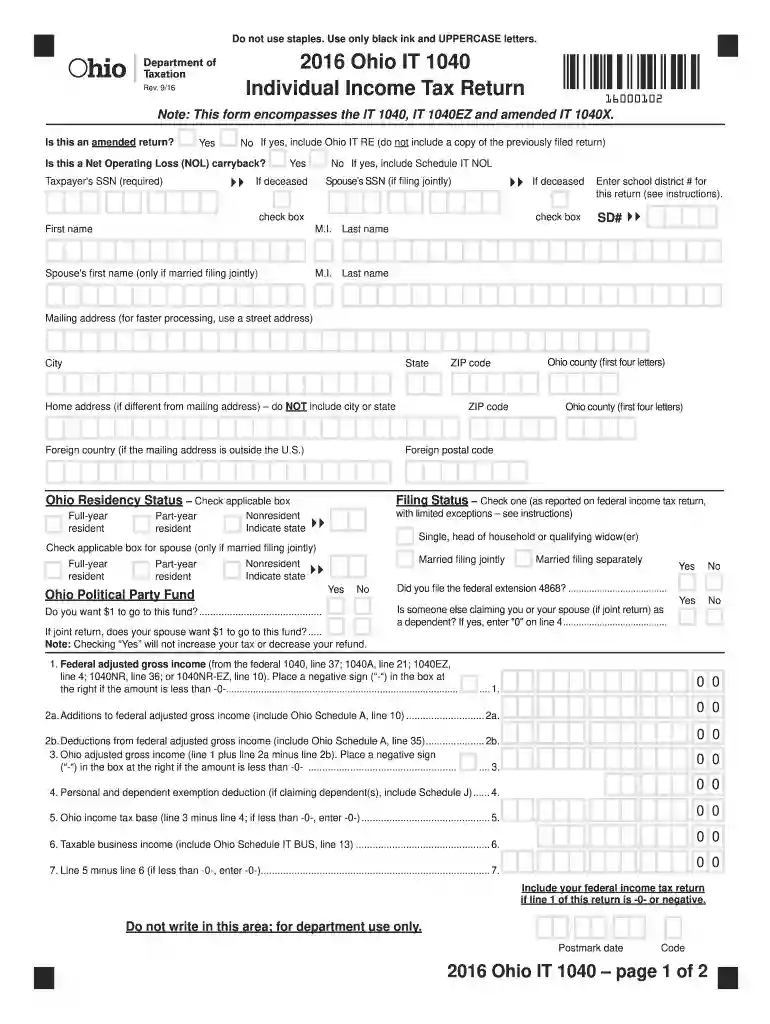
The 2016 Ohio IT 1040 Individual Income Tax Return form is a critical document used by Ohio residents to report their personal income and calculate their state tax obligation. This form is essential for individuals who are legally required to file a tax return due to income earned during the year 2016. It serves as both a report of income and a request for potential tax refunds or confirmation of taxes owed. Understanding its purpose can help ensure the accurate completion of tax responsibilities.
To obtain the 2016 Ohio form, taxpayers can download it directly from the Ohio Department of Taxation's website. This ensures access to the most accurate version of the form. Additionally, hard copies can often be found at local libraries or government offices, or by requesting a print copy directly from the Department of Taxation. For those who prefer digital means, the form can also be accessed through tax preparation software that supports the filing of state tax returns.
Gather Necessary Documents: Before beginning, ensure that you have all necessary documentation, including W-2s, 1099s, and receipts for any deductions claimed.
Fill Out Personal Information: Start by entering your name, Social Security number, and filing status at the top of the form.
Report Income: Fill in all income sources, including wages, dividends, and any additional taxable income.
Determine Deductions and Credits: Calculate any deductions or credits you are eligible for, such as those for dependents or educational expenses.
Calculate Tax Liability: Use the provided tables and instructions on the form to compute your total tax liability for the year.
Sign and Date the Form: Ensure that both the taxpayer and any tax preparer sign and date the form before submission.
Submit the Form: File the completed form with the Ohio Department of Taxation either by mail or electronically through approved tax software.
Residency Status: This determines how you report your income on the form—whether you are a full-year resident, part-year resident, or nonresident.
Exemptions: Reductions in taxable income for the taxpayer, their spouse, and eligible dependents.
Tax Credits: Different from deductions, credits directly reduce the amount of taxes owed.
Amended Returns: If a mistake is discovered after filing, an amended return may be filed to correct any errors.
Schedules: Additional forms that may accompany the main tax return, detailing specific income, deductions, or credits.
The filing deadline for the 2016 Ohio form aligns with the federal tax deadline, typically April 18th, 2017, due to weekends and holidays affecting the standard April 15th schedule. Extensions may be available upon request, giving taxpayers additional time to complete their returns without incurring penalties. It's crucial to adhere to these deadlines to avoid late filing penalties and interest charges.
Taxpayers must use the 2016 Ohio IT 1040 form to comply with state tax laws, ensuring they pay the appropriate state taxes on their income. Compliance involves correctly reporting all taxable income, claiming allowable deductions and credits, and filing the return by the state deadline. Inaccurate or fraudulent reports can lead to audits, penalties, and legal consequences.
Failing to file the Ohio IT 1040 form, or filing late without a sanctioned extension, can result in penalties. These may include late filing fees and interest charges on any unpaid tax balance. The Ohio Department of Taxation enforces these penalties to encourage compliance and timely filing. Taxpayers are encouraged to keep thorough records and seek assistance if needed to avoid such penalties.
We've got more versions of the 2016 ohio it 1040 form. Select the right 2016 ohio it 1040 version from the list and start editing it straight away!
| Versions | Form popularity | Fillable & printable |
|---|---|---|
| 2024 | 4.6 Satisfied (30 Votes) | |
| 2023 | 4.6 Satisfied (37 Votes) | |
| 2022 | 4.2 Satisfied (24 Votes) | |
| 2021 | 4.2 Satisfied (43 Votes) | |
| 2020 | 4.8 Satisfied (113 Votes) | |
| 2019 | 4.4 Satisfied (193 Votes) | |
| 2018 | 4.2 Satisfied (94 Votes) | |
| 2017 | 4.4 Satisfied (219 Votes) | |
| 2016 | 4.4 Satisfied (161 Votes) | |
| 2016 | 4 Satisfied (25 Votes) | |
| 2015 | 4 Satisfied (67 Votes) | |
| 2013 | 4.2 Satisfied (95 Votes) | |
| 2009 | 4 Satisfied (54 Votes) |
At DocHub, your data security is our priority. We follow HIPAA, SOC2, GDPR, and other standards, so you can work on your documents with confidence.
Complete the Ohio IT 1040 (checking the amended return box) and include this form with documentation to support any adjustments to line items on the return.Read more
Nov 14, 2017 Abstract. Two groundwater plumes in north central Minnesota with residual crude oil sources have 20 to 50 mg/L of nonvolatile dissolved.Read more


