







Definition & Meaning
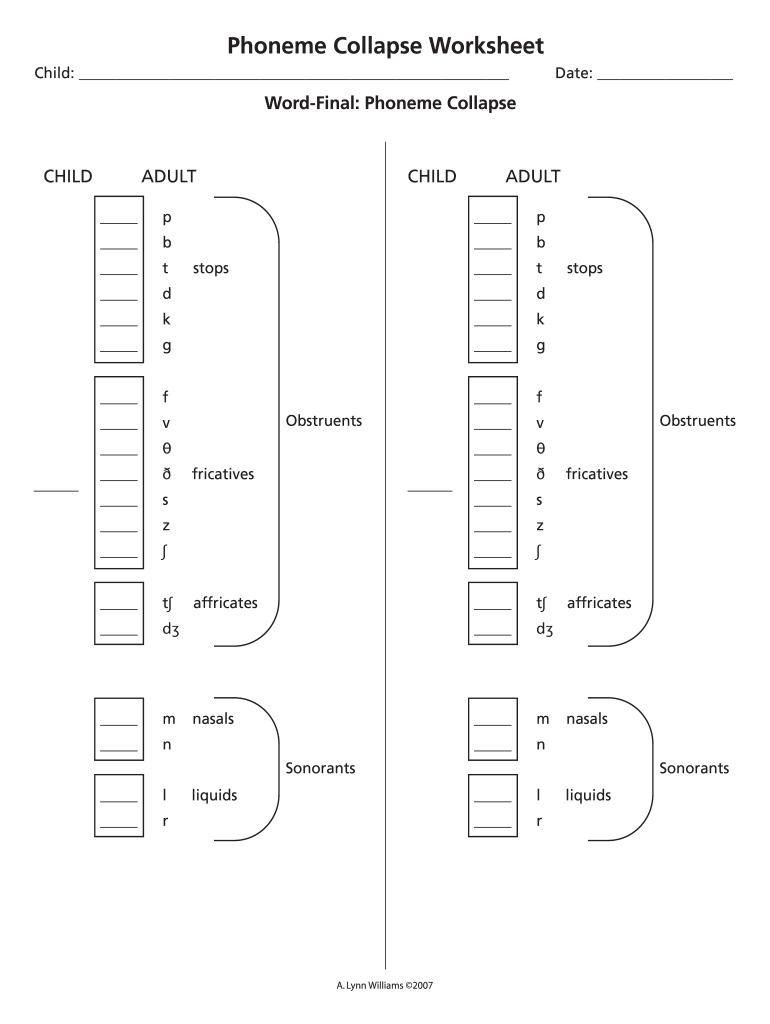
The phoneme collapse worksheet is an educational tool designed to assist children in understanding and practicing phoneme collapse. Phoneme collapse involves the merging of similar phonetic sounds, facilitating streamlined language development, especially for young learners. This worksheet focuses on various phonetic sounds, including stops, obstruents, fricatives, affricates, nasals, and sonorants. Its interactive sections cater to both child and adult responses, allowing for engaging and collaborative learning experiences.
How to Use the Phoneme Collapse Worksheet
Successfully using the phoneme collapse worksheet involves several structured steps to ensure effective learning:
-
Introduction to Sounds: Begin by introducing the sounds included in the worksheet. Discuss each phonetic category, such as stops and nasals, to build a foundational understanding.
-
Interactive Sections: Utilize the sections for child and adult responses. Encourage children to pronounce words and match sounds, while adults can offer feedback and guidance.
-
Repetition and Practice: Repetitive practice is crucial. Engage children in multiple rounds of the exercises to reinforce their understanding of phoneme collapse.
-
Incorporate Visuals and Sounds: If possible, use additional visual aids or sound recordings to support the worksheet activities, making the learning process multisensory and comprehensive.
Steps to Complete the Phoneme Collapse Worksheet
Completing the phoneme collapse worksheet requires attention to detail and a methodical approach:
-
Review Instructions: Read the instructions carefully to understand the objectives and how each section contributes to phonemic awareness.
-
Identify Target Sounds: Focus on the target phonemes and their variants as outlined in the worksheet. Recognize the differences between similar sounds to prevent confusion.
-
Filling Out Responses: Ensure both child and adult sections are filled out. Record children’s responses to track progress and adjust teaching methods as needed.
-
Assess Progress: Regularly evaluate the child's progression through the worksheet. Use this assessment to identify areas requiring additional focus or alternative teaching strategies.
Key Elements of the Phoneme Collapse Worksheet
The worksheet is structured around key elements that enhance its functionality:
- Phonetic Categories: Includes sections for stops, fricatives, and nasals, each requiring different cognitive skills.
- Interactive Features: Divergent sections for child and adult interaction promote active participation.
- Flexible Structure: Adaptable to various age and skill levels by adjusting complexity based on learner progress.
Who Typically Uses the Phoneme Collapse Worksheet
The primary users of the phoneme collapse worksheet are educators and therapists specializing in early childhood education and language development. It is also useful for:
- Speech-Language Pathologists: Professionals providing tailored speech therapy for children with phonological disorders.
- Parents and Guardians: Engaged parents can utilize these worksheets at home to supplement educational programs and aid in speech practice.
- Kindergarten Teachers: Educators incorporating the worksheets into curriculums focused on foundational language skills.


Important Terms Related to Phoneme Collapse Worksheet
Understanding the phoneme collapse worksheet requires familiarity with several key terms:
- Phoneme: The smallest unit of sound in a language that can distinguish one word from another.
- Obstruents: Sounds formed by obstructing airflow, including stops and fricatives.
- Sonorants: Sounds produced with a continuous airflow, like nasals and liquids.
- Phonological Processes: Patterns of sound errors that typically developing children use to simplify speech.
Examples of Using the Phoneme Collapse Worksheet
Several scenarios highlight the practical use of the phoneme collapse worksheet:
- Classroom Setting: A teacher might use the worksheet to support a lesson on the different sounds in the English language. By pairing students, it becomes a collaborative exercise.
- Therapy Session: During speech therapy, a therapist can use the worksheet to address specific phonemic errors, tailoring it to the child’s unique needs.
- Home Practice: Parents can engage children in informal learning sessions utilizing the worksheet as a basis for playful sound exercises.
Digital vs. Paper Version
Utilizing the phoneme collapse worksheet can vary based on the chosen format:
- Digital Format: Allows for interactive features such as audio playback, providing a modern twist to traditional phonetic exercises.
- Paper Format: Offers tangible benefits for tactile learners who benefit from writing and drawing exercises to support verbal learning.
Both versions have their advantages, and choosing the right format depends on access to technology and the learner’s specific needs. In contexts where frequent practice is necessary, combining both formats may be the most effective approach.




