Soldier risk assessment army 2026

Get Form
jrat army Preview on Page 1

Here's how it works

01. Edit your jrat army online
Type text, add images, blackout confidential details, add comments, highlights and more.
02. Sign it in a few clicks
Draw your signature, type it, upload its image, or use your mobile device as a signature pad.
03. Share your form with others
Send medical disability via email, link, or fax. You can also download it, export it or print it out.

How to use or fill out soldier risk assessment army with our platform

Form edit decoration
9.5
Ease of Setup
DocHub User Ratings on G2
9.0
Ease of Use
DocHub User Ratings on G2
  1. Click ‘Get Form’ to open the soldier risk assessment army document in the editor.
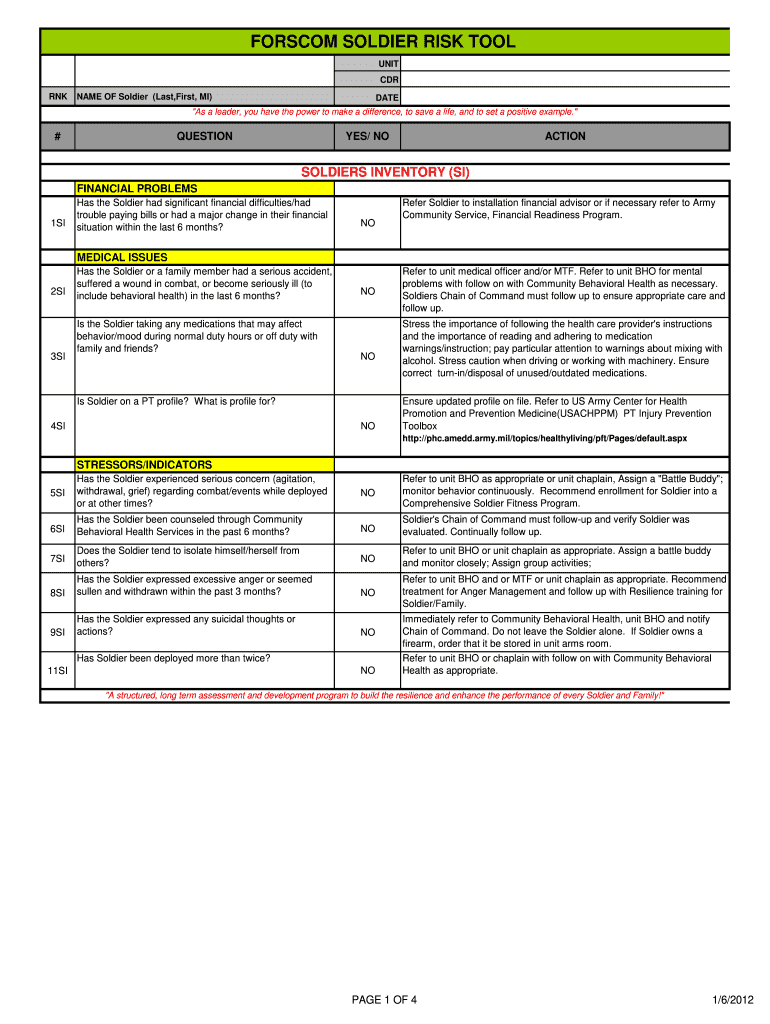
  2. Begin by filling in the unit, commander (CDR), rank (RNK), and the name of the soldier at the top of the form. Ensure all details are accurate for proper identification.
  3. Proceed to the Soldier Inventory section. For each question, select 'YES' or 'NO' based on the soldier's current situation. If 'YES', follow the recommended actions provided in the form.
  4. Continue to the Medical Issues section. Again, answer each question truthfully and refer to medical professionals as indicated if any concerns arise.
  5. Move on to Stressors/Indicators and Soldiers' Social Network sections, ensuring you provide detailed responses that reflect any significant changes or issues faced by the soldier.
  6. Finally, review all entries for accuracy before signing and dating at the bottom of the form. This ensures accountability and clarity in communication.

Start using our platform today for free to streamline your soldier risk assessments efficiently!

See more soldier risk assessment army versions

We've got more versions of the soldier risk assessment army form. Select the right soldier risk assessment army version from the list and start editing it straight away!
Versions Form popularity Fillable & printable
2012 4.8 Satisfied (37 Votes)
2011 4.3 Satisfied (126 Votes)
be ready to get more

Complete this form in 5 minutes or less

Get form

Got questions?

We have answers to the most popular questions from our customers. If you can't find an answer to your question, please contact us.
Contact us
The Health and Safety Executive (HSE) recommends following five actionable steps to conduct an effective risk assessment. Step 1: Identify Hazards. Step 2: Assess the Risks. Step 3: Control the Risks. Step 4: Record your Findings. Step 5: Review the Controls.
Risk Assessment. Once risks are identified, they are assessed based on their likelihood and potential impact. The military uses a risk matrix to categorize risks, helping leaders prioritize which risks require immediate attention and which can be monitored over time.
The five steps of RMidentify the hazards, assess the hazards, develop controls and make risk decisions, implement controls, and supervise and evaluateare used across the Services to help them operate as a joint force. RM must be embedded in Army culture.
Identify hazards. Assess hazards to determine risks. Develop controls and make risk decisions. Implement controls. Supervise and evaluate.
The steps are: Identify the hazards. Assess the hazards. Develop controls and make risk decisions. Implement controls. Supervise and evaluate.

Security and compliance

At DocHub, your data security is our priority. We follow HIPAA, SOC2, GDPR, and other standards, so you can work on your documents with confidence.

Learn more

People also ask

The five steps in risk assessment are identifying hazards in the workplace, identifying who might be harmed by the hazards, taking all reasonable steps to eliminate or reduce the risks, recording your findings, and reviewing and updating your risk assessment regularly.
There are four main types of risk assessments that organisations commonly utilize: qualitative, quantitative, subjective, and objective. In this article, we will explore each type of risk assessment in-depth, discussing their importance, processes, benefits, and limitations.

soldier military