




01. Edit your onett computation sheet online
Type text, add images, blackout confidential details, add comments, highlights and more.

Type text, add images, blackout confidential details, add comments, highlights and more.

Draw your signature, type it, upload its image, or use your mobile device as a signature pad.

Send onett computation sheet excel via email, link, or fax. You can also download it, export it or print it out.
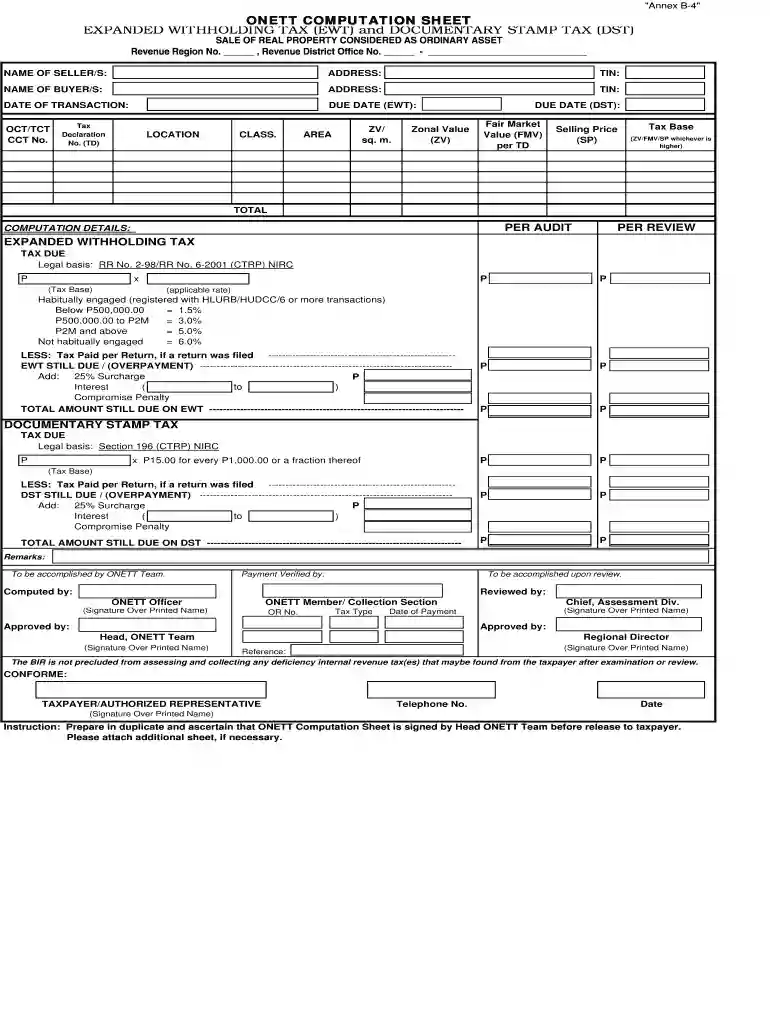
The ONETT computation sheet is a tax document used primarily for calculating the tax liabilities associated with one-time transactions, typically concerning real property sales in the Philippines. The acronym ONETT stands for "One-Time Transactions," and this computation sheet is essential for individuals or entities engaged in transactions classified as one-time sales of property or certain other assets that fall under the jurisdiction of the Bureau of Internal Revenue (BIR).
This form facilitates the determination of taxes owed, including the Expanded Withholding Tax (EWT), Documentary Stamp Tax (DST), Capital Gains Tax, Estate Tax, and Donors Tax, thus helping taxpayers meet their compliance obligations. By providing a structured format, the ONETT computation sheet ensures that all necessary calculations adhere to current tax laws, reducing the risk of errors or misunderstandings that could lead to penalties.
Completing the ONETT computation sheet involves a structured approach to ensure accuracy and compliance. Here are the steps to follow:
Gather Required Information:
Determine the Applicable Taxes:
Input Transaction Details:
Calculate the Tax Liabilities:
Review and Sign:
For instance, if a property is sold for $150,000, and the applicable Capital Gains Tax rate is six percent, the calculation would be:
Understanding critical terms and applicable regulations surrounding the ONETT computation sheet enhances compliance and accuracy in tax computations. Here are the essential terms and key regulations:
Regulatory Framework: The ONETT computation sheet adheres to regulations set forth by the BIR, specifically under Revenue Memorandum Circulars and other official advisories clarifying one-time transaction taxes.
Validity Period: The ONETT computation sheet remains valid as long as the transaction meets the specified criteria under BIR regulations and is accurately completed and submitted.
Required Attachments: Taxpayers must attach supporting documents such as the property deed, previous tax clearance certificates, and any exemption documents relevant to the transaction.
Compliance Deadline: It is vital to submit the ONETT computation sheet before the specified deadlines set by the BIR to avoid penalties associated with late filings.
Legally, the ONETT computation sheet must be used to report and compute one-time taxes as mandated by the BIR. Failure to adhere to the required procedures may result in penalties, including fines or additional tax assessments, highlighting the importance of accuracy and compliance in the completion of this form.
The ONETT computation sheet is primarily utilized by individuals and entities engaged in specific transactions, including:
Real Estate Sellers: Individuals or companies selling real estate classified as one-time transactions are required to use the ONETT computation sheet for tax assessment.
Estate Executors: Executors managing the estate of deceased individuals may use this form when distributing properties that involve one-time transactions.
Donors: Individuals gifting property may need to comply with the regulations outlined in the ONETT computation sheet, especially concerning donors' taxes.
Government Agencies: Certain government agencies may use the sheet to compute taxes related to property sales or transfers they oversee.
Real Estate Agents & Brokers: Professionals involved in closing real estate transactions often assist clients in completing the ONETT computation sheet to ensure a smooth transaction process.


The ONETT computation sheet serves varied scenarios, elucidating its practical applications:
Property Sale Scenario: A homeowner selling their primary residence for $300,000, needing to calculate the capital gains tax based on the current property's value and applicable deductions.
Inheritance Scenario: An heir receiving property as part of an estate settlement must assess applicable estate tax liabilities using the ONETT computation sheet to determine the family's financial obligations.
Gift Transfer Scenario: An individual donating a piece of land valued at $100,000 to a charity will need to utilize the ONETT form to document any donors’ taxes owed during the transfer process.
In each of these examples, the ONETT computation sheet provides a systematic approach to determining tax liabilities, ensuring compliance with BIR regulations while facilitating a clear understanding of the tax obligations related to one-time transactions.
At DocHub, your data security is our priority. We follow HIPAA, SOC2, GDPR, and other standards, so you can work on your documents with confidence.
CHAPTER 2. PRINCIPAL PARAMETERS USED IN BWR SOURCE TERM CALCULATIONS AND THEIR BASES. 2-1. 2.1. Introduction.Read more
by HE NEWSOM 1982 The resulting metallic-liquid/silicate-melt partition coefficient is approximately seven. Assuming this partition coefficient and initially chondritic P and LaRead more


